Prime
Ruto to chair EAC heads of State summit as challenges mount
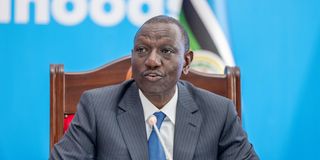
Kenyan President William Ruto.

In Arusha, Tanzania
Kenya's President William Ruto was elected on Saturday to chair the East African Community Heads of State Summit, a rotating but supreme decision-making organ of the EAC.


He takes over from South Sudan's President Salva Kiir.
The decision followed deliberations by the EAC Heads of State, including President Samia Suluhu Hassan (Tanzania), Yoweri Kaguta Museveni (Uganda), Paul Kagame (Rwanda), Hassan Sheikh Mohamud (Somalia) and President Kiir. Burundi was represented by Prosper Bazombanza.
The leaders held closed-door talks before the plenary session at the Arusha International Conference Centre in Tanzania.
President Felix Tshisekedi of the Democratic Republic of Congo, who was expected to take over from President Kiir, did not attend the summit. The leaders then turned to President Ruto as a compromise.
According to sources, President Samia Suluhu Hassan passed up the baton, citing other commitments this season, while Somalia wasn't ready to chair the EAC after being admitted in November last year. However, President Mohamud will now be the rapporteur for the coming year, with the possibility of taking over as chairperson next year.
Ruto takes over at a time when the EAC is more divided than ever, 25 years after its re-establishment.
The original EAC collapsed in 1977 following ideological differences between the leaders of Kenya, Tanzania and Uganda.
Ruto's in-tray is already full as he takes office in a regional economic bloc that needs peace, the reduction of non-tariff barriers and the facilitation of the free movement of goods and people to increase intra-trade, which has been stuck at 14 percent for the past three years.
In the run-up to the summit, tensions between Rwanda and the DRC eased.
The two had accused each other of supporting rebels targeting their administrations.
As a result, Angola has been mediating in their dispute, which is thought to be fuelling the war in eastern DRC.
They recently set up a mechanism to monitor violations of an agreed ceasefire.
Ruto himself became embroiled in controversy in the DRC after hosting some rebels, calling themselves the Congo River Alliance, who wanted to overthrow the government in Kinshasa.
A military court sentenced them to death in absentia, but Kenya refused to deport the rebels. A year later, Kinshasa refused to accredit the Kenyan ambassador.
But within the EAC, Ruto's opportunity comes at a time when borders have been closed between Rwanda and Burundi, Rwanda and the DRC, Uganda and the DRC, and tensions are simmering in the Horn of Africa, where Somalia is at loggerheads with Ethiopia, an expected future member of the EAC.
In his opening remarks, President Ruto urged EAC leaders to remit their dues to the EAC to enable it to achieve its agenda, a call supported by President Kagame of Rwanda.
“Allow me to express my gratitude for nominating me as the next chairperson for the next one year. I want to thank President Kiir, the outgoing chairperson for his excellent role for the past one year,” said Ruto.
“During my tenure, I will work towards improving the quality of life of the people of East Africa through increased competitiveness, value added production, trade and investments.”
Commenting on the poor state of the EAC Secretariat's coffers, President Ruto urged his counterparts to prioritise the regional bloc by remitting their contributions on time.
“To spur economic development in the region, we will continue to strengthen regional peace, security, political accountability, and good governance,” said Ruto.
“To ensure successful implementation of the community’s projects and programmes, I urge partner states to uphold their commitment to the timely disbursement of statutory contributions and fast-track implementation of the sustainable financing mechanism.”
He urged the EAC Secretariat to engage with the European Union to ensure that the region takes advantage of the Economic Partnership Agreement (EPA) signed between Kenya and the EU on December 18, 2023, which came into effect in July 2024.
The EPA gives Kenyan exports duty-free access to the EU market.
On Friday, President Ruto commended Tanzania for taking the lead in trading goods and services with Kenya.
“Today, in terms of trade between all our countries, Kenya was the leading country in terms of goods and services that we trade in East Africa. Today Tanzania has overtaken Kenya, and I must commend Tanzania for the progress they are making, that the numbers of trade are growing between our countries and as the numbers grow, different countries are selling more different products and services within our common market. It is what it is, and that is why we must work on this consistently together,” he said.
President Kagame supported President Ruto's call for EAC partner states to remit their budget contributions and suggested sanctions for those that fail to do so.
Currently, Burundi, South Sudan and the Democratic Republic of Congo are still in arrears for the 2024/25 financial year.
“We need strict compliance measures because the current situation is neither acceptable nor sustainable. The mechanisms put in place by the African Union, for example, have led to better performance of members,” said Kagame, urging the EAC to adopt similar procedures.
President Kiir said the focus must now be on improving regional peace and security, enhancing intra-EAC trade and accelerating digital transformation.
President Samia urged peaceful efforts and called for comradeship among EAC citizens.
President Museveni said the EAC region has been trading for more than 1,000 years and called for the removal of trade barriers among EAC partner states.


