Prime
Senegal adopts anti-French stance in new policy shift
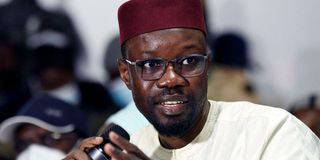
Senegal Prime Minister Ousmane Sonko.

What you need to know:
- The anti-French stance means the West African country is following in the footsteps of neighbours Burkina Faso and Mali, which have also adopted a tough anti-French stance since coups in those countries more than three years ago.
Senegal's new government, led by President Bassirou Faye, is taking a more anti-French stance by making English compulsory in primary schools and encouraging the use of local languages as the medium of instruction.
The decision, announced by Prime Minister Ousmane Sonko in his first address to Parliament, also indicated that the country would close French military bases in the country, fulfilling a key campaign promise inspired by anti-colonial sentiments.
It was his first speech to Parliament since the ruling party won a majority of seats in November's snap elections.

PM Sonko spoke at length about the policy shifts of the new government, which came to power in April.
The anti-French stance means the West African country is following in the footsteps of neighbours Burkina Faso and Mali, which have also adopted a tough anti-French stance since coups in those countries more than three years ago.
Senegal, however, is the only former French colony in West Africa that has never experienced a coup. Senegal remains one of the last countries in Africa with French influence, which has long been crumbling, largely due to frustration with bad governance.
But even Dakar may have felt the burden of toeing the French line. It went beyond language.
Sonko said the new shift also included a plan to withdraw Senegal from all bilateral tax haven treaties and to renegotiate unfavourable clauses in such agreements.
“The vision of a sovereign Senegal was taken into account from the formation of the government, in particular the requirement to defend (first and foremost) the interests of Senegal,” he said.
“This is demonstrated by the openly displayed positions by the President of the Republic in international meetings, whether at the podium of United Nations, at the Global Forum for Sovereignty and Vaccine innovation, at the Olympic Games, Summit of sustainable development, at the meetings of the Organization of the Islamic cooperation. We are campaigning for a rebalancing of global governance and respect for values of universal principles of peace and human rights, in particular the end of the genocide in Gaza and the recognition of rights inalienable rights of the Palestinian people.”
The government also intends to review energy subsidies to ensure that they primarily benefit poor households.
While describing the country's current economic situation as "catastrophic", with a budget deficit of around 10.4 percent of GDP and a public debt of 76.3 percent of GDP, Prime Minister Sonko's plan aims to make Senegal one of Africa's most competitive economies.
The government is banking on the country's newly discovered gas resources, which are expected to finally go operational in 2025. It also wants to densify the industrial fabric.
Another pan-Africanist stance announced on Friday was the application of the "principle of reciprocity for the issuance of visas to nationals of certain unnamed countries that require them from Senegalese nationals".
Sonko also promised to crack down on illegal emigration, which has soared in recent years amid increasing reports of people dying at sea on their way to the West. He said his administration would provide an appropriate solution that would entail "strengthening of measures to combat illegal immigration by multiplying controls and strengthening sanctions, but also by promoting regular migration in partnership with the host countries as well as support for voluntary return initiatives."
These changes will take place over the next five years, during President Faye's term in office. They also include the repeal of a controversial amnesty law passed by the previous government.
In an address to the National Assembly on Friday, Sonko also outlined the government's economic and foreign policies.
But a major highlight of the long-awaited landmark speech was the promise to repeal the amnesty law passed by the dying administration of former President Macky Sall following the political violence that plagued the country in the last two years before general elections in March this year.
The speech had been postponed several times, including in June when the Prime Minister refused to appear before the then parliament, which was dominated by allies of former President Macky Sall.
Two months later, in mid-September, it was postponed again after President Bassirou Diomaye Faye dissolved Parliament and called new elections for November 17.
The elections followed almost two years of unrest, sparked in part by Sall's alleged intention to extend his rule. Dozens of people were killed or injured between 2021 and 2023, and dozens more were arrested or subjected to various human rights violations.
Violence escalated in the run-up to the elections, leading to more arrests and detentions of opposition activists, including Sonko and Faye, who led a youth-led opposition party.
The amnesty law passed by Sall's Parliament allowed both men to be released from prison, along with hundreds of other political prisoners.
But justice was one of the duo's campaign promises when they challenged the then ruling party candidate.
“The Senegalese people voted clearly and massively for the project of a sovereign, just and prosperous Senegal. To build this Senegal, it is imperative to operate a rupture of a depth and scope never seen before in our country, since our accession to independence, 64 years ago,” PM Sonko said in his general policy statement to House on Friday.
He stressed the need for light to be shed on what happened and for those responsible to be held accountable for their actions.
The government, he added, would propose a Bill in the coming weeks.
"This is not a witch-hunt, much less revenge,” he said in the marathon speech, which comes a month after his party swept the polls in legislative elections giving the ruling party an overwhelming majority.
“It is about justice, a pillar without which no social peace can be built."
In his speech, Prime Minister Sonko outlined seven key priority areas for the administration, all aimed at overhauling the public sector and ensuring growth. These include tax reform, with a focus on broadening the tax base and gradually reducing average tax rates.
The aim, he said, is for every Senegalese to pay less, but for everyone to pay.


