The future of health screening: Why 5 African countries are ditching paper forms

A passenger self-screens using the digital tool at Kamuzu International Airport in Malawi after disembarking from a plane.
Across more than 150 border posts in countries such as Rwanda, Zambia, Malawi, and São Tomé and Príncipe, tedious paper forms and crowded health screening halls are vanishing.
They are being replaced by high-tech digital dashboards pioneered by a regional health body, the East, Central and Southern Africa Health Community (ECSA-HC) by leveraging expertise from its own Senior Systems Engineer, Mr Timothy Ayebare and Regional Digital Health expert teams, with support from the World Bank.
So far, the system has screened over a million travellers, speeding up border crossings while protecting frontline staff and safeguarding surrounding communities against cross-border disease transmission. This story explains how this digital revolution is impacting the region.


When Judith Makala, a Port Health Officer, began working at Kamuzu International Airport in Malawi over a year ago, the screening of passengers arriving via this airport was a tedious and time-consuming process.
On a daily basis, Ms Makala had to wrestle with piles of paper logs and manually flip through forms filled out by hand by travellers, and stand for hours in a chaotic airport hall to ensure no one enters her country without being screened.
But beyond taking too long to screen one traveller, the congestion when a plane would arrive with a large number of passengers was another hurdle. Every passenger had to be physically processed. This means longer interaction times and prolonged exposure to potential infection for frontline health workers like Judith.
Unchecked cross-border movement during outbreaks threatens travellers, surrounding communities, and frontline health workers. Data from theWorld Health Organization (WHO) (WHO) shows that high-contact border settings accelerate transmission, with health workers facing up to 32 times higher infection rates.
"The risk was real,” said Judith recently at Kamuzu International Airport arrival terminal as she and her colleagues stood behind their gadgets monitoring incoming travellers.
Every long interaction at that counter was a direct risk to our own health. People are from different countries, and you have to interact with them. Any one of them could be carrying something infectious,” she recalls.
Then, the story changed!
When she recently shared her story, she looked visibly relieved, and it’s no wonder. Her work has become so much easier. The heavy risks and tedious workflows she described have now become history.
In May 2026, Kamuzu International Airport deployed a self-screening digital tool where arrivals from various countries simply self-screen using their mobile phones, with minimal supervision.
Travellers scan the QR code and enter their details. They are then issued a second QR code, which serves as confirmation that their data has been submitted. An officer scans this code to verify it within seconds, and the traveller is cleared.
The tool was developed by the East, Central and Southern Africa Health Community (ECSA-HC), under the World Bank-funded Health Emergency Preparedness, Response and Resilience Program.
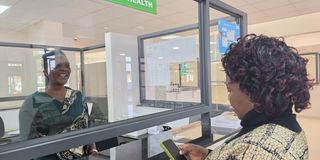
A Port Health Officer at Dedza Ground Crossing on the Malawi-Mozambique border demonstrates how the digital tool works.
The approach has so far contributed to screening over a million travellers from across the East, Central, and Southern Africa region, according to data collected from the Points of Entry where it has been piloted.
That means that across more than 150 border posts spanning countries like Rwanda, Zambia and Malawi, the usually tedious paper forms are rapidly vanishing. São Tomé and Príncipe is expected to go live this year. They are getting replaced by sleek, high-tech user interface dashboards that capture every traveller instantly, even offline, and sync when the second connection is restored.
Timothy Ayebare is the Senior Systems Engineer from ECSA-HC who has been working with regional digital health experts from across the five countries and beyond to design the systems. His daily routine involves testing digital tools on tablets and monitoring live health analytics.
Out of necessity
"When quick action keeps communities safe, paperwork can’t keep up. Our Digital AI Point-of-Entry Tool captures every traveller instantly, even without internet and syncs the second it goes online,”says Ayebare, detailing how using paper made the process slow and isolated, and made it easy to lose the papers.
At the Kisenyi-Gisenyi border in Rwanda, one of the busy regional Points of Entry with chronic congestion now operates with unprecedented speed.
Dr Claver Kayobotsi, a Rwandan Public Health Specialist, noted that the nation’s PoE digital screening system now actively supports operations across points of entry while enhancing national preparedness:
“It has also contributed to operationalising IHR (2005) requirements and strengthening Rwanda's cross-border health security.”
At Kasumbalesa, the border between Zambia and the Democratic Republic of Congo, Mr Kalaluka Koome, the Port Health Officer in Charge of Kasumbalesa on the Zambian side, says that close to 700 people cross the border each day, whether in trucks, buses or private vehicles, and a lot of paperwork had to be done for each individual.
“We were generating a lot of paper for each individual, and each paper means money. So we faced challenges when we could run out of paper. But now with the coming of the digital tool, that is no longer a problem,” says Mr Kalaluka, explaining how the digital tool has improved efficiency, reduced turnaround time and boosted health screening at the Point of Entry.
No more guesswork
Having immediate, real-time data means the national outbreak response team is no longer operating on guesswork or delayed reporting. Health officials know instantly if a potential health threat arrives at a border post, according to Mr Peter Kamuloni from the Ministry of Health in Malawi.
At the country’s border with Mozambique, Tembe spoke of how the digital tool is actively being prepared for deployment at Dedza, the ground-crossing border.
"We are preparing to roll out this digital tool right here at the Dedza border post, and it is going to completely transform health screening on the ground," Mr. Kamuloni said.
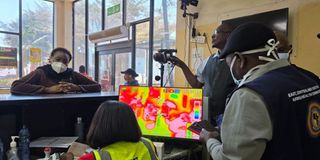
ECSA HC-developed digital tool being utilised at Kasumbalesa border between the Democratic Republic of Congo.
Across the four countries where the digital tool is being applied, the PoE platform has screened 1.89 million travellers, with the overarching regional rollout scaling rapidly toward a target of 4 million in the next one year.
Country-level deployment is led by Rwanda with 1.5 million individuals screened, followed by Zambia with 342,518 across 20 PoEs since June 2026, and Malawi with 51,813 across an expanding network of 36 PoEs, while deployment is currently underway in São Tomé and Príncipe.
The software doesn't require a license, works offline, and runs on the equipment governments already own. It helps health workers spot threats instantly and take action. The system has already checked thousands of travellers against global health databases, successfully flagging over 10,000 people from high-risk Ebola areas and ensuring every single sick traveller got medical attention.
The platform also serves as a central hub for health security across 24 nations and 340 border locations. It keeps track of local readiness scores and monitors nearly 500 safety improvements. This shared system proved vital at the Kasumbalesa border, where Zambia and the DRC used it to build and test a joint emergency plan during an exercise in August 2026.
Is border screening a panacea?
Border health screening, according to Mr Ayebare, is only the first link in a much larger health security chain. The regional strategy is currently expanding to integrate an entire supporting ecosystem of advanced health infrastructure.
This includes diagnostic accreditation platforms like SLIPTA, scheduled for rollout in August 2026, and specialised antimicrobial resistance (AMR) toolkits featuring real-time heatmaps slated for deployment in September 2026.
By connecting regional laboratories, tracking antimicrobial resistance patterns, and strengthening diagnostic standards across East, Central, and Southern Africa, the initiative is building a comprehensive, resilient shield for public health.
"And border health is only one link," Ayebare added. "Before a single traveller is screened, our IHR and Point-of-Entry assessment tools have already measured what each country and each border can do, and our simulation exercises have already tested it."
"When a threat is detected at the border, Digital SLIPTA has already made sure the laboratory that confirms it is accredited and trusted. The AMR Continental Toolkit contains resistance before it spreads, and the Knowledge Repository turns every response into a lesson for the whole region."
"Assess, ready, rehearse, detect, trust, contain, learn — that is the ECSA-HC Health Security Chain, and it runs from readiness to resilience across the entire region."
Standing at her post in Malawi, reflecting on the transition from crumpled paper logs to live analytics dashboards on sleek tablets, Lydia sees a profession redefined. The anxiety of prolonged exposure and crushing airport queues has given way to quiet digital efficiency.
"Seeing travellers scan their QR codes and walk through in seconds still feels like a quiet revolution," Lydia said as another flight cleared immigration smoothly. "We're no longer exposed behind paper stacks, and our health security is stronger than it has ever been."
Through regional cooperation backed by the World Bank and coordinated by ECSA-HC, the architecture of African health security has found a digital heartbeat, turning historical vulnerabilities into a robust, automated defense system.
Follow our WhatsApp channel for breaking news updates and more stories like this.


