150 pastoralist women in Manyara receive customary land titles
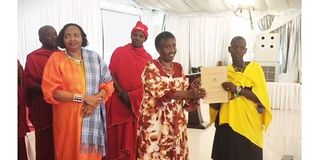
The Chairperson of the Board of the non-governmental organisation Maasai Women Development Organisation (MWEDO), Maria Kaheta, handing over one of the customary land certificates to a resident of Simanjiro District in Manyara Region.
Arusha. A total of 150 women from pastoralist communities in Simanjiro and Kiteto districts in Manyara Region have been awarded customary land ownership certificates in a move aimed at strengthening their economic independence and addressing cultural barriers that have historically denied women the right to own land.
The certificates were handed over on May 23, 2026, in Arusha as part of efforts to empower women from pastoralist communities, many of whom have long faced discrimination under traditional customs and practices.
One of the beneficiaries, Helena Isaya from Naisinyai village in Simanjiro District, said the initiative had brought renewed hope to many women who had endured hardship due to the lack of legal land ownership documents.
“We thank God and the organisation that helped us secure these title deeds because without this support we faced many difficulties. We suffered a great deal because even if you bought land, without legal ownership documents it remained a challenge. Now we will have freedom over our land,” said Ms Isaya.
She called on the government and development partners to continue providing civic education within pastoralist communities in order to address discriminatory customs and traditions, particularly those related to women’s land rights.
Another beneficiary, Suzan Lembris, said the certificate would enable her to legally own land and pursue development activities without fear of losing her property.
“We are grateful to receive these title deeds because they will help me legally own my land. Previously, we faced many challenges, including being denied land ownership because of our community’s traditions and customs,” she said.
Kiteto District Council land officer Valence Huruma said organisations working alongside the government have played a major role in empowering women from pastoralist communities in areas such as education, health and now land ownership.
He said although Tanzanian laws guarantee equal rights to land ownership, women in pastoralist communities have continued to miss out due to entrenched cultural practices.
“The Village Land Act No. 5 clearly outlines the right of every citizen to own land, but because of customs and traditions, women in these communities have not been given direct opportunities to own land,” said Mr Huruma.
He added that collaboration between the government and development partners has helped raise awareness among women about their fundamental rights to own and use land for personal and community development.
“We appreciate these stakeholders for working with the government to build the capacity of pastoralist communities, especially women, so they too can access land ownership and use it to improve their livelihoods,” he said.
Earlier, the executive director of the Maasai Women Development Organisation (MWEDO), Ms Ndinini Kimesera, said the distribution of the certificates coincided with the organisation’s 25th anniversary celebrations.
She said the organisation focuses on empowering women, girls and pastoralist communities through programmes in education, health, economic empowerment and land ownership.
“Today is a day of celebration for us as we mark 25 years of our organisation, while also handing customary title deeds to women from pastoralist communities. Many of them have very limited means and a large number are widows,” said Ms Kimesera.
She said that through collaboration with the district authorities of Kiteto, Simanjiro and Longido, the organisation had successfully facilitated the issuance of customary land ownership certificates to 150 women.
Beyond land rights, Ms Kimesera said the organisation has also been implementing education projects for girls, ensuring those who miss out on schooling opportunities receive support.
“So far, we have supported the education of more than 2,000 girls, some of whom are now professionals in fields such as law, medicine and nursing,” she said.
She added that the organisation also runs health programmes in 15 villages in Kiteto District, focusing on maternal and child health services that benefit more than 10,000 people annually.
On climate change, she said the organisation has been educating communities on ways to cope with drought and encouraging alternative economic activities suited to changing environmental conditions.
“We are looking at how communities can adapt to climate change, including crops that can survive in dry conditions and livestock breeds that are drought-resistant. But none of this can succeed unless women have ownership of land and resources,” she said.
Lawyer Elifuraha Laltaika said empowering women is essential to national development.
“As men, if we fail to empower women, then we are not doing the right thing. When you empower a woman, you empower the nation and the entire community,” he said.