ECSA Health Community steps up joint Ebola preparedness at regional borders
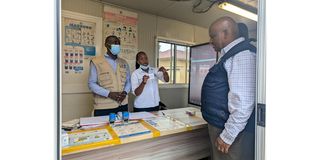
Senior Specialist in Health Systems Strengthening and expert in Disease Surveillance at the East, Central and Southern Africa Health Community, Dr Benedict Mushi, inspects a screening facility at the Tanzania–Uganda border post of Mutukula as part of Ebola preparedness efforts. PHOTO | Courtesy
Mutukula. Tanzania and Uganda have intensified joint border surveillance and emergency response measures following a surge in Ebola Virus Disease (EVD) cases in the Democratic Republic of Congo (DRC) and Uganda, as regional health authorities move to contain the spread of the deadly virus.
The cross-border operation, coordinated by the East, Central and Southern African Health Community (ECSA-HC), aims to strengthen regional preparedness and establish a coordinated epidemiological response to prevent further transmission.
The intervention follows an Ebola outbreak in the DRC that has since spread into Uganda, prompting high-level technical engagements to reinforce emergency response systems across the region.
Implemented in partnership with regional ministries of health, the exercise focuses on high-risk border areas, including the Tanzania–Uganda, Uganda–Kenya and Tanzania–Burundi frontiers.
The World Health Organisation (WHO) recently declared the outbreak a Public Health Emergency of International Concern (PHEIC), while the Africa Centres for Disease Control and Prevention (Africa CDC) classified it as a Public Health Emergency of Continental Security (PHECS), following a sharp increase in infections linked to the rare Bundibugyo ebolavirus strain, for which there is currently neither an approved vaccine nor specific treatment.
Speaking on the urgent need for a unified regional response, the Director General of ECSA-HC, Dr Ntuli A. Kapologwe, said cross-border disease threats require stronger coordination and localised leadership.
“Disease outbreaks do not respect national borders; they thrive on our interconnectedness. Therefore, our response must match the speed of our communities,” said Dr Kapologwe.
He noted that while Uganda is a core ECSA-HC member state, the intergovernmental body is also supporting the DRC through its regional health security and emergency preparedness frameworks.
“We stand in full solidarity with the governments, ministries of health and frontline healthcare workers in Uganda and the DRC. As a region, we are not merely planning; we are actively deploying smarter systems by strengthening cross-border simulations, harmonising surveillance data and equipping border teams with real-time digital tools,” he said.
Through ECSA-HC interventions, a Digital Point of Entry (PoE) Screening system has been rolled out at high-risk border posts and mass gatherings to replace traditional paper-based reporting with a real-time digital surveillance network.
The platform enables health officials to capture traveller information instantly, monitor highly mobile populations, improve data accuracy and transmit alerts directly to national surveillance databases for rapid verification and contact tracing.
Uganda has intensified surveillance across 35 official Points of Entry and extended community monitoring to 44 border districts. Tanzania has also expanded its surveillance infrastructure by mapping 59 official Points of Entry and deploying more than 600 port health officers to high-risk border areas.
Speaking during the opening of the cross-border engagement at Mutukula, ECSA-HC Senior Specialist in Health Systems Strengthening and disease surveillance expert, Dr Benedict Mushi, described the initiative as timely.
“The increasing movement of people, goods and services across our borders continues to heighten the risk of cross-border transmission of infectious diseases, including Ebola. These Points of Entry are not only gateways for trade and integration; they are also the frontline of public health security,” he said.
Dr Mushi added that preparedness must be viewed as a continuous obligation.
“Recent outbreaks in the region have reminded us that preparedness is not a one-off exercise. This initiative is about operational readiness — ensuring our systems can detect outbreaks early, respond rapidly and coordinate effectively across borders,” he said.
Providing an epidemiological update, Uganda’s Principal Medical Officer in the Department of Integrated Epidemiology, Surveillance and Public Health Emergencies, Dr Moses Ebong, said the outbreak first raised alarm in the DRC following unusual clusters of community and healthcare worker deaths reported in late April and early May.
By May 15, the DRC had declared its 17th Ebola outbreak in Ituri Province, with cases spreading across Mongbwalu, Rwampara and Bunia health zones before extending to North Kivu, including Goma and Butembo.
Uganda reported its first imported case in Kampala on May 15 involving an elderly traveller from the DRC who later died. Post-mortem tests later confirmed infection with the Bundibugyo strain.
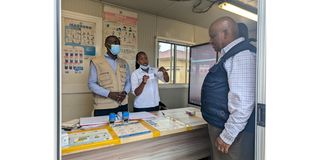
The team from the East, Central and Southern Africa Health Community led public health experts from Uganda and Tanzania in assessing Ebola response preparedness at the Tanzania–Uganda border on Saturday, 23 May 2026. PHOTO | Courtesy
According to the latest WHO situation update issued on May 21, 2026, suspected cases linked to the outbreak had risen to 746, with 176 suspected deaths recorded across the region.
Confirmed infections in the DRC and Uganda stood at 85 cases, including two confirmed cases in Uganda, while the confirmed death toll had reached 10.
Dr Ebong warned that the outbreak was expanding rapidly, particularly in densely populated border communities.
“The numbers are doubling in less than a week,” he said. “While rigorous screening is underway at official Points of Entry, there are also people crossing through informal routes. This means community-based surveillance must be strengthened significantly.”
Tanzania’s Principal Epidemiologist, Dr Remidius Kakulu, said the interconnected nature of communities across the region made coordinated action essential.
“Communities in Uganda, the DRC and Tanzania are deeply interconnected through social and economic ties. Because our borders are naturally porous, collective regional action and harmonised real-time surveillance tools are the only way to stay ahead of this virus,” he said.
The initiative adopts a One Health approach, bringing together ministries of health, immigration, customs, security agencies, local government authorities, veterinary services and port health officials to strengthen regional preparedness against the growing health threat.
The East, Central and Southern African Health Community (ECSA-HC) is also working closely with its 11 member states alongside regional bodies, including the Africa CDC and the WHO, to safeguard the collective health and wellbeing of the region.
Through its regional network comprising Tanzania, Uganda, Kenya, Eswatini, Lesotho, Malawi, Mauritius, Zambia, Sao Tome and Principe, Mozambique and Zimbabwe, the intergovernmental body is coordinating a united response aimed at containing the expanding Ebola threat across the region.