Dodoma. The government has announced a review of public agencies and institutions that regulate and oversee business activities.
The initiative aims to reduce bureaucratic red tape and unnecessary levies that hinder business growth, while curbing the proliferation of regulatory bodies.
Only a few efficient agencies will remain, streamlining business operations and attracting investment.
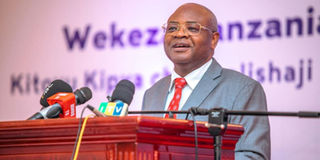
The Minister of Planning and Investment, Prof Kitila Mkumbo, said on Wednesday, March 11, 2026, in Dodoma, that the review was part of a meeting on the draft Second Plan for Improving the Business and Investment Environment.
Prof Mkumbo said the exercise will simplify the business environment, boost investment, and stimulate national economic growth.
He noted that many businesses face bureaucratic hurdles due to the numerous regulatory institutions and levies imposed on traders.
According to the Minister, a person starting a small business, such as a fish grill, encounters more than 27 institutions.
“I spoke with Honourable Kadogosa (Masanja), who told me that when he started his business, he spent over Sh20 million paying various levies. This is not business capital; in this way, we cannot grow enterprises,” said Prof Mkumbo.
He added that the Ministry of Planning, in collaboration with the Ministry of State in the Prime Minister’s Office Regional Administration and Local Government (PMO-RALG), is preparing a system to benchmark regions and local government authorities in assessing how they enable business and attract investment.
Meanwhile, Prime Minister Dr Mwigulu Nchemba said achieving the 2050 National Development Vision requires collaboration between the government and the private sector.
The premier noted that each year between 1.5 million and two million young people graduate at various educational levels and enter the job market, making the private sector crucial in creating employment opportunities.
“Leaving the private sector to stagnate will prevent us from achieving our goals. We must build it, respect it, and grow it, because the government alone cannot create jobs for all the youth entering the job market every year,” said Dr Nchemba.
According to him, achieving a high-income economy under Vision 2050 depends on internationally competitive production, particularly in industrial sectors, productive agriculture, the blue economy, and digital transformation.
He urged regional commissioners and council directors to adopt a positive attitude towards the private sector and support business rather than oppress traders.
Mtwara Regional Administrative Secretary (RAS), Bahati Geuze, who spoke on behalf of regional administrative secretaries, advised the government to continue promoting the private sector by prioritising private companies and institutions in economic development.
A member of the Parliamentary Standing Committee on Governance, Constitution and Legal Affairs, Dr Oscar Kikoyo, urged the government to ensure that laws enacted align with the objectives of the plan to improve the business environment and the 2050 National Development Vision.