Museveni takes over from Ruto as EAC Summit makes key changes to save bloc from collapse
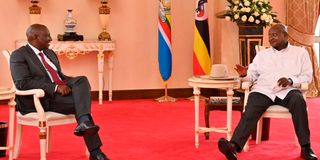
President William Ruto and his Ugandan counterpart Yoweri Museveni.

Ugandan President Yoweri Museveni has been appointed as the new chair of the East African Community (EAC), replacing Kenyan President William Ruto during the EAC Summit of Heads of State and Government in Arusha, Tanzania, on Saturday, 7 March.
The Summit also named Tanzanian bureaucrat Stephen Patrick Mbundi as the new Secretary General of the bloc, skipping the tradition of rotation that would have gone to non-paying South Sudan.
Mbundi is a former Permanent Secretary in charge of East African Community affairs in Tanzania, and will replace Kenya’s Veronica Nduva.


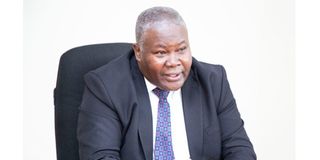
Tanzanian Bureaucrat Stephen Mbundi appointed EAC Secretary-General to replace Kenya’s Veronica Nduva whose term has come to an end.
Overall, the Summit adopted a series of changes as it sought to save the bloc from collapsing under the mire of financial mess.
And as such, the bloc adopted a new funding model effective July 1, 2026, in which all member states will contribute to the budget of the organisation, in the ratio of 50 percent based on their GDP size and another 50 percent based on the shared quotas.
It is a departure from the Initially, there had been a proposal that countries pay in the ratio of 65:35 formula, seen as burdening some members while allowing others a joyride.
Meeting in Arusha, the ordinary summit of heads of state and government also decided that members of the East African Legislative Assembly (EALA) be paid salaries by their respective home countries.
The EAC, the Summit decided, will only cater for allowances for these MPs. It means the bloc will no longer be carrying the burden of paying these lawmakers.
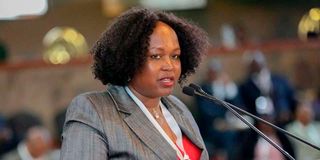
Outgoing EAC Secretary-General Veronica Nduva.
The Summit also decided that no senior employee at the EAC secretariat will go to staff from non-paying members, although this does not affect current staff whose contracts are still running.
“The five senior positions in EAC; secretary general, speaker, president of the court and the two deputy secretaries-general, countries nominating these individuals must have ratified the treaty, must have done all the requirements of the treaty so that we can look into the future and know that the political will to belong in this Community is registered,” said outgoing chairperson Ruto.
This Summit came on the back of a serious financial mess that had seen staffers at the Arusha-based secretariat go for months without pay. Some members, like Burundi, Democratic Republic of Congo and South Sudan, had lagged sorely behind on paying up membership fees.
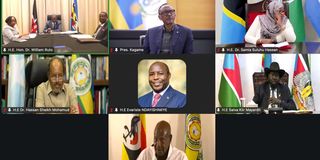
EAC presidents William Ruto (Kenya), Paul Kagame (Rwanda), Samia Suluhu Hassan (Tanzania), Hassan Sheikh Muhammud (Somalia), Evariste Ndayishimye (Burundi), Salva Kiir Mayardit (South Sudan) and Yoweri Museveni (Uganda) virtually attend the 24th extra-ordinary summit on the fighting in DR Congo on January 29, 2025.
The Summit, skipped by presidents of South Sudan, DRC and Rwanda, decided that defaulting partner states will have their contributions waived by 50 percent. However, they must pay their arrears within two years from now.
Ruto also spoke of the decision-making process that he said had been crippled by the frequent absenteeism of some members. This time, the Summit decided to cure that by adjusting the quorum.
“The statute that established the Community was formalised when we had only three countries, and there was no need for a forum. It is increasingly becoming difficult to get a consensus of all countries now that we are eight.
“We have therefore taken the decision that decisions of the Community will be made by consensus or by 65 per cent of members present to make our Community more effective and efficient.”
The Community’s future had looked paradoxical in recent years.
While it expanded from the original three members, Kenya, Tanzania and Uganda, to eight, it has faced frequent financial challenges and what looked like a lack of commitment from some members.
The bloc now includes Burundi, Rwanda, DRC, Somalia and South Sudan. Some members are also facing serious security and political challenges, distracting their usual participation.
Ruto says there will be no more massaging of other countries' egos, opening the door for exits for those who want.
The latest decisions could make the bloc function with certainty. But it could also portray a lesser sense of belonging for those who can’t afford to pay up and have their nationals employed.
Present during the summit were Presidents Suluhu Hassan (Tanzania), Évariste Ndayishimiye (Burundi), Yoweri Museveni (Uganda), and Hassan Sheikh Mohamud (Somalia), development partners and members of the diplomatic corps.
The summit also saw the swearing-in of three new judges to the East African Court of Justice, namely Somalia's Abdullahi Warsamme, Kenya's Anne Amadi, and South Sudan's Digo Stephen Abraham.
At the same time, President Ruto outlined some of the successes achieved during his 15-month chairmanship of EAC, including efforts to resolve the conflict in the Democratic Republic of Congo.
Additionally, he announced that the volume of trade within the bloc rose by nearly 22 per cent from $33 billion in 2024 to $40.3 billion in 2025.
"Exports from the region grew significantly by 32 per cent to $19.6 billion, while imports rose more moderately by 13 per cent to $20.6 billion. This narrowed the region’s trade deficit from $3.4 billion to $1.0 billion," he said.
In his acceptance remarks, President Museveni called for increased trade among Member States, the continent and beyond.
"If we do not create a big and reliable market for our wealth creators, how do businesses expand to produce more products, create more jobs and pay more taxes?" he asked.
The meeting also formally launched the EAC Seventh Development Strategy (2026/27-2030/31), and the East African Customs Bond.
Also present at the meeting were Rwanda's Prime Minister Justin Nsengiyumva, South Sudan's Foreign Affairs minister Monday Kumba, and DR Congo's Regional Integration minister Floribert Anzuluni Isiloketshi, representing Presidents of their respective countries.
What is changing
- All EALA MPs to be paid salaries by their respective parliaments
- All countries that nominate candidates for the top 5 EAC positions must have ratified the EAC treaty and be up to date in subscriptions
- Quorum changed from 100 percent to 65 percent of members.
- Member States with huge arrears will get a 50 percent waiver but must pay the remaining 50 percent within 2 years.
- Bigger economies to contribute more. 50 percent equal contributions, the other 50 percent equitable (or proportional).
- The decisions taken by the Summit are not subject to review or discussion
Follow our WhatsApp channel for breaking news updates and more stories like this.


