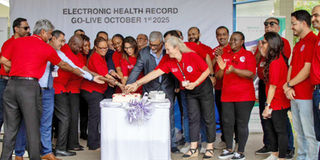
Aga Khan Health Service Tanzania staff mark a key milestone in its digital transformation journey with the rollout of the Meditech Electronic Health Record system in 2025. PHOTO | COURTESY
The system dubbed Meditech is expected to ease the work of healthcare professionals and ensure continuity of care for patients moving between facilities, eliminating the need for repeated tests or paper-based procedures.
Dar es Salaam. Aga Khan Health Service, Tanzania (AKHS,T) has taken a major step in its digital transformation journey following the rollout of the Electronic Health Record (EHR) system across its national healthcare network.
The system dubbed Meditech is expected to ease the work of healthcare professionals and ensure continuity of care for patients moving between facilities, eliminating the need for repeated tests or paper-based procedures.
The rollout aligns with the One Health Strategy of the Aga Khan Development Network (AKDN), which integrates human, community and environmental health.
The 170-bed Aga Khan Hospital, Dar es Salaam—a tertiary referral and teaching hospital accredited by the Joint Commission International (JCI)—officially began using the EHR system in 2025. Plans are underway to implement the same system at Aga Khan University Hospital, Karachi, in 2026.
The move is aimed at improving the delivery of seamless healthcare services across Tanzania.
AKHS,T operates an integrated healthcare system anchored by Aga Khan Hospital, Dar es Salaam, supported by Aga Khan Medical Centre, Mwanza, and 20 outreach health centres across the country, which provide specialised services directly to communities.
“Together, this integrated healthcare system serves more than one million patients every year. All these facilities are now fully connected through the Meditech platform, enabling the secure and rapid transfer of patient records, clinical information and financial data,” said the Chief Executive Officer of Aga Khan Health Services, Tanzania, Mr Sisawo Konteh.
He said the system will allow healthcare providers to access real-time clinical information to support informed decision-making, while ensuring patients moving from one facility to another receive uninterrupted care without repeating tests or relying on paper records.
“This unified system demonstrates our commitment to delivering the highest standards of healthcare and reflects AKDN’s One Health approach, which connects human, community and environmental health,” said Mr Konteh.
He added that the system has the capacity to be deployed across the global AKDN network.
The implementation of the Meditech platform in AKDN health institutions worldwide will enable the secure cross-border transfer of patient records.
“Tanzanian patients receiving treatment at AKDN facilities in countries such as Kenya, Pakistan and elsewhere will benefit from faster and safer care based on their medical history. This will significantly transform medical tourism and access to quality healthcare at the global level,” he said.
Mr Konteh noted that the digital transformation is in line with the Tanzanian government’s efforts to expand access to affordable, quality healthcare.
By simplifying the management of medical information and reducing duplication of services, the system helps cut costs, improve efficiency and strengthen national health outcomes, he said.
Through the Patient Portal, patients can now securely access their health information, test results and appointment schedules—placing them at the centre of their care and encouraging active personal health management.
He also said the initiative will significantly reduce paper usage, supporting AKHS,T’s broader efforts to protect the environment and build healthier, safer communities.
“This aligns with AKDN’s Go Green strategy and its commitment to achieving net-zero emissions by 2030,” said Mr Konteh.
He added that the institution has already made significant strides in adopting solar energy, replacing equipment with environmentally friendly technologies, and acquiring electric vehicles to reduce its environmental footprint.