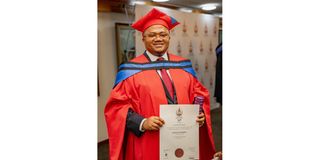
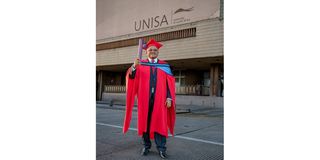
Pretoria. CRDB Bank Group Chief Executive Officer and Managing Director, Dr Abdulmajid Mussa Nsekela, graduated on June 12, 2026, with a Doctor of Philosophy (PhD) from the University of South Africa (UNISA), marking a milestone that combines academic achievement with corporate leadership.
Dr Nsekela was awarded the PhD following his research titled “Corporate governance and financial performance of East African banks: The moderating role of information leakage.”
His study examines how governance structures, information integrity and transparency influence the financial performance of banks in East Africa. It also finds that information leakage can weaken institutional performance, while strong governance and disciplined disclosure frameworks enhance resilience, investor confidence and long-term growth.
CRDB Bank Group Chief Executive Officer and Managing Director, Dr Abdulmajid Mussa Nsekela
The research reflects Dr Nsekela’s leadership philosophy, shaped by more than two decades of experience in banking and financial services, spanning corporate finance, risk management and executive leadership.
The CRDB Bank chief said his academic journey was rooted in continuous learning, curiosity and professional growth.
“Strong governance, as my research shows, is not theoretical; it is the foundation of sustainable financial performance and institutional trust across East Africa,” he said.
He thanked his supervisors and staff at UNISA for their guidance, and expressed appreciation to his family for their support during his studies.
“To my fellow managing directors and chief executive officers in Tanzania and across Africa, learning is a continuous journey. We must deliberately create time to acquire new knowledge and skills that strengthen leadership, decision-making and institutional performance,” he said.
Under his leadership since October 2018, CRDB Bank has recorded strong financial growth. The bank’s share price has risen from Sh95 in 2018 to about Sh3,000 in June 2026, while dividends per share increased from Sh8 to Sh90 in 2025.
Profit after tax rose from Sh64.1 billion in 2018 to Sh728.6 billion in 2025, representing growth of more than 1,000 percent in seven years, driven by governance reforms, strategic execution and data-led decision-making.
The bank has also undergone significant digital transformation, with more than 98 percent of transactions now conducted through digital channels. Its customer base has grown to over 7.2 million, served through agents, ATMs, more than 260 branches and mobile platforms.
CRDB Bank has expanded its regional footprint to Burundi and the Democratic Republic of Congo, and opened a representative office in Dubai to support cross-border trade and investment.
It has also strengthened its institutional ecosystem through the CRDB Bank Foundation, CRDB Insurance Company and support for the establishment of the Co-operative Bank of Tanzania.
Earlier, the bank secured accreditation from the Green Climate Fund (GCF) as a Direct Access Entity in 2019, enabling access to climate finance. In 2022, it secured a $200 million facility for the Tanzania Agriculture Climate Adaptation Technology Deployment Programme (TACATDP) and expanded into Islamic banking and bancassurance.
CRDB Bank Board Chairperson, Prof Neema Mori, congratulated Dr Nsekela, noting the alignment between his academic research and leadership practice.
She said his work had strengthened the bank’s position in sustainable finance and governance, including its recognition by the Green Climate Fund in East and Central Africa.
“His PhD thesis reinforces how sound corporate governance and effective information management directly influence financial performance,” she said.
Prof Mori added that his achievement underscored the importance of integrating academic excellence with executive leadership.
“CRDB Bank’s transformation demonstrates how governance, leadership and continuous learning can turn an institution into a regional powerhouse,” she said.
Dr Nsekela’s achievement, she added, reflects the growing trend among African corporate leaders to combine academic advancement with executive responsibility in driving institutional growth and resilience.