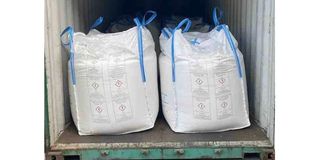
Engaruka project set to end Sh326 billion soda ash imports
Arusha. The Tanzanian government is expecting to save about $121 million (more than Sh326 billion) annually importing soda ash for industrial use, as it invites local and international private sector investors to participate in the development of a major natural soda ash mining and processing project in Engaruka, Monduli District, Arusha Region.
The project, which is expected to produce more than 500,000 tonnes of soda ash annually, is being developed by the National Development Corporation (NDC) and aims to utilise the country’s vast soda ash resources found in the Engaruka Basin to meet domestic industrial demand and supply international markets.
The invitation was issued yesterday by NDC Director of Heavy Industries, Dr Yohana Mtoni, while presenting a paper at a special forum organised by Nature Tanzania on the conservation of Lake Natron, held in Arusha.
Dr Mtoni said the government had opened the opportunity for private companies to submit proposals for investment in the extraction and processing of soda ash at Engaruka under a Public-Private Partnership (PPP) arrangement.
The deadline for submission of investment proposals is September 18, 2026.
“The government has already announced a request for project proposals from investors who will partner with NDC through the PPP framework”
“I therefore use this opportunity to invite investors to work with the government in designing, financing, constructing and operating the Engaruka soda ash mining and processing plant,” Dr Mtoni said. He said the project was part of the government’s strategy to promote basic industries, add value to natural resources and reduce reliance on imported raw materials.
Currently, Tanzania spends about $121 million (more than Sh326 billion) annually importing soda ash for industrial use, a cost that is expected to be significantly reduced once production begins at the Engaruka project.
The project will be implemented on an area covering 60,884 acres in Engaruka Ward, Monduli District, located about 58 kilometres from Lake Natron and approximately 190 kilometres from Arusha City.
Feasibility studies conducted in the area have established the presence of more than 3.8 billion cubic metres of saline water (brine) containing soda ash minerals, with an estimated potential to produce up to 787 million tonnes of sodium carbonate.
According to NDC, the project will initially produce 500,000 tonnes of soda ash annually, with plans to increase production capacity depending on market demand.
Once operational, the project is expected to position Tanzania as the world’s third-largest producer of natural soda ash after the United States and Turkey, which each produce approximately 11 million tonnes annually.
In Africa, Tanzania is projected to become the leading producer, surpassing Kenya, which currently produces between 280,000 and 300,000 tonnes annually.
Dr Mtoni said extensive studies conducted in Engaruka had confirmed that the area has high-quality resources capable of producing soda ash suitable for various industrial applications.
“The soda ash produced will be used in glass manufacturing, detergents, chemicals, paper production, water treatment, mineral processing and other sectors,” he said.
Beyond boosting industrial production, the project is expected to stimulate infrastructure development, including roads and railway networks, particularly through the Tanga Development Corridor due to increased transportation needs.
The products are expected to be exported through the Port of Tanga, which is already connected to the railway network from Arusha.
As part of preparations, the government paid $5.8 million (equivalent to Sh14.4 billion) in compensation to 595 residents from four villages — Engaruka-Chini, Mbaash, Idonyo Nado and Irerendeni — to pave the way for implementation of the project.
Tanzania relocated plans for soda ash extraction from Lake Natron to Engaruka as part of efforts to protect the lake and its surrounding ecosystem, following studies that showed Engaruka has significant potential for soda ash production.
Earlier plans to mine soda ash at Lake Natron were halted due to environmental concerns, particularly because the lake is a critical breeding ground for flamingos and is recognised under the Ramsar Convention on wetlands.
Through the Engaruka project, the government also aims to establish industries that use soda ash as a raw material, create more than 4,000 jobs and increase government revenue through taxes and other payments from investors.
Register to begin your journey to our premium contentSubscribe for full access to premium content