How Tanzania navigates delicate diplomatic ties after polls chaos
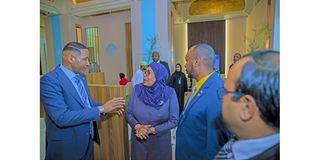
President Samia Suluhu Hassan greets her Botswana counterpart Duma Boko ahead of meetings with various leaders on the sidelines of the World Governments Summit (WGS 2026) on February 3, 2026 at Madinat Jumeirah, Dubai, United Arab Emirates. PHOTO | COURTESY
Dar es Salaam. Tanzania’s post-election period has been defined by a delicate balancing act: asserting national sovereignty while engaging strategically with the international community.
Following the October 29, 2025 general election, which returned President Samia Suluhu Hassan to office amid opposition complaints and sporadic election-related unrest, the administration has pursued a mix of inbound and outbound diplomacy.
Through hosting foreign leaders, engaging visiting diplomats and conducting official trips abroad, Tanzania has sought to project stability and economic opportunity while defending its political autonomy.
The first major diplomatic milestone came with President Hassan’s inauguration on November 3, 2025, held at the Tanzania People’s Defence Force parade grounds in Dodoma.
The ceremony drew a host of regional leaders who offered congratulations and pledged continued collaboration.
Mozambique President Filipe Nyusi, described her victory as “a testament to the trust of the Tanzanian people” and encouraged continued peace and regional cooperation.
Burundi’s President Évariste Ndayishimiye personally congratulated President Hassan and urged unity and dialogue among Tanzanians.
The presidents of Zambia and Somalia were also present, stressing that post-election unrest could undermine national stability and calling for calm.
Following the inauguration and a series of regional visits, Tanzania’s foreign relations began drawing closer examination from Western capitals. On December 8, 2025, President Hassan met Acting U.S. Chargé d’Affaires Andrew Lentz at Chamwino State House in Dodoma.
The meeting occurred amid growing pressure from Washington, which had announced a “comprehensive review” of bilateral relations with Tanzania.
U.S. concerns focused on the government’s handling of post-election unrest, perceived restrictions on freedom of expression and religious freedoms, and what the State Department described as “disturbing violence against civilians” before and after the October 29 polls.
A statement from the U.S. Department of State warned: “The United States cannot overlook actions that jeopardise the safety of our citizens, or the security and stability of the region. The future of our bilateral relationship with the Government of Tanzania will be based on its actions.”
At Chamwino, both sides sought to balance candour with diplomacy. President Hassan reiterated Tanzania’s commitment to economic engagement while defending sovereign decision-making.
“Tanzania is prepared to work with all partners who respect our sovereignty and share our vision for prosperity,” she said, noting the national importance of strategic investment projects.
Among these are the $42 billion Liquefied Natural Gas (LNG) project, the $942 million Tembo Nickel project, and the $300 million Mahenge Graphite initiative — all moving toward finalisation with U.S. and other foreign partners.
Ambassador Lentz responded by emphasising Washington’s desire to reset relations on a foundation of mutual economic benefit.
“The United States is committed to a partnership based not on aid dependency but on shared prosperity,” he said.
State House communiqués noted that discussions also covered political stability, regional security, economic reforms, private-sector growth, and health sector collaboration — signalling that engagement extended beyond immediate investments to long-term strategic interests.
Despite U.S. concerns over rights and security, President Hassan underlined Tanzania’s position as a non-aligned nation. “As a non-aligned country,” she said, “Tanzania is open, ready, and committed to working with all partners who respect our sovereignty and share our vision for prosperity.”
Her comments reflected a broader philosophy of “sovereign pragmatism,” where engagement is encouraged but interference is not tolerated.
Tanzania’s diplomatic balancing act continued in January 2026 with a high-profile visit from China’s Foreign Minister Wang Yi, who arrived in Dar es Salaam on January 9 for a two-day working visit.
Welcomed by Tanzanian Foreign Minister Mahmoud Thabit Kombo, Wang emphasised the long-standing friendship between China and Tanzania, describing it as a resilient and “most valuable spiritual asset” amid changing global circumstances.
“China appreciates Tanzania’s firm commitment to sovereignty, independence, and national dignity,” he said, stressing Beijing’s readiness to support Tanzania’s development priorities. President Hassan responded by thanking China for its continued backing, highlighting the Forum on China-Africa Cooperation as a framework for deepening bilateral ties.
She emphasised practical cooperation, the expansion of people-to-people exchanges, and investment in major infrastructure projects, including revitalisation plans for the Tanzania-Zambia Railway Authority (Tazara).
She also conveyed New Year greetings to President Xi Jinping, reaffirming the strategic importance of the Tanzania-China partnership.
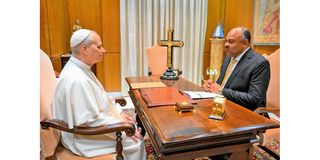
Pope Leo meets with Tanzania’s Foreign Affairs and East African Cooperation minister Mahmoud Thabit Kombo late in January, 2026. PHOTO | COURTESY OF VATICAN MEDIA
Domestically, diplomatic efforts were no less intensive. President Hassan and Minister Kombo engaged ambassadors and representatives from multiple countries, assuring them of Tanzania’s commitment to partnership while reiterating that the nation’s sovereignty remains inviolable.
“We are listening to our partners, but listening does not mean surrendering our sovereignty,” Kombo said.
On top of that, the government also hosted its annual Diplomatic Sherry Party in January 2026, where President Hassan stressed that foreign partners must respect Tanzania’s internal political processes, reinforcing a framework of pragmatic engagement.
Regional diplomacy remained a key pillar. Uganda’s President Yoweri Museveni visited Dar es Salaam on February 8, 2026, describing Tanzania as “a pillar of peace in East Africa” and stressing the importance of stability for regional development.
Bilateral discussions covered trade, infrastructure and energy projects, including oil and refined petroleum pipelines — reflecting a mutual commitment to deepening regional integration.
However, President Hassan’s first foreign trip since her re-election took her to Dubai on February 2, 2026, for the World Governments Summit.
Addressing global investors, foreign ministers, and representatives of international financial institutions, she projected Tanzania as a stable and investment-ready nation.
“What investors want is trust in institutions, policy consistency, and governments that honour commitments,” she said, signalling that Tanzania’s economic diplomacy complements its political independence.
Political analysts have noted the deliberate sequencing of these engagements. Dr Paul Loisulie of the University of Dodoma observed: “The order and timing of these visits were calculated to show the world that Tanzania is stable, open for cooperation, but not for interference. By hosting regional leaders first, then engaging global partners, the government signals confidence in its domestic political processes.”
Similarly, Prof Makame Ali Ussi of the State University of Zanzibar emphasised the strategic nature of these interactions.
“These engagements are not ceremonial. They protect sovereignty while demonstrating to investors and diplomats that Tanzania is a reliable partner. The Dubai trip reinforces that message — economic diplomacy complements political autonomy.”
Register to begin your journey to our premium contentSubscribe for full access to premium content