Dar es Salaam. Accountability is a crucial element that drives expected results, and where it is absent, outcomes often fall short, with success visible only in areas requiring intervention.
Within the government operational system, accountability is essential as it seeks to deliver positive outcomes for citizens who expect proper services from leaders and government officials.
There are various government accountability mechanisms, and in this digital age, operations are increasingly shifting online, not only to simplify communication but also to deliver faster results.
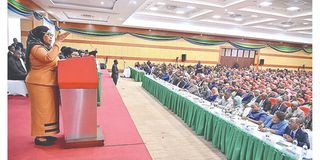
When launching the CCM election campaigns on October 28, 2025, the party’s presidential candidate, Samia Suluhu Hassan, pledged multiple initiatives to be implemented within the first 100 days, including establishing a digital accountability system.
In that context, President Hassan said that if citizens granted her the mandate, the government would introduce citizen-friendly accountability mechanisms where ministers, regional commissioners, and other officials would provide information and respond to citizens’ queries digitally and via free SMS.
The ruling party’s candidate stressed that this would serve as a benchmark for evaluating ministers, based on the number of citizens’ issues submitted, the number addressed, and the actions taken.
In that election, Ms Hassan was declared the winner and sworn in on November 3, 2025, forming a government, and she is set to mark the first 100 days of her second term in office shortly.
The Citizen has examined the implementation of President Hassan’s pledge and found that the government has begun executing it by launching systems allowing citizens to submit complaints directly.
The Health ministry
On January 26, 2026, the Minister of Health, Mohamed Mchengerwa, officially launched the “Talk to the Minister” system in Arusha, a strategic step aimed at bringing the health sector closer to citizens, listening to their concerns, and responding through practical actions.
During the event, Mr Mchengerwa said the initiative sends a clear message to Tanzanians that the citizen’s voice is not marginal but the compass for improving health services.
“In the health sector, these are major transformations. When we talk about health, we refer not only to systems and buildings but to human dignity, the protection of life, and every Tanzanian’s right to timely, and quality services,” said the Minister.
The launch also emphasised the use of technology as a tool to improve service delivery, not merely as a showpiece.
The ministry of Water responds
The Permanent Secretary in the Ministry of Water, Ms Mwajuma Waziri, said the ministry continues to fully implement President Hassan’s pledge to improve service delivery through technology and modern communication systems.
She explained that the ministry uses various platforms, including e-Feedback, call centres, and social media networks such as YouTube and WhatsApp, to facilitate access to information and receive feedback from citizens.
“This step aims to enhance transparency, accountability, and efficiency in water service provision, ensuring citizens receive prompt responses to their challenges,” said Ms Mwajuma.
She added that the ministry has provided contact numbers of leaders and officials to allow citizens to submit complaints, suggestions, advice, and information regarding water projects and services.
“All information received through these platforms is processed with relevant stakeholders to ensure citizens receive accurate information and timely solutions,” she said.
She noted that the Ministry of Water plans to upgrade call centres to integrate them with the National Communication Centre.
“Currently, the ministry intends to improve call centres so they connect with the National Centre, enabling monitoring of information implementation,” she said.
Shinyanga joins
The Shinyanga Regional Commissioner, Ms Mboni Mhita, said in implementing the President’s directive to communicate directly with citizens, she has visited all six councils, held public meetings, and shared phone numbers of all government officials, including his own.
Ms Mhita said the initiative aims to strengthen digital communication in receiving and addressing citizens’ complaints promptly.
“We meet citizens and provide these numbers to give them the chance to communicate with us directly, especially those facing challenges, so they can easily express their grievances,” said Ms Mhita.
He added that his numbers, along with those of other officials, are available across the region, as part of the President’s promise to reach citizens directly. “Citizens have been calling or sending messages to explain their challenges, and this is what we are implementing practically,” he said.
Implementation in Songwe
The Songwe Regional Commissioner, Mr Jabir Makame, said the region plans to launch a digital system enabling citizens to submit complaints and development issues directly to regional leaders by the end of this week.
“Apart from launching this digital system, we will provide information on other promises fulfilled during President Samia’s first 100 days. Coordination procedures are ongoing to enable citizen participation,” he said. He added that the first 100 days end on February 13, and preparations to complete the system are still under way.
“After the launch, we will provide detailed explanations. This system is expected to be officially launched on Saturday. We will present it to the public and explain the packages prepared for citizens, along with the purpose of direct communication,” he said.
Lindi sets up a system
The Lindi Regional Commissioner, Ms Zainab Telack, said the region has long maintained communication systems with citizens, with ongoing efforts to enhance them further.
Ms Telack said the region launched the “Talk to the Regional Commissioner” system, allowing citizens to submit complaints directly via phone calls.
“We launched the ‘Talk to the Regional Commissioner’ system, where every citizen can call and explain their complaint. Every citizen can reach me by phone. This is not new, but we continue to improve it,” she said.
Citizens’ views
A resident of Ubungo, Dar es Salaam, Mr Shukrani Sabinus, praised the system, saying it improves communication between citizens and leaders, though he expressed concerns about its effectiveness.
“It is a good system for communicating with citizens, but citizens are many, each with their own challenges. It is difficult to implement effectively if one person is expected to solve all problems,” he said.
He advised the government to strengthen decentralisation so every leader is directly accountable to citizens locally, reducing reliance on the President or regional commissioner alone.
A social affairs analyst, Prof Samuel Wangwe, said the system is important for obtaining feedback for leaders and assessing how their actions affect citizens.
He added that to enhance accountability, a feedback system must involve leaders at all levels, from regional commissioners, districts, councils, and wards to villages.
“To promote accountability, feedback must reach the Regional Commissioner, district, council, ward, and village. If feedback is sent to a village, a copy must also reach higher levels,” said Prof Wangwe.
He said the system will yield results by motivating leaders to hold each other accountable and perform duties on time.
Register to begin your journey to our premium contentSubscribe for full access to premium content