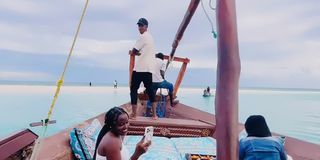
The rhythmic Swahili Taarab gently plays as the dhow sails through the calm waves of the Indian Ocean as the sun sets.
From the shaws of Stone Town in Zanzibar, these Swahili luxury dhow sails have become synonymous with curated tourism, a tourism innovation that blends the old taarab music with the local dhow sailing that has been practiced for centuries, only now that they are creatively fused to create unparalleled nautical tourism.
Abdillah Salim, the Mwana Unguja Dhow director, speaks of the two-year journey that has transformed the ordinary activity for the natives in Zanzibar into one of the most sought-after tourism experiences on the island.
“The goal was to incorporate the Swahili sailing; we Swahili people have been sailing for a very long time with the beauty of our music, “ he mentioned.
Colourful cotton fabric
The dhows are decorated with khanga, a colourful rectangular cotton fabric that Zanzibaris have worn since the mid-19th century. Fully embracing the Swahili culture during the sailing.
The music pays homage to the old taarab, in what they call “old is gold,” a band plays taarab songs sung in the 1980s to early 90s, before the new taarab was invented.
The nostalgic music flavour that celebrates the beauty of Zanzibar, the beauty of love and even songs that celebrate the beauty of Zanzibar cuisine.
Songs like Kijiti, sung by the legendary taarab musician Fatuma binti Baraka, are famously known as Bi Kidude has often been featured in the sails.
The local bands, comprised of older natives, practice these songs to perfection. Some grew up to this music and know the songs by heart.
You can feel the passion they put into their music as tourists watch as they are taken on a dhow sail through the Indian Ocean. Taarab music has a rich history in the archipelago. For centuries, it has connected Arab, Indian and African cultures along the Swahili coast.
They purposely chose Stone Town as their docking area, at the seashore overlooking the ancient city.
Right after a tourist gets off the ferry, their colourful dhows are conspicuous and inviting.
Visitors would, on many occasions, stop what they are doing and just marvel at the colourful traditional boats.
Local cuisine is served during these hours-long trips, with Swahili snacks, like visheti, Samosas and Kashata, traditional foods eaten casually between meals and street foods influenced by African, Arab and Indian coastal cuisine. Clients from the US, Europe and East Africa, including locals, have cruised in these dhow rides.
“We have visitors from Nigeria, South Africa and across the world, but one thing is for sure: everyone who sails with us leaves with a great smile,” he laughed.
For most Swahili-speaking clients, they vibe to the music sung in a language they understand, but the beauty of music is that even for those who don't, that in no way stops them from enjoying the rhythm, melodies and the soothing taarab vocals.
“Sometimes we would translate the words for them and they would get excited when they understood what the songs meant, which makes the journey more joyful,” he said.
When the idea of Swahili dhow sailing came about, Abdillah and his team were meticulous about choosing the musicians. They searched through the island for entertainers with a deep knowledge of the old taarab genre, people who understood the history of the music.
It's no surprise that most of the band is comprised of senior performers. “We made sure that when they step into our dhow to perform, it is something authentic,” he added. The two-year journey has really transformed the dhowsail experience at the heart of Zanzibar.
As Tanzania is boosting its tourism visibility across the world, luxurious dhow-sailing has surprisingly gained attention on the island. The infusion of Swahili music, beauty, culture and food has propelled dhow sailing to the top of tourist activities on the island.
Other dhow operators are still stuck to the traditional sails with no added advantage. As their clients sit on hardwood, the luxurious Swahili dhow places big cushions across the deck and covers them with khanga, comfort and beauty.
“Some riders would come to board other dhows, but when they see ours, they all want to jump ships and come to ours,” he smiled.
The concert cruise, as some clients have come to call it, starts in Stone Town at 4;30 PM to sunset. When the tide is good, they sail all the way to Nakupenda Sandbank, the temporary stretch of white sand popular with tourists who go there for swimming, sunbathing and snorkeling.
The sandbank in the Indian Ocean appears when the tide is low. At high tide, it disappears underwater. As the sandbank submerges underwater, the dhow sails back to Stone Town accompanied by the smooth sounds of taarab.
Go for a swim
Along the way, clients are allowed to stop mid-sails and go for a swim and carry on when they are content. For visitors who find accommodation far from the shores, transport is always provided to take them to the dhows and take them back at the end of the sail.
The Swahili dhow has become a symbol of pride and innovation among tourism stakeholders and even the government brings foreign dignitaries when they come to the island. To showcase the unique dhows, the recognition that Abdillah is proud of.
Even the 2025 Miss World, Opal Suchata Chuangsri, who visited the Island as part of tourism promotion, was scheduled to take a ride in their dhow, but the schedule overlap occurred and she missed out.
The dhow sails are currently serving private booked clients, exclusively for those who book the whole dhow. But plans are underway to create options, as they push to have more affordable sails and expand their market to accommodate even those on a budget. They are looking at shared options, where two or more different clients can book one dhow.
Trip across the ocean
The sails are more than just a trip across the ocean. These luxurious sails have served as celebratory occasions for work colleagues, festively marking the end of a year, newlyweds on a honeymoon rejoicing in their union, married couples on anniversaries, or a group of friends who just want a unique experience in the middle of the ocean.
Mwana Unguja dhows are accelerating their nautical tourism promotion, with presence on social media, sharing their details with tourism authorities, different travel agents and tour guides.