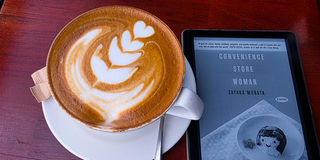
‘Convenience Store Woman’ by Sayaka Murata: Who decides what is normal?

What you need to know:

  • Convenience Store Woman starts an important conversation about what is considered normal and what is not. Why is marriage the only achievement that should matter for women? And why should being a provider be the only measure of a man's success?

In 2019, I wrote a tweet about the expectations society places on people. I wrote, "A lot of us think life is so straightforward: graduate from university, get a job, buy a plot of land, build a house, buy a car, get married, have children, and live happily ever after. Life is full of ups and downs. It can't be this straightforward."

I think about that tweet a lot. I thought about it while reading Convenience Store Woman by Sayaka Murata. In this dark humour novel, Murata explores what is considered normal and what is not, and how society expects people to follow a particular path.

The novel follows Keiko, a 36-year-old woman who works at a convenience store, a job she began 18 years ago while still in college. By society's standards, Keiko is not considered normal.

From a very young age, Keiko didn’t behave the way a "normal child" is supposed to. Normal children don’t take the world so literally. One incident at school confirms that she, after all, is not a normal child.

"When some boys started fighting during the break time. The other children started wailing. 'Get the teacher! Stop them.' And so I went to the tool shed, took out the spade, ran over to the unruly boys, and bashed one of them over the head."

To Keiko, this was simply the quickest way to stop the fight, but it wasn't the "right" way to do it. Who is responsible for teaching children the right way to stop other children from fighting? Also, have you met young boys fighting?

From this incident, Keiko decided that it wasn't worth speaking when her thoughts and words would make those around her, especially her parents, unhappy.

It made me think about how much of who we become is informed by the people who raise us. We are rewarded based on how normal or how good we are by the people who love us and whose validation we crave.

But the funny thing about society is that you can never do right by it. Sooner or later, it changes its mind.

"The adults seemed relieved when I did not say a single word more than necessary or act on my own initiative. But as I got older, being so quiet apparently became a problem in itself."

Keiko lives by observing the people around her. She imitates how they speak, react and behave until those behaviours become her own. Depending on who she speaks to, her reactions are informed by what feels appropriate.

This didn't shock me because everyone who knows me knows a different Jane. My colleagues know one. My closest friends know another. So does my family.

My point is, we all have different versions of ourselves across different social settings. We absorb what we believe is acceptable and we stick with that. We are chameleons, if you will. Perhaps the difference is that Keiko knows she is pretending, while the rest of us have become so used to performing that we no longer notice it.

These expectations are not limited to women only. Men, too, are not immune to it.

Murata introduces Shiraha, who believes that the world has not changed at all and that we still live in the Stone Age, despite pretending to be a contemporary society, because we still behave as we did in prehistory.

Shiraha is so overwhelmed by society's expectations that he joins the convenience store, hoping to find a woman to marry, someone who can support him financially so he can finally appear normal. I wanted to climb into the book and slap some sense into him and, while I was at it, Keiko too, for being willing to do it so she can please everyone.

"You are secondhand goods. Even if you are a virgin, you are grubby. You are like a Stone Age woman, past her childbearing age, who can't get married and is left to just hang around the village, of no use to anyone, just a burden.

This kind of thinking and pressure is what, in my opinion, pushes women to seek marriage with anyone for the sake of fulfilling society's expectations, regardless of how safe that person is for them.

Convenience Store Woman starts an important conversation about what is considered normal and what is not. Why is marriage the only achievement that should matter to women? Or why should being a provider be the only thing that should define a man's highest achievement?

Perhaps we are all chameleons after all. The only difference is that some of us become so good at changing our colours that we forget what they looked like before the world told us who to be.

Jane Shussa is a digital communication specialist with a love for books, coffee, nature, and travel. She can be reached at [email protected]