For girls who have fallen out of school or struggled to find opportunities, the Wezesha Binti programme is opening new routes into vocational training, entrepreneurship and employment.
Girls in Kigoma know what it means for a young woman’s hopes to disappear—and what it means to have them restored.
For them, the turning point came when they encountered the Wezesha Binti programme, an initiative helping them regain confidence, acquire skills and begin looking at their future not through the limitations surrounding them, but through the possibilities ahead.
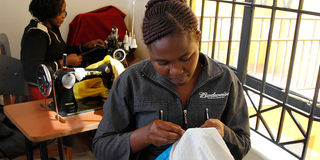
“I never knew I could still have value in this world after failing to get the marks that would allow me to continue to advanced-level secondary education. I believe God has answered my prayers,” says Sofia Ombeni, one of the girls.
Sofia’s story reflects a wider change taking place in Kigoma, where efforts to keep girls in education are increasingly moving beyond the classroom to address what happens afterwards.
That shift matters because, for many Tanzanian girls, completing school has historically not guaranteed a pathway to economic independence.
Experts note that barriers can begin long before graduation. Poverty, long distances to school, early pregnancy, child marriage, household responsibilities, inadequate facilities and harmful gender norms continue to affect girls’ educational journeys.
UNICEF estimates that 3.2 million children aged seven to 17 are out of school in Tanzania, with rural and poor girls particularly affected by dropout from about age 12.
Menstruation, inadequate water and sanitation facilities and child marriage are among the factors identified as contributing to girls leaving school.
Kigoma illustrates the challenge sharply. In 2024, UNICEF and the government identified the region as having one of the country’s highest proportions of out-of-school children, at about 25 percent.
This prompted a campaign to bring more children back into education. But keeping girls in school is only part of the solution.
The more difficult question is: What happens when they leave school?
That is where Wezesha Binti is attempting to change the traditional model.
The €25 million, five-year bilateral programme, funded by the Kingdom of Belgium and implemented by Enabel from 2023 to 2027, operates in five Kigoma districts: Kibondo, Kasulu Rural, Kasulu Urban, Kigoma Rural and Kigoma Urban.
The project's central ambition is to help girls and young women aged 14 to 29 move safely from school to decent work.
For the project’s manager, Ms Christine Rwankote, that transition requires a fundamental rethink of how Tanzania approaches vocational training.
“We need to listen to the private sector so that it can tell us, ‘This is the kind of person we need and these are the skills we require,’” she tells Smart World.
The logic is simple but potentially transformative: instead of training young people first and asking employers afterwards whether their skills are useful, employers should be involved in determining what institutions teach.
“At the end of the day, the training programme and curriculum should respond to the needs of the labour market,” she says.
This addresses one of Tanzania’s persistent education-to-employment problems.
A World Bank assessment has found a mismatch between the skills demanded by employers, qualifications supplied by training institutions and emerging skills.
The Ministry of Education’s Education Sector Development Plan similarly recognises that TVET enrolment remains low and that training faces challenges including inadequate infrastructure, outdated equipment, shortages of qualified instructors and curricula that are not always aligned with labour-market needs.
The answer being tested in Kigoma is therefore not simply to send more young people to vocational colleges, but to bring industry into the training process.
Ms Rwankote argues that even trainers need exposure to industry because technology changes faster than many institutions can afford to change.
“Student attachments are valuable, but we also need industry attachments for trainers. They need to go into industries and see the current technologies and understand how the sector is evolving,” she remarks.
That approach is particularly important in TVET, where having a certificate is increasingly less important than demonstrating what one can actually do.
Beyond the certificate
The programme is also challenging another assumption—that employment must always mean securing a formal job.
In Kigoma, where the formal labour market cannot absorb every graduate, the project is developing entrepreneurship pathways alongside employment opportunities.
Young people are taken through business idea generation, starting enterprises, improving them and eventually growing them.
The programme is also exploring access to finance, including a planned subsidy fund of nearly €300,000 intended to reduce the risks faced by financial institutions when lending to entrepreneurs.
The objective is to turn skills into economic activity.
“If these entrepreneurs grow, the economy grows. When their businesses grow, they also create jobs,” Ms Rwankote says.
The programme has also begun addressing a problem often overlooked in skills development: people who possess skills but have no recognised qualifications.
At Kasulu Sugar, 32 machine operators have reportedly gone through a process of recognition and certification of skills acquired through work.
For such workers, certification can open doors to further education, career advancement and better employment prospects.
The idea is consistent with Tanzania’s broader policy direction.
The Education and Training Policy recognises the need to remove barriers preventing learners from completing the education and training cycle and calls for greater participation of girls and boys in vocational and higher education, particularly in science, mathematics and technology.
Making TVET work for girls
Yet the Kigoma experiment goes further than employment.
For girls, entering a training institution does not automatically mean entering a safe or equal environment.
“That is why we have placed gender centres, safe spaces, childcare, referral systems and community awareness at the heart of its intervention,” she says.
The project has also supported childcare centres at training institutions—an intervention that can make the difference between a young mother continuing her training and dropping out again.
Kigoma is showing that re-entry into education must be accompanied by practical support.
Experts note that a young mother needs somewhere safe for her child while she studies.
Gender advocate Margaret Thomas, based in Kigoma, says the transformation is also challenging an old and damaging perception of girls from the region.
For years, she says, Kigoma girls were sometimes viewed primarily as potential domestic workers in major cities such as Dar es Salaam.
That narrative, she argues, is changing.
“Kigoma is now being respected, and girls are also being transformed into responsible women through various projects,” she says.
Her argument is significant because empowerment is not only about placing a girl in a classroom or workshop. It is also about changing society’s expectations of what she can become.
A girl who learns electrical installation, solar technology, welding, plumbing, irrigation, carpentry or entrepreneurship begins to occupy a different position in her household and community.
And that change can alter the expectations of the next generation.
Some of the most interesting innovations are taking place inside the training institutions themselves.
At a Focal Development College (FDC) in Kibondo, for example, Ms Rwankote says training has expanded from plumbing into irrigation after employers identified a need for technicians.
A borehole supported through the project then created another opportunity: “students could use the water for horticulture, grow vegetables, learn through production and generate income for the institution.”
A model beyond Kigoma?
That is perhaps the most important question emerging from the Kigoma experience.
Can this approach move beyond one project and become part of how Tanzania generally thinks about education?
There are already signs that the national system is moving in that direction. The government has placed greater emphasis on industry-academia collaboration.
These national ambitions make the Kigoma experiment particularly relevant. Its lesson is not that every region needs to copy every activity undertaken in Kigoma.
Rather, Ms Margaret notes: education becomes more powerful when the system follows a young person beyond enrolment and graduation.
For Sofia and other girls, that connection has already meant something more personal: a return of hope.
Their experience is a reminder that education policy is ultimately not about institutions, curricula or statistics alone. It is about whether a young person can look at her future and see a path.