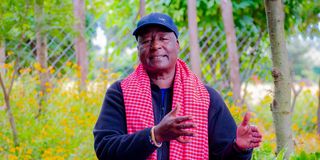
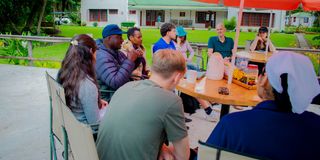
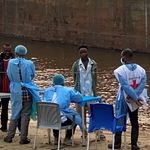
Maasai elder Mr Alais Ole Morindat shares insights into how the Maasai community is responding to climate change during a discussion with students and researchers (not pictured) at Aga Khan University's Arusha Climate and Environmental Research Centre. PHOTO I COURTESY.
Scientific data can reveal changes in rainfall, temperature and ecosystems, while indigenous communities hold generations of knowledge about their land. A research centre in Arusha is combining both perspectives to develop more relevant and resilient solutions.
For Maasai elder Alais Ole Morindat, the survival of his community rests on three closely connected pillars: natural resources, livestock and society.
The elder from Arusha Region’s Monduli District says that when researchers ignore how these pillars interlock, they fail to see that fighting poverty without addressing climate change is a futile endeavour.
His experience reflects a wider challenge facing scientific research in Tanzania. For decades, research has often followed a top-down approach, with experts studying rural communities as subjects rather than working with them as partners.
While this model has produced valuable academic knowledge, it has also created a gap between what researchers discover and what communities need in their daily lives.
For pastoralist communities, knowledge is not found only in books, databases or scientific papers. It is also built through years of observing rainfall, pasture, livestock behaviour, water sources, diseases, vegetation and how communities respond when resources become scarce.
It is this knowledge that the Aga Khan University Arusha Climate and Environmental Research Centre (AKU-ACER) is seeking to integrate with modern science.
Under the leadership of Dr Emmanuel Sulle, the centre is testing what he describes as the “two eyes” approach.
“This philosophy allows researchers to see the world through both a scientific lens and an indigenous lens, acknowledging that not all education is earned in a classroom,” Dr Sulle says.
The approach goes beyond simply asking communities to participate in research. The centre has taken an unusual step by appointing Ole Morindat, the Maasai elder, as an adjunct faculty member, creating a direct link between traditional knowledge and scientific research.
Dr Sulle says elders carry years of experience that cannot always be found in books.
“By involving the community in co-designing and co-implementing research, the centre ensures that the knowledge created addresses real needs rather than abstract academic curiosities,” he says.
The approach is supported by research showing that indigenous knowledge remains important in helping communities respond to climate change.
A 2023 study published in the Tanzania Journal of Development Studies, which examined climate change adaptation among Maasai communities in Ngerengere Division, Morogoro Region, found that pastoralists use practices such as moving in search of pasture and water, keeping both livestock and crops, and reducing livestock numbers during difficult periods.
The researchers concluded that better adaptation requires recognition of indigenous and traditional pastoral knowledge.
Another University of Dar es Salaam study in Parakuyo Village, Kilosa District, found that indigenous knowledge played an important role in managing pasture and livestock as climatic conditions changed.
Such evidence challenges the old belief that knowledge is credible only when it comes from universities or research institutions.
AKU-ACER's approach does not suggest that traditional knowledge should replace modern science. Instead, it seeks to make the two work together.
A 2024 study of Maasai pastoralists in Longido District found that communities were increasingly aware that weather patterns were becoming harder to predict and that traditional knowledge was becoming less reliable on its own.
Researchers compared community observations with rainfall and temperature data over time. The finding is important because climate change is changing the very conditions in which traditional knowledge was developed.
This means indigenous knowledge should neither be romanticised nor dismissed. Local observations can provide valuable information, while scientific measurements can help test, explain and strengthen those observations.
The experience of Ole Morindat demonstrates why this partnership matters. He lost 75 percent of his cattle to drought in just two years. Through working with researchers, he has been able to move towards more resilient livestock breeds.
“The lesson is not that one form of knowledge is better than the other. Rather, both can help communities make better decisions when they are brought together,” the elder believes.
The benefits of this partnership are also visible on the AKU-ACER land in Arusha, which remains green during the dry season when surrounding areas struggle with water and pasture.
Researchers and communities have been testing simple measures such as farming without disturbing the soil and restoring degraded land.
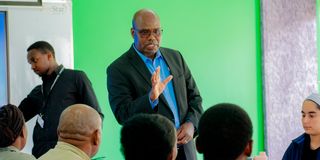
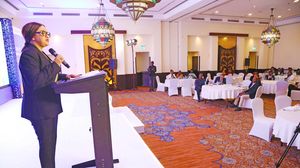
Director of AKU-ACER, Dr Emmanuel Sulle, speaks with researchers from various institutions who regularly visit the centre to learn best practices for conducting research in collaboration with communities, particularly on cross-cutting issues such as climate change. PHOTO | COURTESY.
One of the successes has been the testing and distribution of “banana grass,” a nutritious fodder that helps address both livestock shortages and land degradation.
“Every morning, local women visit the centre’s land, which now serves as a reservoir for the grass they desperately need to sustain their livelihoods,” Dr Sulle says.
The centre's work also shows that making research useful is not only about what researchers study. It is also about how they communicate their findings.
Many pastoralists have limited literacy. AKU-ACER has therefore worked with community leaders to turn complex scientific information into simple visual signs and codes.
This has been particularly useful in work on neglected tropical diseases. Researchers and elders have developed symbols and codes that translate information from English and Swahili into Kimaasai.
The tools help community members recognise symptoms and seek treatment regardless of their level of formal education.
“This approach ensures that the products of intensive research are not confined to academic journals but are instead translated into a simple, life-changing language that reaches the most marginalised and voiceless populations,” Dr Sulle says.
For Dr Sulle, language is more than a communication issue. It is also a research issue.
“If communities cannot describe their experiences in their own language, researchers risk losing important meanings during data collection,” he says.
He adds: “Likewise, when findings are returned only in technical English, communities can be excluded from understanding research that concerns their own lives.”
Aga Khan University Deputy Vice Chancellor Dr Tania Bubela says this way of working can also help rebuild trust between researchers and the public.
She describes the centre's collaborative approach as important at a time when misinformation is widespread because it encourages experts and communities to agree on priorities and work towards shared goals.
The approach comes as Tanzania seeks to strengthen its response to climate change. The country aims to reduce greenhouse gas emissions by between 30 and 35 percent against the business-as-usual scenario by 2030. Its climate plans identify agriculture, livestock, forestry and water among the key areas requiring adaptation and greater resilience.
The work at AKU-ACER offers one possible way of turning those national commitments into actions that communities understand and can take ownership of.
Dr Bubela says the centre is already doing more than its share to absorb carbon through tree planting and land restoration. But she believes such efforts can have a greater impact if other research institutions also learn to connect their work with the realities of the people they serve.
She says universities should become points where local knowledge and talent meet international expertise to build evidence that can guide responsible policies.
“By treating indigenous people not as ‘people of the bush’ but as intelligent creatures with a sophisticated culture, the centre is showing that traditional ways of life offer vital lessons for surviving under extreme environmental constraints,” she says.
This approach also raises a bigger question for Tanzania's universities: who should be regarded as an expert?
An elder who can identify changes in pasture, animal behaviour, water availability or seasonal patterns may not have an academic qualification, but years of observing and understanding the environment can provide knowledge that is important to research.
Researcher and cultural development expert Dr Mrisho Jonas says the challenge is to create research systems that document, test and protect such knowledge without taking it away from communities or treating local people simply as sources of free information.