Drought spreads beyond Kenya’s arid north, pushing herders into crisis
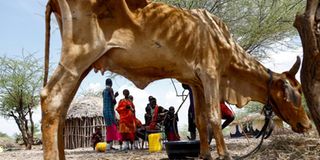
Members of the Lakaanki family from the Maasai pastoralist community gather near their emaciated cow at their manyatta homestead following worsening drought due to the failed rainy season at a village settlement near Magadi township along the Kenya-Tanzania border, in Kajiado, Kenya, February 5. PHOTO | REUTERS
Shompole. Dozens of dead cows and goats scattered around Maria Katanga’s family compound tell the harsh story of a worsening drought that is devastating pastoralist communities who depend on livestock for survival.
Since August, the 24-year-old Maasai herder has lost more than 100 cattle and 300 goats. The few animals that remain are too weak and emaciated to produce milk.
Kenya has experienced severe droughts before, most recently in 2022 when record dry conditions wiped out livestock and triggered a hunger crisis in the country’s arid north and northeast.
However, the current drought is now spreading to areas that traditionally did not face such extreme conditions, including Kajiado County near the capital, Nairobi, where Katanga lives.
As livestock grow weaker, their market value has dropped sharply. A cow that previously sold for between 60,000 and 70,000 Kenyan shillings is now fetching as little as 5,000 shillings.
Families are being forced to sell animals at throwaway prices to buy feed due to lack of pasture.
Local administrator Lemaiyan Samuel Kureko said some herders have moved long distances, with others crossing into Tanzania in search of water and grazing land.
Kenya’s National Drought Management Authority has warned that repeated droughts are increasing competition for scarce resources and raising the risk of conflict.
The crisis has also hit the wider Horn of Africa. Somalia declared a national drought emergency, with the UN warning that millions face severe hunger and rising malnutrition.
Weather forecasts show Kajiado is likely to receive near-average to below-average rainfall, deepening fears that conditions may worsen.
“No people have died yet, but the livestock are gone and the sun is getting hotter every day,” Kureko said. “We have been weakened to such a level that we can only pray for God’s help.”