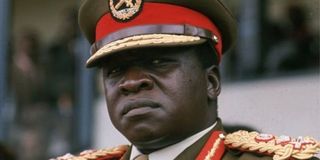
The story of Idi Amin and his women is bizarre, peculiar, comical and brutal.
He had five wives, 30 mistresses and 34 children. Before rising to Uganda’s presidency, Amin worked as a bellboy at the Grand Imperial Hotel in Kampala and later as an assistant cook at Magamaga in Jinja Barracks.
He became a law enforcement corporal and was promoted to sergeant in 1954. Because of his thirst for blood and penchant for violence, he was described as a “brilliant chap” by his British superiors and rose to the rank of warrant officer and platoon commander in 1958.
He was awarded the Sword of Honour in 1959 after military service in Gilgil and Nakuru. As a result of his brutality, he was appointed a lieutenant after a stint that led to the infamous Turkana massacre, although he barely passed his written examination.
At 28, in November 1961, he crossed paths with Sarah Mutesi Kibedi, a 22-year-old seamstress working as an apprentice at the Singer Sewing Machine Company in Jinja.
He was familiar with her background. Her brother was Wanume Kibedi, the former Ugandan Foreign Minister, attorney and diplomat, and her father, Elkanah Kibedi, was a renowned head teacher at Busoga College in Mwiri.
Amin courted and proposed to her. She began a course in Islamic instruction and changed her name to Malyamu. Despite her parents’ fierce opposition, the couple married in March 1962, just eight months before Uganda’s independence on October 9.
During their courtship, Amin was cohabiting with Kay Androa. She was a striking Makerere University medical student, celebrated for her flawless dark skin and dignified, introspective demeanour. She belonged to the Lugbara community of the West Nile region, the same Sudanic ethnic group Amin descended from, and she was the first woman to study medicine at Makerere.
Malyamu learnt of her husband’s infidelity and plotted to expose him. She told Amin she was travelling to visit her parents in Busoga. He even encouraged her to extend her stay.
After nightfall, Malyamu quietly returned home in a taxi. She entered the house and found Amin in the living room chatting with a senior air force officer.
She headed straight to the bedroom and found a naked Kay lying on her marital bed. Enraged, she grabbed her by the hair and punched her repeatedly.
Amin was expected to marry a woman from his own ethnic group. He and Kay were distant cousins on his mother’s side. Kay’s father, a clergyman, disapproved of their relationship, partly because of the stark educational gap between them. While Kay excelled academically, Amin had completed only four years of primary school and was a semi-literate Kakwa with a fearsome reputation.
In May 1966, less than four months after Malyamu found Kay in her matrimonial bed, Amin married Kay as his second wife. After Amin’s rise to national prominence, President Milton Obote grew suspicious of his intentions.
To allay these suspicions, Amin decided to marry Nora, a Langi from Obote’s ethnic group, signalling unity and diffusing ethnic tensions. In 1967, Nora joined the household and later had his children. By the late 1960s, Amin had fathered more than 15 children.
In September 1972, after orchestrating a coup d’état, Amin announced his marriage to a fourth wife, Medina, a dancer from Buganda with the Heartbeat of Africa Troupe.
She was among the performers he used to entertain dignitaries at state functions.
On March 26, 1974, without warning, Amin divorced Malyamu, Kay and Nora. Following Muslim custom, he accomplished this by simply declaring, “I divorce thee” three times.
The book A State of Blood: The Inside Story of Idi Amin, written by Amin’s former Health Minister Henry Kyemba, recounts how Amin’s womanising never left him.
For two years, the women lived in near isolation in his two presidential lodges, lonely and increasingly frustrated. Eventually, they all took lovers. Kay’s was Dr Peter Mbalu-Mukasa, a senior medic at Mulago Hospital, who had several children with his wife before Kay became pregnant by him.
The book A State of Blood: The Inside Story of Idi Amin by Amin’s former Health Minister Henry Kyemba.
Photo credit: Photo I Pool
Kay’s father, Reverend Adroa, hoping to preserve the family’s reputation, intervened on her behalf, pleading with Amin to reinstate her as his wife. Amin, unaware that Kay was pregnant with Mbalu-Mukasa’s child, agreed to build her a house in her hometown of Arua.
He frequently drove past her home in an attempt to discover her lover.
In early August 1974, Kay was arrested, allegedly for possessing a pistol and ammunition—the same firearm Amin had given her.
Shortly afterwards, on August 13, Kay’s dismembered body was delivered to the Mulago Hospital mortuary. The circumstances surrounding her death were both unclear and horrific.
On the morning of August 14, Mulago Hospital telephoned Kyemba at his ministry office in Entebbe to inform him that Kay’s secret lover, Dr Mbalu-Mukasa, had mysteriously died of an overdose.
Amin continued using state agents to victimise his former wives. On April 11, 1975, Malyamu was arrested near Tororo at the Kenyan border on a false accusation of smuggling a bolt of fabric into Kenya.
Amin blocked her from obtaining bail and ordered that she be kept in police custody.
Fearing she would meet the same fate as Kay, Malyamu fled Uganda for London in November 1975, leaving her six children in the care of Amin’s other lovers. She never returned.
The authoris a novelist, Big Brother Africa 2 Kenyan representative and founder of Jeff's Fitness Centre (@jeffbigbrother).