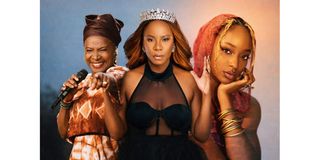
The continent’s sound is carried onto the global stage by iconic trailblazers and a fearless new wave of artistes redefining identity, creativity and cultural expression
Across generations, across borders, and across genres, African women have not only contributed to the continent’s sound, they have defined it.
From the golden era of Afro-jazz and soul to the current global explosion of Afrobeats, Amapiano and Bongo Flava, these artistes have carried culture, language and identity onto the world stage, often against the odds and always with unmistakable influence.
Few names command as much global reverence as Angélique Kidjo.
With a career spanning over four decades, Kidjo has become one of Africa’s most decorated musicians, earning multiple Grammy Awards while seamlessly blending traditional West African sounds with funk, jazz and Latin influences.
Beyond music, her advocacy for education and women’s empowerment has positioned her as both an artist and a global cultural force.
In more recent years, the rise of Afrobeats has been impossible to ignore, and women have been central to its global takeover.
Tiwa Savage, often referred to as the “Queen of Afrobeats,” helped bridge African pop with international markets, moving effortlessly between Lagos, London and Los Angeles.
Her sound, equal parts Afrobeat, R&B and pop, opened doors for a new generation of female artistes.
Among those who walked through those doors is Tems. With her distinct, atmospheric sound, Tems has redefined what African music can feel like, introspective, alternative and globally resonant.
Her collaborations with global heavyweights and her Grammy success have solidified her as one of the most important voices of her generation.
While West Africa often dominates global headlines, East Africa has quietly and powerfully built its own sonic revolution.
At the forefront of this new wave is Sofia Nzau, arguably Kenya’s most internationally recognized female artist right now.
Nzau’s rise is anything but conventional.
She blends electronic dance music with indigenous Kikuyu language and folk elements, creating a sound that feels both ancestral and futuristic.
Her performances at global stages like Tomorrowland and collaborations with top-tier DJs including Diplo, Tiësto and Steve Aoki have positioned her at the intersection of African identity and global electronic culture.
In many ways, she represents a new frontier, one where African languages are no longer confined to traditional genres but are thriving in global club spaces.
Kenya’s influence does not stop there. Victoria Kimani has long been a key figure in Afro-pop and R&B, helping shape the region’s contemporary sound with her bold, cosmopolitan style.
Meanwhile, Amani remains a foundational figure whose early hits defined East African pop in the 2000s.
Uganda, too, has seen a surge of female talent redefining the narrative.
Azawi stands out for her fusion of Afrobeat, soul and traditional Ugandan rhythms.
Her music often carries themes of resilience, independence and social consciousness, reflecting the realities of a new African generation.
In Tanzania, female artistes have long played a pivotal role in shaping Bongo Flava, even when the industry tilted heavily male.
Lady JayDee remains one of the genre’s most enduring and respected voices.
Her ability to blend R&B with Swahili lyricism has made her a household name for over two decades.
Alongside her, Ray C brought a bold, edgy energy to early Bongo Flava, influencing a generation of artists with her fearless persona and street anthems.
These women did not just make hits, they created space.
Artistes like Nakaaya Sumari expanded the boundaries even further, incorporating Afro-pop with socially conscious storytelling.
Commercial success reached new heights with Vanessa Mdee, who became one of Tanzania’s most recognizable global music exports before stepping away from the industry.
Her polished sound and crossover appeal helped bring Bongo Flava to wider audiences.
Meanwhile, artistes like Mwasiti have maintained a strong presence through soulful, emotionally rich music, while alternative voices such as Witness Kibonge Mwepec are pushing creative boundaries through poetry, fusion and experimental sound.
The power of groups and collaboration
Beyond solo acts, female groups have also played a crucial role in shaping African music culture. Uganda’s Blu3 became a regional sensation in the early 2000s, dominating charts and redefining what a girl group could achieve in East Africa.
Their success proved that collaboration among women could be both commercially viable and culturally impactful.
The new guard, current voices shaping the future
As African music continues its global ascent, a new generation of female artistes is emerging, bold, experimental and unapologetically African.
Artists like Ayra Starr are bringing youthful energy and fearless storytelling to Afrobeats, while Tyla is redefining global pop through the lens of Amapiano, earning international chart success and viral acclaim.
Across the continent, more women are stepping into the spotlight and reshaping the narrative.
From rising alternative voices to mainstream chart-toppers, today’s female artistes are more visible, more diverse and more influential than ever before.
What sets this new wave apart is not just talent, but autonomy. Many of these artistes are taking control of their sound, image and storytelling, challenging industry norms that once limited female expression.
They are experimenting with language, blending genres and collaborating across continents, proving that African music is not a monolith but a dynamic, evolving force.
As the industry continues to evolve, African women are not just participating in the music movement, they are leading it, redefining it and ensuring its future sounds as rich and diverse as the continent itself.