Israeli settlers set fire to West Bank mosques after deadly clash
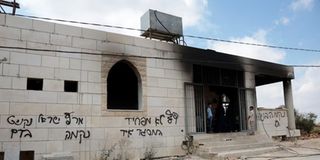
Palestinian boys stand at a damaged a mosque, which Palestinians say was damaged by Israeli settlers, in Qusra near Nablus, in the Israeli-occupied West Bank, July 26, 2026. Graffiti on the wall includes "Blood does not frighten us, the mosque will testify" and "the land of Israel was bought with blood." PHOTO | REUTERS
Qusra. Israeli settlers attacked Palestinian villages across the occupied West Bank early on Sunday, setting fire to two mosques and spray-painting graffiti on buildings, Palestinian officials said.
The attacks followed a deadly confrontation on Friday in which four Palestinians and two Israeli soldiers — one of them serving as a security coordinator for a nearby Israeli settlement — were killed after a group of Israeli settlers, some armed, approached the Palestinian village of Tal, southwest of Nablus.
Palestinian residents came out to confront the settlers, leading to a violent stand-off. Video footage appeared to show one Palestinian seizing a settler's weapon. Palestinian authorities said the settlers provoked the violence, while the Israeli military said both sides exchanged gunfire.
The incident is the latest in a series of settler-related clashes that have left dozens of Palestinians dead and hundreds injured this year, according to the United Nations and the Palestinian Authority.
Israeli Prime Minister Benjamin Netanyahu, whose country is due to hold elections in October, ordered a major security operation against what he described as terrorism targeting Israeli civilians. He also reinforced military units in the West Bank and cancelled leave for security personnel.
Members of Netanyahu's government, including far-right Finance Minister Bezalel Smotrich, have continued to call for the annexation of the West Bank, which Israel captured in the 1967 Middle East war.
Palestinian officials said the latest attacks appeared to be retaliation for the deaths of the two Israelis near Tal.
Abdel Azim Wadi, head of the village council in Qusra, southeast of Nablus, said settlers set fire to a newly completed mosque in the village.
"The mosque was in its final stage and was ready to receive worshippers. It had already been furnished. They set it on fire and spray-painted Hebrew slogans on its walls," he told Reuters.
The graffiti included the words "Jewish revenge" and the name of one of the Israelis killed near Tal.
The Palestinian Authority described the attacks as part of what it called an escalating campaign against Palestinians across the occupied territory.
The Israeli military said troops deployed to Qusra found evidence of arson and graffiti and had launched a search for those responsible. It said police officers had been sent to collect evidence.
"The security forces strongly condemn incidents of this kind, including harm to religious sites, and will continue to act decisively to maintain security and public order in the area," the military said.
In separate incidents, Palestinian officials said settlers also attempted to burn a mosque near Kour, southeast of Tulkarm, and attacked Palestinian workers at a stone-cutting facility in Kafr Malik, near Ramallah.
Farid Jiyousi, a member of the Kour village council, said worshippers managed to extinguish the fire before it spread through the mosque.
"This is the first attack our village has experienced," he said, adding that the attackers also sprayed Hebrew graffiti on the mosque walls.
As part of a wider security operation, Israeli forces arrested about 60 Palestinians overnight, according to the Palestinian Prisoners Club, which monitors Palestinians held in Israeli custody.
Most countries and United Nations bodies regard Israeli settlements in the West Bank as illegal under international law, a position Israel rejects.
The Palestinians seek the West Bank as the core of a future independent state, while Israel cites historical and biblical ties to the territory. Netanyahu's government, which opposes Palestinian statehood, has continued to expand settlements.
Speaking on Sunday, Pope Leo said he was following the worsening violence with deep concern and called for negotiations to achieve "a just political solution". He also urged all sides to respect the status of holy sites and refrain from actions that undermine them.