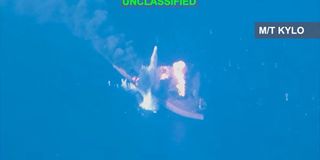
Fire and smoke rise during what US Central Command (CENTCOM) says are strikes on Iranian oil carriers, at an unknown location in this screengrab taken from a handout video released on September 5, 2026. PHOTO | REUTERS
Dubai. US and Iranian forces exchanged fire in waters around Iran on Saturday, with US forces striking three Iranian oil carriers and Iran saying it had targeted three tankers travelling through unauthorised routes in the Strait of Hormuz.
US Central Command said it struck the three Iranian vessels, including one off the coast of Kharg Island, Iran’s main oil export hub, after Iran’s Islamic Revolutionary Guard Corps (IRGC) launched ballistic missiles at two US Navy ships.
“Let the message to the IRGC be clear: If you shoot at two of our ships, we will impose an even higher economic cost — taking out three of yours,” said Admiral Brad Cooper, head of US Central Command, which oversees US military operations in the Middle East.
The IRGC threatened to intensify attacks on US military vessels in the region and later said it had targeted the three tankers, as well as three US-linked vessels elsewhere.
“Do not be deceived by the ‘terrorist’ US military and refrain from any suspicious movement aimed at passing through unauthorised waterways,” the IRGC Navy said in a statement broadcast by Iranian state television.
“Otherwise, you will be targeted.”
Iranian semi-official news agency Tasnim reported that four US missiles struck a tanker near Kharg’s anchorage. Citing local sources, it said there were no casualties and the crew was being evacuated.
Central Command said no US personnel were injured.
The exchange followed an escalation over the past week in a conflict that began after the US and Israel launched strikes on Iran in February, disrupting global energy supplies and fuelling opposition to the conflict among a majority of Americans ahead of congressional elections in November.
Trump’s threats over Kharg Island
The latest fighting comes as President Donald Trump’s administration seeks to tighten economic pressure on Iran through wider sanctions, while Trump himself has kept open the possibility of further military action.
On August 31, Trump posted a one-line message on social media alongside an AI-generated video depicting Kharg Island being “blown to smithereens”. Iranian authorities have vowed a strong response if the island is attacked.
Iran is the third-largest producer in the Organisation of the Petroleum Exporting Countries (Opec) and exported 90 per cent of its crude through Kharg Island before the war. Oil flows have been disrupted since the US imposed a blockade on Iranian exports in mid-April.
Trump has previously threatened action against Kharg. On June 11, he said he wanted to take over the island, before later ruling out a US military operation there, days before Tehran and Washington signed an interim agreement on June 17 aimed at ending the war.
A US attack on Kharg would put further pressure on Iran’s oil industry and economy, already strained by the naval blockade.
The US imposed the blockade on Iranian ports after Iran effectively shut the Strait of Hormuz, a strategic waterway that carried about one-fifth of global oil supplies before the war.
Brent crude futures closed at their highest level since July 24 on Friday at $96.28 a barrel, as heightened Middle East tensions fuelled concerns over global energy supplies.