AfDB sees 5.4 percent Tanzania growth amid geopolitical risks

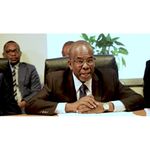
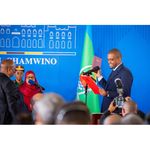
AfDB president Sidi Ould Tah (left) speaks at a presidential dialogue on Tuesday, May 26, during the opening of the AfDB Annual Meetings in Brazzaville, Republic of Congo. PHOTO | COURTESY

Dar es Salaam. The African Development Bank’s (AfDB) latest outlook projects Tanzania’s economy to grow by 5.4 percent in 2026, as geopolitical tensions in the Middle East push up energy and import costs across the region, although the country is still expected to remain among East Africa’s stronger performers.

The continental lender expects growth to rebound to 6.1 percent in 2027, supported by infrastructure investment, ongoing structural reforms, and gradual improvements in the business environment.
“Downside risks include the impact of the Middle East conflict and global geopolitics that could increase oil and food prices and disrupt export and import supply chains, climate change vulnerabilities, and lingering effects of socio-political tensions,” the bank said.

The projection is lower than estimates from other multilateral institutions and domestic authorities. The International Monetary Fund (IMF) projects Tanzania’s economy to grow by 5.9 percent in 2026, while the World Bank forecasts about 6.2 percent.

The Bank of Tanzania (BoT) has maintained growth expectations around six percent, noting in its latest monthly economic review that high-frequency indicators point to 6.2 percent growth in the first quarter of 2026 and 6.1 percent in the subsequent quarter, despite global uncertainties.

Across East Africa, Uganda is expected to be the region’s fastest-growing economy, with growth projected at 6.2 percent in 2026 and accelerating to 8 percent in 2027 as commercial oil production begins and extractive sector investment expands.

Rwanda is projected to grow by 7.0 percent in 2026 and 7.4 percent in 2027, though the AfDB cautions that insecurity in eastern Democratic Republic of Congo and higher global commodity prices could weigh on activity.

Kenya, the region’s largest economy, is projected to grow by 4.6 percent in 2026 and 4.7 percent in 2027, constrained by elevated energy costs and supply disruptions linked to global geopolitical tensions.

Burundi is expected to grow by 4.3 percent in 2026 and 4.6 percent in 2027, driven by agriculture, mining, electricity generation and public investment.

The AfDB says East Africa will remain Africa’s fastest-growing region, even as momentum slows, with regional growth projected to ease from 6.6 percent in 2025 to 5.9 percent in 2026 before recovering to 6.4 percent in 2027.

At the continental level, Africa’s economies are projected to grow by 4.2 percent in 2026, down from 4.4 percent in 2025, before stabilising at 4.4 percent in 2027.

 Beyond growth projections, the report highlights a deeper structural constraint: Africa’s development financing gap. At the centre of the 2026 outlook is a stark estimate that the continent faces an annual financing shortfall exceeding $1.3 trillion needed to achieve the Sustainable Development Goals.

The AfDB attributes the gap to weak domestic resource mobilisation, underdeveloped financial systems and tightening external financing conditions.

However, it argues the challenge is not only a shortage of resources, but inefficient deployment of existing capital. According to the report, Africa could unlock up to $1.43 trillion annually through improved revenue collection, more efficient public investment, deeper capital markets, expanded public-private partnerships, diaspora financing and better use of natural capital.

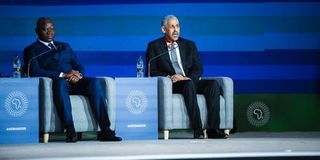
Speaking at a presidential dialogue on Tuesday, May 26, during the opening of the AfDB Annual Meetings in Brazzaville, Republic of Congo, AfDB president Sidi Ould Tah said Africa holds substantial untapped financial resources that could be mobilised for development.

“Africa has nearly four trillion dollars in African-held financial resources that can be leveraged to raise capital at scale for bankable projects,” he said.

“It is our role at the bank to work with states and financial institutions to design bankable projects and mobilise the necessary financing,” he added.

Dr Tah said the bank would focus on improving investment conditions, protecting investors and strengthening partnerships to narrow Africa’s widening financing gap.

“We need to create conditions for our partners to make gains also,” he said. “This will help us crowd in more foreign direct investment.”

The lender estimates that stronger tax and non-tax revenue mobilisation could generate an additional $469 billion annually, while improved efficiency in public investment could unlock about $299 billion in savings.

Public-private partnerships are highlighted as a key growth lever, with the report noting that every dollar of public investment could attract about $1.40 in private capital.