Arusha. African nations have been urged to intensify investments in building societies grounded in justice, compassion and human dignity to secure a peaceful future free from violence and bloodshed.
The call was made in Arusha by Mayor Maximilian Iranghe during the 32nd commemoration of the 1994 Genocide against the Tutsi in Rwanda, widely known as Kwibuka 32.
The event was held on Tuesday, April 7, 2026, at the East African Community headquarters in Arusha.
Mr Iranghe, who was the guest of honour, said the genocide remains a stark reminder of the devastating consequences of hatred, division and the systematic dehumanisation of people when left unchecked.
“It is our duty as nations, institutions and individuals to reject all forms of discrimination, intolerance and incitement to violence.
“We must speak out against injustice, even when it is inconvenient, to prevent the seeds of conflict from growing into violence,” he said.
He said that peace cannot be achieved by chance.
“It requires deliberate and sustained investment in societies that uphold justice, compassion and human dignity,” he said.
Held under the theme “Remember, Unite, Renew,” Kwibuka is a 100-day annual commemoration that honours more than one million victims, mostly Tutsi and moderate Hutu, killed within just 100 days in 1994 (from April to July).
The period focuses on remembrance, solidarity with survivors and renewed commitment to preventing genocide through education and awareness.
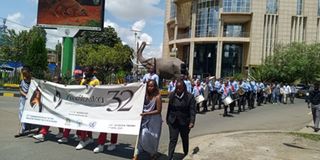
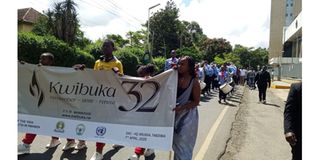
The event in Arusha began with a solemn procession from the EAC Secretariat headquarters.
Hundreds of participants marched along Makongoro Road, through Mwenge Junction to Pangani Street and later onto Uhuru (Sokoine) Road before proceeding to the Clock Tower roundabout, widely regarded as the symbolic heart of Africa.
The procession later returned to the EAC premises, where officials and representatives from international organisations laid wreaths in honour of the victims.
Chairperson of the Rwandan Community in Arusha and Kilimanjaro, Ms Flavia Busingye, said the annual commemoration has grown into a vital regional platform for reflection and unity.
“We are gathered not only to remember, but to reaffirm our shared commitment to truth and to ensure such atrocities never happen again,” she said.
Ms Busingye said the importance of educating younger generations who did not witness the events.
She warned that conflicting narratives, some rooted in truth and others shaped by denial or distortion, pose challenges, particularly for youth seeking clarity.
“We must protect truth, unity and our shared future by rejecting distortion and ensuring history is not rewritten, whether in our homes, communities or institutions,” she said.
She also called on East African nations and partners to take firm action against impunity and ensure justice is not selective.
Representing the EAC Deputy Secretary General for Infrastructure, Productive and Political Sectors, Andrea Aguer Malueth, Ms Dorcas Omukhulu said the genocide was not an isolated event but a tragedy that shook the entire region and humanity at large.
“It did not happen overnight. There were clear warning signs: hate speech, systemic discrimination and organised violence. Yet the international community failed to act in time,” she said.
Ms Omukhulu warned that some of these warning signs remain visible in parts of the region today, including divisive rhetoric, exclusionary politics and weak institutions.
She urged governments to take proactive measures to prevent similar atrocities.
On his part, Mr Diallo Nouhou Madan, Special Assistant to the President of the African Court on Human and Peoples’ Rights, described genocide as one of the gravest violations of human rights.
“Those of us here today carry the responsibility to ensure that ‘Never Again’ is not just a slogan, but a reality achieved through action, cooperation and accountability,” he said.
Mr Madan said that many conflicts around the world stem from injustice and inequality, stressing that human life is sacred and must be protected at all costs.
He further called for genocide education to be integrated into secondary school curricula across Africa to safeguard future generations.
Representing Rwanda’s High Commission in Tanzania, Mr Louis Uwimana described the 1994 genocide as “the darkest chapter in human history,” noting that over one million people were killed within just 100 days.
He thanked Tanzania and other EAC member states for their continued solidarity with Rwanda.
“Never Again must go beyond words; it must be translated into concrete action,” he said.
Assistant Secretary-General and Registrar of the United Nations Residual Mechanism for Criminal Tribunals, Mr Abubacarr Tambadou, highlighted the role of justice in addressing genocide crimes.
He noted that Arusha has played a historic role in international justice, having hosted the UN International Criminal Tribunal for Rwanda since 1996.
“Genocide stands above all crimes because it reflects a clear intent to destroy a group of people,” said Mr Tambadou, adding that beyond direct killings, many victims died from starvation, disease and other consequences of the violence.
He further revealed that perpetrators also targeted individuals who opposed the genocide, as well as foreigners married to members of the Tutsi community.