AI innovation seeks to bridge Tanzania’s digital divide for people with disabilities
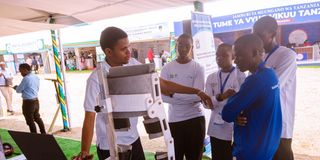
Muhimbili University of Health and Allied Sciences (Muhas) student, Mr Sabri Salumu (left) demonstrates the SautiBox innovation to fellow exhibitors during the National Education, Skills and Innovation Week in Tanga. The Bridging Silence innovation aims to address the digital divide facing people with disabilities. PHOTO | JACOB MOSENDA
Tanga. For individuals who rely on sign language, a classroom, workplace, public meeting, or family gathering can quickly become a place of isolation when those around them cannot communicate effectively.
To address this everyday barrier, a group of young innovators from Muhimbili University of Health and Allied Sciences (Muhas) has developed an artificial intelligence (AI) solution, Bridging Silence that translates sign language into Kiswahili text and speech in real time.
Showcased during the National Education, Skills, and Innovation Week in Tanga, the technology eases communication for people with hearing and speech disabilities, particularly students facing learning environments unequipped for their needs.
At the core of the system is SautiBox, a device equipped with a camera, speaker, and microprocessor.
It captures user gestures, processes them, and outputs spoken Kiswahili for hearing individuals.
The team is also developing a supporting mobile application and web portal.
Core Software Developer Sabri Salumu explained that the project grew out of witnessing the persistent social exclusion experienced by sign language users.
“In Tanzania, individuals who rely on sign language face constant barriers because spoken language is routinely assumed to be the default,” he said.
“The lack of localised digital sign-language infrastructure, limited awareness among hearing populations, and the absence of scalable translation tools created an urgent need for action,” added Mr Salumu.
The team, which includes Project Manager, Ms Radhia Omary, Signal Processing Developer, Mr Ezekiel Paul, and Community Liaison Coordinator, Ms Joycelyne Joshua, began by engaging with specialized institutions in Mbeya and Dar es Salaam.
Their observations revealed that communication challenges affect children long before they reach the classroom.
Concerns over societal integration lead some families to delay schooling.
Those who do enrol often struggle when teachers, peer groups, and learning materials are ill-prepared for inclusive communication.
Innovators emphasize that the core issue is not learning capability.
Rather, the communication gap prevents these students from participating fully in lessons, asking questions, socializing, and accessing information on equal terms.
Bridging Silence aims to close that gap. The team has already built a baseline system translating letter-based hand gestures into speech.
Their next objective is to build a two-way model converting spoken Kiswahili back into sign language using 3D animation and motion-sensing technology.
Scaling from a prototype to a commercial product will require dedicated funding, computing capacity, data, and institutional partnerships.
This is where Tanzania’s expanding innovation ecosystem becomes vital.
Through the Tanzania Commission for Science and Technology (Costech), the government provides technical and financial assistance via initiatives such as MAKISATU to help commercialize emerging solutions.
Marking Costech’s 40th anniversary, the director general, Dr Amos Nungu, reiterated the national imperative to translate research into practical solutions for local challenges, urging academic institutions to focus on high-impact development outcomes.
The effort aligns with wider national priorities. Under the National Digital Education Strategy 2024/25–2029/30, the Ministry of Education, Science and Technology is scaling up digital infrastructure and inclusive education frameworks.
Innovations like Bridging Silence offer practical technological tools to reinforce these policy objectives on the ground.