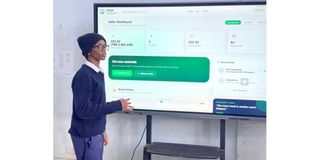
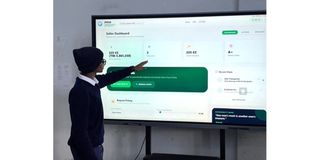
Arusha. A group of six Form Five students from Arusha Science Secondary School has developed a digital platform aimed at turning Tanzania’s growing waste challenge into economic opportunity while promoting environmental sustainability.
The project, dubbed “Cyclo – turning waste into wealth”, is a digital marketplace and smart waste management system designed to connect waste producers, collectors and recyclers on a single coordinated platform, supporting a more efficient circular economy.
The innovation comes at a time when Tanzania is grappling with rising volumes of solid waste.
According to the National Environment Management Council (NEMC), the country generates between 14.4 million and 20.7 million tonnes of solid waste annually.
However, less than 50 percent is formally collected, while only five to 10 percent is recycled.
NEMC warns that low recycling rates continue to contribute to environmental pollution, blocked urban drainage systems, disease outbreaks, and the deterioration of urban landscapes.
Presenting the project during the school’s first Science-to-Use (SITU) innovation graduation exhibition on Sunday, May 31, 2016, a team member, Ms Shawn Mareale, said Cyclo seeks to bridge the information gap between waste generators, collectors, and recycling companies.
“CYCLO is a digital platform that streamlines waste management by connecting producers, collectors, and recyclers within one coordinated system. By improving communication, and reducing information gaps, it enables more efficient, transparent, and organised waste handling,” she said.
The platform features a waste collection request system, digital tracking of waste movement, recycling, and sorting coordination, a marketplace for recyclable materials, and data analytics tools to support waste reduction strategies.
According to Ms Mareale, the innovation is expected to reduce landfill waste, create green jobs, stimulate recycling industries, improve urban cleanliness and support Tanzania’s Vision 2050 ambitions for a green and sustainable economy.
Another team member, Ms Janelle Dominick, said rapid urbanisation, and industrialisation have significantly increased plastic and industrial waste, while weak waste management systems continue to pose environmental, and public health risks.
“Many valuable recyclable materials such as clothes, bottles, electronic waste, plastics, and others are discarded instead of being reused because there is no efficient mechanism linking waste producers with collectors, and recyclers,” she said.
She noted that the platform allows users to request waste collection services, locate nearby collectors, and manage transactions digitally, improving efficiency, and transparency across the waste value chain.
The system, she added, has the potential to reduce pollution, generate income for collectors, and recyclers, and create cleaner, and more organised urban environments.
Team member Theo Kikula explained that users submit waste pickup requests through the application, after which the system automatically matches them with verified nearby collectors.
“Collectors then coordinate transportation, and collection services, while all transactions and updates are managed digitally within the platform,” he said.
Beyond waste collection, Cyclo also promotes the transformation of waste into value-added products, including environmentally friendly construction materials, creating new business opportunities from materials that would otherwise end up in landfills.
The innovation was showcased during the school’s inaugural SITU graduation ceremony, which focuses on practical scientific innovation, and entrepreneurship.
Head of Science Department, Mr Ally Msangi, said the programme is designed to nurture confidence, competence, and excellence among students by encouraging them to identify real-world challenges, and develop practical solutions.
“These projects demonstrate students’ ability to think critically, innovate, and solve societal problems. Our goal is to ensure their ideas contribute meaningfully to communities while creating economic opportunities,” he said.
Mr Msangi said the SITU programme was launched in 2025, with Form Five students undergoing a year-long innovation training course.
Out of 28 projects developed in the first cycle, 19 have been successfully completed.
The projects span science, technology, renewable energy, entrepreneurship, environmental conservation, and health.
He said the school is committed to supporting promising innovations beyond the classroom so they can evolve into viable products, and services that address societal challenges while generating income for young innovators.
“We want these innovations to open doors for students, create jobs, and become drivers of economic development. We are therefore calling on stakeholders to support student-led projects through funding and mentorship,” he said.
The School Headmaster, Prof Nuhu Habibu, said continuity remains one of the biggest challenges facing student innovators after secondary education.
He said many promising projects lose momentum when team members join different universities, making it difficult to continue collaboration.
“Students may develop excellent innovations while at school, but sustaining them after graduation becomes difficult when teams are separated. Parents should work closely with schools and help young innovators remain connected so they can continue developing their ideas and even establish companies,” he said.
Prof Habibu said many successful global enterprises began as student collaborations, stressing the importance of maintaining partnerships to transform school innovations into sustainable businesses.
Beyond Cyclo, students also showcased other innovations aimed at solving everyday challenges through technology.
One is an artificial intelligence-powered smart lighting system that allows users to switch electrical lights on and off remotely using a mobile phone.
Student Mohamed Abubakari, one of the developers, said the system can be integrated into smart electrical setups, allowing homeowners to control lighting even when away from home.
“The technology saves time by eliminating the need to physically switch lights on or off. It is also beneficial for people with disabilities, who can control lighting directly from their phones without using wall switches. In addition, it helps reduce electricity wastage when users forget to switch off lights before leaving home,” he said.
Another group developed a Smart Water Card System designed to improve water management and reduce wastage through a prepaid mechanism.
According to student Constantine Dominic, users purchase water credit similar to mobile airtime, which is stored on a smart card.
“The user loads the card with a selected amount of water and uses it at a dispensing machine. By tapping the card, the user selects the required number of litres, and water flows until the limit is reached, after which the system stops dispensing,” he said.
He said the technology could significantly reduce water wastage by giving users greater control over consumption.
Register to begin your journey to our premium contentSubscribe for full access to premium content