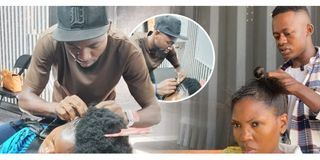
Dar es Salaam. In the past, it was rare to see Frank Mwingira, 22, braiding a client in daylight.
Instead, he worked in secret, not out of incompetence, but from a fear of public scrutiny and ridicule.
Drawn to hair-styling from a young age after watching his mother and relatives braid, Mr Mwingira would sit aside and unravel his younger sibling's hair.
He gradually honed his craft into professional skill, though societal views that braiding is exclusively women's work presented a major obstacle.
“If someone asked me to braid their hair, I would tell them to come inside. I was afraid of people's eyes because I thought, this is feminine work; as a man, how will people view me?” he recounts.
That marked the beginning of the journey for the youth now known online as Frank Msusi, a moniker given by a client who discovered his talent and urged him to use it as part of his brand.
Having completed his Form Four studies in 2021 at Mbande Secondary School, Mr Mwingira chose his passion over initial career aspirations.
Though he once dreamed of becoming a journalist, discouragement from his surroundings led him to take braiding seriously.
Although he initially worked in hiding, his clients became brand ambassadors, bringing in customers from different areas and proving the trade could be lucrative.
After operating secretly for a time, Mr Mwingira secured a job at a salon in Kijitonyama, officially launching his professional career.
Reluctant at first to advertise himself online, a client persuaded him to embrace social media.
TikTok soon became his gateway to a broader market, while his Instagram page rapidly gained followers and massive online popularity.
Today, braiding enables Mr Mwingira to support his family, including paying school fees for his younger sibling from Form One to college.
Mr Mwingira is not alone. Mr Chrispin Madison, famously known as Chris Minyoosho, also entered the profession after trying various jobs, including furniture manufacturing and motorcycle taxi riding.
Unlike Mr Mwingira, Mr Madison was not initially drawn to braiding; rather, economic necessity pushed him into the sector.
His journey began when he lived with a braider, learning salon tasks such as hair unravelling.
Comparing the income from braiding with his previous jobs, he saw a viable opportunity.
“When I saw the money generated from braiding and realised how few men do this work, I told myself I could do it,” he recounts.
Moving to Dar es Salaam in 2024 to learn braiding, success did not come instantly.
He struggled to gain the trust of salons, and seeing peers he had trained secure opportunities he missed out on forced him to redouble his practice.
Instead of giving up, he sought employment alongside experienced braiders to sharpen his skills.
Both men represent a growing group of self-employed male braiders who, despite earning guaranteed incomes, face lingering community prejudice.
Negative online comments and social stigma have not deterred them from pursuing their dreams, driven by a steadily rising demand for diverse, everyday hair styles.
The expansion of the braiding market is not limited to Tanzania.
According to Custom Market Insights, the global braiding market was valued at approximately $529.3 million (Sh1.4 trillion) in 2022, rising to $538.9 million (Sh1.43 trillion) in 2023.
The research estimates the market will reach $625.3 million (Sh1.66 trillion) by 2032, growing at an average of three percent annually.
Challenges
Mr Mwingira notes that many young people possess valuable skills but refuse to utilise them out of fear of social stigma or gender stereotypes.
“Many youth are selective about jobs. Someone might know how to braid but refuses because they consider it feminine work, yet they remain unemployed,” he says.
While working for an employer meant fixed wages, self-employment gave him direct insight into his revenue, costs, and profits.
For Mr Madison, even today, his parents remain unaware of his profession, as they are not active internet users.
He plans to inform them only after achieving a major milestone that can alleviate any initial negative perceptions.
Though sarcastic remarks and online insults initially felt like thorns in their sides, both men have hardened their resolve and pressed on.
Clients
Reflecting on her experience, client Neema Mwanga says she was initially drawn to male braiders via social media before deciding to give them a try.
“I had never been braided by a man, so I wanted to see for myself. Also, I am not a talkative person, and I figured I would be comfortable not being forced to chat constantly,” says Ms Mwanga, noting she also wanted to test if men could braid as well as women.
Another client identified by one name Ms Victoria, who has always been styled by male braiders, saw no issue supporting them.
“I believe there is no such thing as men's work or women's work. If someone can do a job well, they should do it without societal opposition. Doing so will help reduce youth unemployment driven by fear of negative public perceptions,” she says.
Goals
Despite facing numerous challenges, Mr Mwingira dreams of opening a large salon and, eventually, a braiding college to train other youth.
He also advocates for technical education in schools to extend beyond sports and traditional talents, creating space for students to discover practical skills like braiding and beauty.
“A child who does not continue with formal education can still acquire skills to become self-employed,” he says. To men hesitant to enter the profession out of fear of gossip, his message is clear: “Stop looking at work through the lens of gender. Any work earned through legal means is honourable work,” said Mr Mwingira.
For Mr Madison, the journey continues, demonstrating that entering the sector does not require vast capital, only a willingness to learn, practice, and build an environment for growth.
Economy
Economic expert, Mr Massawe Assey, views the influx of men into the braiding business as a sign of labour market evolution, emphasising that professions should be judged on income generation and employment potential rather than gender.
In today's economy, he notes, individuals with in-demand skills have ample opportunity to self-employ and build businesses.
“Today's economy requires people to look at market opportunities. If there is demand for braiding services and someone has the skill, there is no reason to label the work exclusively for women. The focus should be on income, service quality, and business growth,” he says.
Mr Assey advises male braiders to treat the profession as an expandable enterprise rather than just a service.
“By treating braiding as a business, you can start small, employ others, and eventually open multiple branches. That is its true economic importance: it generates personal income while creating jobs for others,” he concludes.
Register to begin your journey to our premium contentSubscribe for full access to premium content