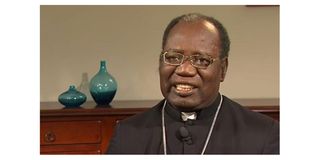
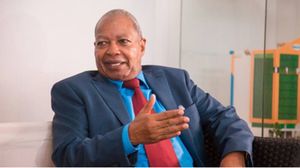
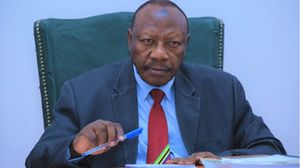
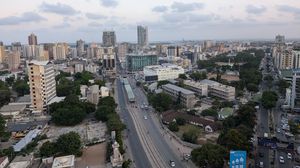
Dar es Salaam. On the night of February 19, 2026, Tanzania lost one of its foremost spiritual, moral, and national voices.
Cardinal Polycarp Pengo, retired Archbishop of the Archdiocese of Dar es Salaam, passed away at the Jakaya Kikwete Cardiac Institute (JKCI) in Dar es Salaam, aged 82.
The Archbishop Jude Thaddaeus Ruwa’ichi formally announced his death.
National mourning ensued, with President Samia Suluhu Hassan among the first to offer condolences, recalling him as a voice of wisdom on social and moral issues who championed peace, respect, and humanity across Tanzanian society.
Cardinal Pengo’s life mirrored much of Tanzania’s history, a man at the crossroads of faith and politics, Church and nation, African culture and global change.
Understanding his leadership offers insight into the Catholic Church’s history in Tanzania and its interaction with successive governments.
Early courage and advocacy
During his first two decades in Dar es Salaam, Cardinal Pengo became known for remarkable courage.
He spoke out boldly, criticising governments and institutions when their actions threatened the Church or national unity.
A notable instance followed the Zanzibar unrest of 2001. In February of that year, a statement signed by Catholic bishops, including Cardinal Pengo, condemned the “killing of innocent people” and the ensuing “riots.”
On HIV/Aids, he maintained the Church’s position that the epidemic could not be addressed by condoms alone, but through education on personal responsibility within a moral view of human sexuality, a stance sometimes at odds with international health policies.
Regarding same-sex relations, he stated in 2000 that such acts were among the gravest sins.
In November 2018, Cardianl Pengo spoke against “ideological colonialism,” urging the government to reject foreign aid linked to Western advocacy of same-sex relations.
During the Harvest Thanksgiving Mass at St Joseph’s Cathedral in Dar es Salaam on 25 November 2018, he urged refusal of aid tied to practices contrary to God’s will, saying it was better to face hunger than compromise morality.
One of his most challenging periods came during President John Pombe Magufuli’s tenure (2015–2021).
The Tanzania Episcopal Conference (TEC) issued strong statements criticising trends in democratic governance, human rights erosion, and suppression of dissent.
Even amid such tensions, Cardinal Pengo maintained a careful balance between spiritual leadership and political reality.
Relations with successive governments
During Mwalimu Julius Nyerere’s era, Cardinal Pengo served as bishop in peripheral dioceses, including Nachingwea and Tunduru-Masasi.
His studies in Rome included research on Nyerere’s nation-building philosophy, which he used to illustrate the Church’s role in fostering patriotism, showing an early understanding of Church, state dialogue.
During the final years of Ali Hassan Mwinyi (1985–1995) and throughout Benjamin Mkapa’s presidency (1995–2005), Cardinal Pengo, Archbishop of Dar es Salaam from 1992 and Cardinal from 1998, navigated major changes, from single-party to multi-party politics and economic reform.
His decisive action during the 2001 Zanzibar unrest, signing the bishops’ statement condemning killings, reflected his readiness to challenge authorities while maintaining engagement in human rights matters.
During Jakaya Kikwete’s tenure (2005–2015), Cardinal Pengo maintained a courteous, measured voice.
In 2014, TEC’s peace and justice committee issued a letter on constitutional review recommendations; Cardinal Pengo dissociated himself, emphasising that it did not reflect the Church’s position, illustrating his careful balancing of conscience and collective Church decisions.
During Magufuli’s term, TEC issued strong letters critical of government policy.
Cardinal Pengo appeared to distance himself from two high-profile documents, arguably to preserve spiritual leadership amid a tense political environment and declining health.
Even so, he remained firm on moral matters, such as foreign aid tied to ethical compromises.
Under President Samia Suluhu Hassan (2021–2026), respect for Cardinal Pengo’s seniority was evident.
She marked his 50th priesthood anniversary and contributed to his church project in Makulunge, Bagamoyo.
After his death, she recalled him as a voice of wisdom on social and moral issues.
Global leadership and African voice
Cardinal Pengo’s influence extended beyond Tanzania. He participated in two papal conclaves: in 2005, electing Pope Benedict XVI, and in 2013, electing Pope Francis.
He served on several Vatican councils, including the Congregation for the Doctrine of the Faith, the Congregation for the Evangelisation of Peoples, and the Council for Interreligious Dialogue.
In 2007, he was elected President of the Symposium of Episcopal Conferences of Africa and Madagascar (SECAM), a position he held until 2013, defending Africa’s contribution to the universal Church.
Cardinal Pengo as a mirror of his era
Assessing Pengo’s leadership is neither simple nor one-sided. He was shaped by rigorous moral philosophy, tasked with guiding Tanzania and Africa through challenging times.
His strengths included exceptional intellect, the ability to strengthen Church institutions, courage to speak publicly, and representing Africa internationally with dignity.
His controversial positions, especially in later years, will remain debated by Church and Tanzanian historians.
Yet even in controversy, he will be remembered as a leader who climbed the long mountain of spiritual leadership in Tanzania, built a strong Church, and stood as Africa’s voice in Vatican councils for decades.
Most distinctively, Pengo believed that true faith must engage with all aspects of human life, political, moral, and social.
Tanzania has lost a mirror of its recent history, but it has gained a historical treasure for generations to study and learn from.
Register to begin your journey to our premium contentSubscribe for full access to premium content