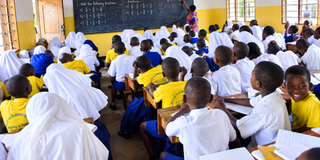
Dar es Salaam. Tanzania is entering a major test of its education system as nearly 1.17 million Standard Seven pupils begin their final primary examination today, setting the stage for a double cohort that will seek Form One places in 2028.
The 1,168,649 candidates sitting the Primary School Leaving Examination (PSLE) across 20,019 schools are the last single cohort to complete primary education under the existing structure.
From 2028, the situation will change. In 2027, both Standard Six and Standard Seven pupils will sit their final assessments. Standard Six pupils will be the first cohort to complete the six-year primary education cycle introduced under the Education and Training Policy, 2023 Edition, while Standard Seven pupils will be the last to complete the previous seven-year cycle. Both groups will then advance to secondary education in 2028, creating an unprecedented demand for Form One places.
Government projections put the number of pupils seeking Form One admission that year at 3,021,177, a surge linked to the large Standard One intakes of 2021 and 2022, which enrolled 1,549,279 and 1,581,823 pupils respectively. The numbers are forcing the government to look beyond public investment and towards the private sector as a critical partner in expanding the country's education infrastructure.
A huge infrastructure task
The scale of the preparations is substantial.
Prime Minister Mwigulu Nchemba has said Tanzania needs Sh1.77 trillion to prepare for the 2028 transition, including the construction of 23,226 classrooms, 46,632 toilet facilities and 9,366 laboratories, as well as the recruitment of 40,192 teachers.
Speaking during a working visit recently, Dr Nchemba also said, "We are talking about a need for more than 16,000 classrooms."
The urgency has also reached the highest level of government. President Samia Suluhu Hassan recently directed regional and local government leaders to make preparations for the 2028 Form One intake a priority. For the private sector, the message is clear: the government cannot meet the challenge alone.
Investors see opportunity, but with caution
The expected surge presents a potentially significant opportunity for investors in private education, particularly in the construction and operation of schools, classrooms, laboratories, hostels and other supporting facilities.
The government has already signalled its willingness to work with private investors.
The Deputy Permanent Secretary in the Ministry of Education, Science and Technology, Dr Hussein Omar, has called on private investors to join efforts to build the infrastructure required to accommodate the growing number of students.
Minister for Education, Science and Technology Adolf Mkenda has also introduced a Public-Private Partnership (PPP) framework intended to guide greater private-sector participation in education. But while the demand is attractive, investors say the 2028 opportunity must be approached carefully.
An investor in private schools, Mr Leonard Mmari, says the immediate demand should not blind investors to what happens after the double cohort passes through the system.
"After the double cohort in one year, 2028, schools will come back to normal and the number of students will reduce. Where will we get more students to fill the empty classrooms we built?" he asked.
His concern is about sustainability: investors who construct schools specifically for the 2028 peak could face excess capacity once enrolment returns to normal levels. Yet Mr Juma Abdi, another investor based in Dar es Salaam, sees the issue differently. "The opportunity is huge because every year the number of students from primary schools is increasing, so automatically more schools and classrooms will be required every year," he said.
For him, the double cohort should therefore be viewed as a trigger for long-term investment rather than a one-year business opportunity.
Turning a crisis into lasting capacity
An education expert, Mr Obed Mgura, also believes the opportunities outweigh the risks.
"The opportunities are huge compared to the caution because this will help the government to curb the problem of a lack of classrooms and desks for good," he said.
For years, shortages of classrooms, desks and other facilities have constrained access to quality education. The 2028 transition, despite its pressure, could therefore give Tanzania the impetus needed to address some of these deficits permanently.
But investors will need an enabling environment to make that possible.
The Tanzania Association of Managers and Owners of Non-Government Schools and Colleges (Tamongsco) has raised concerns over the tax burden facing private education providers, who it says are subjected to more than 10 different taxes, including property, land and corporate taxes.
“Reducing such barriers, while improving investment procedures, could make it easier for private providers to expand capacity,” said Mr Mmari.
The double cohort is therefore both a warning and an invitation.
For the government, it is a test of planning and preparedness. For investors, it is a sizeable market — but one that requires careful long-term thinking.