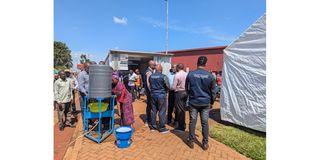
ECSA Health Community launches Ebola preparedness measures along DRC borders

Lusaka. The East, Central and Southern Africa Health Community (ECSA-HC) has launched a six-month cross-border emergency intervention at 33 priority points of entry (PoEs) along the Democratic Republic of Congo (DRC) border to prevent the spread of Ebola disease caused by the Bundibugyo virus (BDBV) to neighbouring countries.

The initiative targets high-risk transit countries, including Uganda, Rwanda, Burundi, South Sudan, Zambia, Tanzania, Kenya, Angola, Malawi and Mozambique, along 16 major trade and migration corridors.

Through the World Bank-funded Health Emergency Preparedness, Response and Resilience (HEPRR) programme, ECSA-HC is equipping frontline border health teams with digital surveillance systems, safe isolation protocols, rapid laboratory transport networks and cross-border notification systems.

The measures are intended to help detect and contain imported cases at land borders, river ports and airports.

According to data from the World Health Organisation (WHO) and Africa Centres for Disease Control and Prevention (Africa CDC), the outbreak has recorded 4,945 confirmed cases and 2,325 deaths, with a case fatality rate of 47 percent across 55 health zones in six provinces of the DRC.

At day 81 of reporting, case trajectories showed that the outbreak was nearly nine times larger than the 2014-16 West Africa Ebola outbreak and 18 times larger than the 2018-20 Zaire outbreak at the same stage, making it the second-largest and fastest-growing Ebola outbreak recorded.

ECSA-HC Director General Dr Ntuli Kapologwe said the regional response was necessary because disease outbreaks did not respect national borders.

“Today, ECSA-HC stands in profound solidarity with our brothers and sisters in the Democratic Republic of Congo and all affected communities,” Dr Kapologwe said.

“Pathogens do not respect national boundaries. As this outbreak expands, our defence systems must be as fluid and interconnected as the populations we serve.”

He said the World Bank funding under the HEPRR programme would enable ECSA-HC to deploy a standardised package at 33 key points of entry to ensure frontline teams could detect cases early, isolate patients safely and notify authorities rapidly.

Seven-point intervention package

The six-month intervention focuses on seven operational areas:

Baseline readiness assessments: Using standardised WHO point-of-entry evaluation tools to identify and address operational gaps.

Simulation exercises and contingency planning: Conducting cross-border drills to test referral systems and communication procedures.

Harmonised standard operating procedures: Aligning workflows involving port health, immigration, customs and transport operators for safe screening and referral.

Event-based surveillance: Training frontline personnel and community informants at transit hubs to identify early warning signals.

Digital surveillance and 21-day tracking: Linking electronic screening at border posts with district Rapid Response Teams for automated follow-up.

Safe border infection prevention and control (IPC) and water, sanitation and hygiene (WASH): Strengthening safe triage, hand hygiene, personal protective equipment compliance and decontamination.

Laboratory readiness and biosafety: Improving safe sample collection, triple packaging, rapid transportation and diagnostic links with reference laboratories.

Dr Mohamed Mohamed, Senior Medical Epidemiologist at ECSA-HC and coordinator of the HEPRR programme, said the intervention was designed to address gaps in preparedness along busy trade and migration routes.

“Cross-border Ebola risk is highest where people, goods and services move rapidly across connected corridors,” Dr Mohamed said.

“Our focus over these six months is operational readiness. We are harmonising SOPs so that a port health officer, a bus driver or a border agent knows exactly who to notify within minutes when a suspected case arrives.”

The operational rollout began in Lusaka, where technical teams are aligning cross-border protocols for critical corridors, including the high-volume Zambia-DRC crossings at Kasumbalesa and Sakania.

Dr Malungwe Kalaluka, a public health specialist responsible for simulation exercises in Zambia, said regional cooperation was critical in responding to public health emergencies.

“Alone, Zambia may be able to carry the load, but collectively, with our neighbouring countries, the load is lighter and the implications are less,” he said.

The World Bank-supported HEPRR programme will be rolled out in phases across 10 priority countries: Zambia, DRC, Uganda, Burundi, Rwanda, Tanzania, Kenya, Malawi, Mozambique and Angola.

Phase One will focus on the highest-risk corridors directly linked to areas with active transmission.