Dar es Salaam. For more than five decades, the bilateral relationship between Tanzania and China has been defined by major physical projects such as the Tanzania-Zambia Railway Authority (Tazara) and the Nyerere Bridge.
However, as the two countries mark 70 years of China-Africa diplomatic ties, the partnership is undergoing a strategic shift from ‘steel and concrete’ projects towards human capital development and ‘skills-to-skills’ exchanges.
The transformation was a central theme of the China-Tanzania Dialogue on Youth Development and Exchange held in Dar es Salaam on Wednesday, August 12, 2026.
Opening the dialogue, Chinese Ambassador to Tanzania Chen Mingjian said the future of the historic relationship now rests in the hands of the younger generation.
She said while landmark infrastructure projects had demonstrated the strength of the two countries’ solidarity, the next chapter of cooperation should place young people at its centre.
“Friendship between states lies in people-to-people exchanges, and people-to-people exchanges hinge on youth,” Ms Chen said, urging young Tanzanians to become ‘dream-chasers’ who align their personal development with national progress.
The government has welcomed the shift, saying the partnership must evolve to respond to a changing economic landscape.
Director of Technical and Vocational Education and Training at the Ministry of Education, Science and Technology, Dr Fredrick Salukele, said the strongest bridge between the two countries would increasingly be built through shared knowledge rather than physical structures.
He said the transition was essential as Tanzania implements education reforms that place greater emphasis on digital competencies.
Preparing for the AI revolution
A key component of the skills-based partnership is preparing the workforce for a rapidly changing global economy.
Dr Salukele warned that automation and emerging technologies were fundamentally reshaping employment, requiring education and training systems to keep pace.
“The world of work is changing rapidly because of Artificial Intelligence, automation and new technologies. Our education and training systems must be dynamic,” he said.
Tanzania is already benefiting from technological cooperation through initiatives such as the Huawei ICT Academy at the University of Dar es Salaam (UDSM), where students receive advanced training in 5G, cloud computing and cybersecurity.
The impact of the training was recently demonstrated when a student from the College of Information and Communication Technologies (CoICT) emerged first in Tanzania and across Africa in the Huawei ICT Competition.
The ‘Triple Helix’ model for job creation
To ensure that these skills translate into economic opportunities, academic leaders are proposing stronger collaboration among industry, universities and government.
CoICT Principal at UDSM, Prof Baraka Maiseli, advocated a ‘Triple Helix Model’, arguing that Tanzanian and Chinese youth should work together to address practical industrial challenges rather than focusing solely on academic research.
“We need industry to provide technology, real-world problems and jobs. We need universities to provide research, talent and innovation. And we need government to take prototypes to market and create the enabling environment,” said Prof Maiseli.
He drew on his experience as a former scholarship student in China, saying international education could transform individuals and contribute to national development.
Localising leadership
The dialogue also highlighted a shift in the operations of Chinese companies in Tanzania towards greater localisation.
Chairman of CRJE (East Africa) Ltd, Mr Jiang Yuntao, said developing local talent was now as important as building infrastructure.
He committed the company to ensuring that Tanzanian engineers, technicians and managers would take leadership of major projects currently managed by Chinese firms within the next decade.
Tanzanian engineer at CRJE, Mr Titus Lukuwi, exemplifies that ambition.
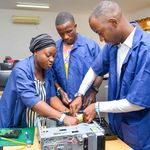
Having joined as a frontline worker in 2022, he rose through systematic mentorship to become a core technical staff member.
“When I was given my first assignment, I was afraid to say I don’t know. But CRJE gave me a welcoming environment. Senior engineers took time to train us on site,” said Mr Lukuwi.
He expressed hope that more Tanzanian engineers would soon acquire the capacity to independently deliver high-quality infrastructure projects.
‘Chinese masters, Tanzanian heritage’
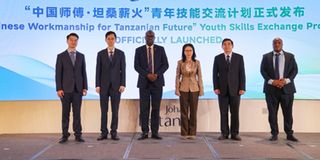
To sustain the talent pipeline, the dialogue launched the ‘Chinese Masters, Tanzanian Heritage’ Youth Skills Inheritance Programme.
The initiative seeks to transform previously scattered master-apprentice training arrangements into a standardised, long-term system.
Through formalised mentorship, the programme aims to create a steady pipeline of skilled young professionals to meet workforce demands in Tanzania’s expanding infrastructure and digital sectors.
Students welcomed the practical opportunities.
A third-year UDSM student, Mr Brian Samuel, said young people were being allowed to engage directly with ambassadors and business leaders on issues affecting their future.
“We don’t just want certificates. We want to build real projects, learn from engineers on site, and get certified in skills that companies actually need,” he said.
He said students were ready to harness technology to address challenges in sectors such as health and agriculture, signalling a new phase in Tanzania-China relations centred on skills, innovation and shared prosperity.
Register to begin your journey to our premium contentSubscribe for full access to premium content