How Mkapa built entities that stand the test of time
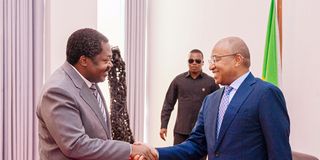
Vice President Emmanuel Nchimbi greets President of Zanzibar Hussein Ali Mwinyi upon his arrival at the Julius Nyerere International Convention Centre in Dar es Salaam yesterday to attend the Fourth Benjamin William Mkapa Legacy Conference. PHOTO | VPO
Dar es Salaam. The late President Benjamin Mkapa’s belief in building strong institutions rather than relying on individuals continues to shape Tanzania’s governance and development agenda, Vice-President Emmanuel Nchimbi said on Thursday July 15, 2026.
Speaking on behalf of President Samia Suluhu Hassan during the Benjamin William Mkapa Foundation’s (BMF) 20th anniversary celebrations and the Mkapa Legacy Summit in Dar es Salaam, Dr Nchimbi said the former president’s vision enabled institutions established during his tenure to remain effective long after he left office.
“Many of the institutions established during President Mkapa’s leadership continue to perform effectively today. The Benjamin William Mkapa Foundation is among the strongest examples of that lasting legacy,” he said.
Mr Mkapa, who served as president from 1995 to 2005, is widely credited with laying the foundations for Tanzania’s modern economy and public administration.
His administration introduced wide-ranging economic reforms that helped transform the country from a state-led economy into a market-oriented one, paving the way for Tanzania to attain lower-middle-income status in 2020.
His government also championed public-private sector dialogue through institutions such as the Tanzania National Business Council (TNBC) and strengthened the role of the Tanzania Chamber of Commerce, Industry and Agriculture (TCCIA), creating structured platforms for engagement between government and business.
Recognising the need for strong oversight as the economy liberalised, Mr Mkapa established several independent regulatory authorities to protect consumers and promote fair competition in newly privatised industries.
Apart from laying the background for the establishment of the Energy and Water Utilities Regulatory Authority, Mkapa also established the Tanzania Communications Regulatory Authority (TCRA), the Surface and Marine Transport Regulatory Authority (Sumatra), now the Land Transport Regulatory Authority (Latra) and the Tanzania Civil Aviation Authority (TCAA).
Together with institutions such as the Tanzania Revenue Authority (TRA) and the Tanzania Investment Centre (TIC), they helped strengthen governance, improve the business environment and enhance investor confidence.
The summit, held under the theme From Legacy to the Future: Youth-led Leadership, Health Systems and Human Capital, also marked six years since Mr Mkapa’s death.
Dr Nchimbi said the Benjamin William Mkapa Foundation was established to support the government’s response to HIV/AIDS before expanding its work to improve healthcare delivery in underserved communities, strengthen rural health services and construct housing for health workers in remote areas.
He said the Foundation has since become one of Tanzania’s leading institutions supporting health workforce development and strengthening the country’s health system.
“The Foundation has remained committed to finding practical solutions to health challenges while working closely with the government and development partners. Its contribution has gone beyond healthcare delivery to preparing future leaders in the health sector,” he said.
Dr Nchimbi urged African governments to invest more in developing young health professionals and building resilient health systems capable of responding to future public health emergencies.
He said leadership development should receive greater attention alongside clinical training, arguing that modern health systems require leaders with expertise beyond medicine.
“The health sector requires leaders who understand not only medicine but also the relationship between health, economics, politics, culture and the interaction between national and global health systems,” he said.
He said the Covid-19 pandemic underscored the need for stronger, better coordinated health systems capable of responding effectively to disease outbreaks.
Dr Nchimbi also called on governments to place young people at the centre of health sector reforms, saying they would shape the future of healthcare across the continent.
“There can be no prosperous future without young people. They are tomorrow’s health professionals, researchers and leaders. We must equip them with the skills, knowledge and opportunities they need to lead the transformation of Africa’s health systems,” he said.
He encouraged young professionals to embrace emerging technologies, including artificial intelligence, digital healthcare, data analytics and telemedicine, saying they would redefine healthcare delivery in the coming years.
Dr Nchimbi also proposed making the Mkapa Legacy Summit an annual continental platform for policy dialogue, innovation and knowledge sharing on health systems and workforce development, instead of holding it every two years.
Earlier, Zanzibar President Hussein Ali Mwinyi said Africa’s future health systems would depend on how well governments prepare young leaders today.
“As we reflect on President Mkapa’s legacy, we must ask ourselves one important question: how are we preparing Africa’s future health leaders? The answer lies in strengthening our health systems, investing in human capital and creating opportunities for young people to realise their full potential,” he said.
Dr Mwinyi praised the Benjamin William Mkapa Foundation for its two decades of partnership with the Revolutionary Government of Zanzibar, saying it has strengthened primary healthcare, developed the health workforce and improved community health services.
He also commended President Hassan for expanding healthcare infrastructure, increasing investment in health workers and advancing universal health coverage.
He said her appointment as the African Union Champion for Maternal, Newborn and Child Health reflects both her leadership and Tanzania’s commitment to improving the wellbeing of women, children and young people across the continent.
Register to begin your journey to our premium contentSubscribe for full access to premium content