Investors urged to employ local graduates for project sustainability
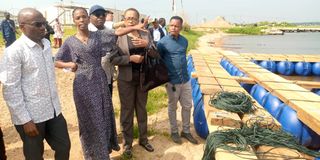
Deputy Minister in the President’s Office for Planning and Investment, Dr Pius Chaya, inspects the progress of a cage fish-farming project implemented by Rofi Farming in Magu District, Mwanza Region, during a regional tour on Tuesday, January 6, 2026. PHOTO | DAMIAN MASYENENE
Mwanza. The government has urged all investors in Tanzania to employ trained Tanzanian university graduates and skilled youths to ensure the sustainability of their projects.
Deputy Minister in the President’s Office for Planning and Investment, Dr Pius Chaya, said the move was crucial to prevent investments from failing or stagnating should investors withdraw.
Inspecting investment sites in Mwanza on Tuesday, January 6, 2026, Dr Chaya directed the Tanzania Investment Centre and the Special Economic Zones Authority (Tiseza) to supervise compliance, ensuring all registered investors employ Tanzanians with relevant skills.
He said these range from Form Four and Form Six leavers to holders of professional and university qualifications.
Dr Chaya visited Rofi Farming’s poultry, fish, and soybean oil processing plant, as well as Ziwa Steel’s facility in Magu District, which manufactures nails, rods, and wire.
Together, the factories have created more than 950 jobs, spanning skilled and unskilled roles in administration, accounting, production, and general labour.
“The government wants these investments to thrive. Without skilled personnel capable of understanding operations from foreign investors, it will be difficult to sustain the projects,” he said.
He emphasised that the ministry will monitor all investors registered with Tiseza to ensure they employ qualified young Tanzanians.
“Even if investors leave, we must have trained personnel capable of running these projects,” insisted Dr Chaya, adding.
“This applies to all investors across Tanzania. Here, degree holders are employed in law, administration, and accounting. In production, which drives growth, we expect people with formal training in relevant fields.”
Dr Chaya also noted that universities such as Sokoine University of Agriculture (Sua) and the University of Dar es Salaam (UDSM) offer training in disciplines such as fish farming.
He urged Tiseza to closely monitor compliance, noting that clear guidelines specify the number of skilled youths investors must employ.
Commending the two factories, including Ziwa Steel, whose investor is local, Dr Chaya said the combined investment was worth Sh84 billion.
He assured that the government will continue improving infrastructure, including roads, electricity, and water supply, to boost production and create more jobs.
“The government is committed to economic growth that generates productive employment. When investors create jobs for Tanzanians, we must support them. We cannot afford to see such projects stall,” he said.
Representing Rofi Farming, Mr Neziah Mussa highlighted challenges facing the company despite a Sh19 billion investment.
He said some raw materials, such as soybeans, are sold at between Sh2,200 and Sh2,500 per kilo, yet production capacity would allow purchases at Sh1,500.
“We need government support, including policy guidance and a network of fish farmers in the Lake Zone to secure stable markets. Delays in obtaining permits also hinder timely production,” said Mr Mussa.
Mr Philip Sylivanus of Ziwa Steel praised the government for improving the investment climate, which he said has attracted foreign clients.
He noted that the favourable environment enabled the company to secure a Sh30 billion contract to supply nails, rods, and wire for Rwanda’s Bugesera Airport.
Misungwi District Commissioner Ms Johari Samizi, speaking on behalf of the Mwanza Regional Commissioner, said the region is coordinating with the Southern Highlands, where most soybeans are produced, to ensure adequate raw materials for soybean oil processors.
She said factories were currently operating below capacity due to high raw material prices.
“Soybean supply remains a challenge. The region is already engaging in producing areas. I urge farmers across the country to seize this opportunity, as factories cannot operate efficiently without sufficient supply,” said Ms Samizi.
The directive underscores the importance of aligning investment with local capacity building.
By ensuring skilled Tanzanians are employed, the initiative aims to safeguard project continuity, expand employment, and strengthen the economy.