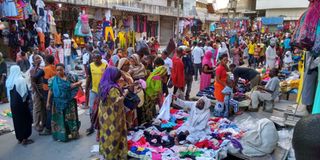
Dar es Salaam. Despite ongoing government operations to clear informal traders, popularly known as machinga, from unauthorised zones, several vendors have returned to Uhuru and Msimbazi roads, triggering fresh complaints from road users.
The persistent presence of street vendors on pedestrian walkways and road margins continues to pose a challenge to commuters, with some drivers claiming the resulting gridlock has forced them to alter their routes.
The initiative to clear Machinga from Kariakoo’s Uhuru and Msimbazi roads officially commenced on March 4, 2026, spearheaded by the Dar es Salaam City Council alongside the city auxiliary police and the Police Force.
The operation was executed following a directive issued on February 17, 2026, aimed at restoring order along major transport corridors, specifically targeting illegal trading on road reserves, footpaths, and other areas posing safety hazards to the public.
However, months into the exercise, traders continue setting up informal stalls along the edges of these major thoroughfares.
Speaking to The Citizen’s sister newspaper on Sunday, August 2, 2026, Kariakoo Machinga Chairman, Mr Stephen Lusinde, attributed the enforcement challenges to unfulfilled obligations by responsible parties during the initial relocation process.
He stated that vendor leadership fulfilled its mandate by mobilising traders to vacate road reserves for designated markets.
“We agreed that each party fulfils its obligations. We undertook the responsibility of maintaining internal order, ensuring traders moved inside designated areas safely and conducted business in compliance with government directives,” said Mr Lusinde.
He emphasised that local executive authorities must account for enforcement lapses in unallocated areas outside his jurisdiction.
“Whether the operation succeeded or stalled is a question for local executives, the City Director, and area supervisors. They are best placed to assess where the process hit a snag,” he added, insisting his mandate remains strictly confined to managed market grounds.
Continuous enforcement
Addressing the situation, Ilala District Commissioner (DC), Mr Edward Mpogolo, described the removal of Machinga as an ongoing exercise, noting that cleared vendors frequently return to prohibited spots.
He likened the enforcement effort to daily police patrols required to maintain public order.
“This is a continuous exercise because traders return after being cleared. Just as the police maintain daily security, supervising and organising traders requires constant enforcement,” stated Mr Mpogolo.
Public outcry over congestion
Despite government assurances, road users in Kariakoo insist that the situation remains a major public nuisance, as vendors continue to block designated pedestrian footpaths.
Consequently, motorists are reportedly bypassing standard traffic lanes and encroaching onto Bus Rapid Transit (BRT) lanes to avoid congestion caused by pedestrians forced onto the main roadway.
A minibus driver, Mr Seif Mohamed, operating the Kigamboni–Muhimbili route, noted that drivers regularly alter routes to avoid congestion along feeder roads.
“These traders have created a serious nuisance by blocking footpaths. Pedestrians are forced onto the carriageway, exposing them to traffic hazards,” said Mr Mohamed.
A resident of Mbagala, Ms Nice Salum, lamented that walking through Kariakoo has become increasingly treacherous.
“I avoid Kariakoo due to the chaotic mix of vehicles, motorcycles, and auto-rickshaws operating dangerously close to pedestrians. Traders have completely blocked footpaths with their wares,” observed Ms Salum.
Designated markets overwhelmed
A street vendor on Msimbazi and Narung’ombe streets, Ms Hawa Ally, stated that designated market areas are overcrowded, leaving hawkers without permanent stalls no choice but to trade on streets.
“The designated streets are fully occupied by traders with permanent tables. Those of us displaying goods on the ground or hawking by hand are forced onto the roads to target passers-by,” she explained.
She urged the government to expand designated market infrastructure to provide all traders with viable, legal trading spaces.