Mother recounts her son’s costly dialysis ordeal, ending in burial
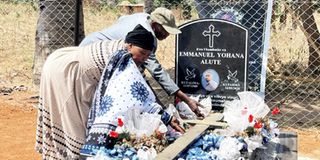
Christina Hamis (69) with her husband, Yohana Alute, at the grave of their son, Emmanuel Alute, who died on May 16 this year while undergoing dialysis treatment at Benjamin Mkapa Hospital in Dodoma. PHOTO | HERIETH MAKWETTA
Singida. Inside Makiungu Hospital in Ikungi District, Singida Region, a middle-aged woman sits quietly on a bench in the outpatient department.
Dressed in a black headscarf and a white khanga, Christina Hamis, 69, looks exhausted. Her eyes are heavy with grief and her hands are clasped tightly, as if holding back tears.
“I have come to be treated for high blood pressure,” she says softly.
But as the conversation unfolds, it becomes clear that Christina’s pain cannot be measured by any hospital machine.
“My blood pressure problems started after I buried my son,” she says, tears rolling down her cheeks.
A few months earlier, Christina had buried her 35-year-old son, Emmanuel Alute, who died on May 16, 2026, at Benjamin Mkapa Hospital (BMH) in Dodoma after battling chronic kidney disease and undergoing dialysis for more than two years.
For Christina, her son’s death was not only the loss of a child. It was the culmination of years of financial hardship that left the family stripped of almost everything it owned.
She believes the story might have been different had specialised kidney services been available closer to home.
“If Singida Regional Referral Hospital had these services earlier, we would not have spent two years living in Dodoma as strangers, buying water and food,” she says.
“We sold everything. Perhaps my son would still be alive.”
The cost of staying alive
Every trip from Singida to Dodoma added another financial burden to a family already struggling to cope. “A poor person suffers twice. First from the disease, and secondly from the cost of treatment,” Christina says. For more than two years, Emmanuel underwent dialysis at BMH. At one point, the family paid Sh750,000 a week for the treatment before the cost later fell.
That was only the beginning.
There were transport costs, food, water, rent, medicines, blood transfusions and medical tests. Christina rented a room in Ujasi Ng’ombe and took her son to hospital every Monday, Wednesday and Friday.
“A bajaji cost us Sh4,000 a day to take him to and from hospital. I woke up thinking about dialysis and went to bed wondering where I would get money for the following week,” she says.
Even after taking out health insurance on the advice of doctors, Christina says the family continued to meet substantial costs.
She began selling one asset after another.
“I sold everything. Farms, cattle, a small building. Even the house I was constructing had to be abandoned. As you can see, it is still unfinished. Today, I have nothing.”
It started with a mining accident
Emmanuel’s kidney disease was not where his health problems began.
In 2014, while working as a small-scale gold miner in Ikungi, he was buried by rocks at a mine, suffering a serious back injury near his kidneys.
His father, Yohana Alute, says the family first rushed him to Puma Hospital before he was transferred to Mtimaru and later to Kilimanjaro Christian Medical Centre (KCMC) in Moshi, where he received treatment for almost a year.
“When he returned home, he was walking with crutches and later with a walking stick. Gradually, he became independent again,” Yohana recalls.
But the treatment had already drained the family’s resources.
“I sold many cattle to pay for his treatment. I thought we had overcome the problem,” he says.
Towards the end of 2023, however, Emmanuel began suffering severe chest pain and difficulty breathing.
His family took him to Makiungu Hospital, where he was referred to the Dodoma Regional Referral Hospital.
“We left Makiungu in an ambulance while he was struggling to breathe. Even the doctor was not sure he would arrive alive,” his father says.
He survived the journey, but it marked the beginning of another, more expensive battle.
Two years in Dodoma
Christina says her life effectively moved to Dodoma as she accompanied her son for treatment. For the first 10 days, Emmanuel was admitted to the intensive care unit, with costs mounting by the day. After leaving the ICU, he began dialysis three times a week.
“I rented a room in Ujasi Ng’ombe. Every Monday, Wednesday and Friday, I took him for dialysis.”
The family initially paid Sh750,000 every week for dialysis. Relatives and Emmanuel’s siblings helped in the early months, but their support gradually dried up.
“At first, they called every day. Later, they stopped answering their phones. People were tired,” Christina says. She does not blame them. “Everyone has their own life. But the burden remained on my shoulders. It was just me and my son.”
The final days
In May 2026, Christina’s health insurance expired. She says the hospital required her to resume paying the cost of dialysis, which had become unaffordable. “I told them I had nothing left. I had sold everything I owned.”
She says she asked hospital officials for help and was given a short period to raise the money.
Christina returned to Singida to look for anything she could sell. While she was away, Emmanuel remained alone in the rented room. On the night of May 15, she received a call informing her that his condition had deteriorated. She returned to Dodoma the following morning.
“When I saw him, he started calling me: ‘Mama, I am dying. Pray for me,’” she recalls.
Christina knelt beside his bed and began praying.
“When I opened my eyes, he was snoring. A few minutes later, he was dead.” She broke down as she recalled the moment, before describing how she began the journey home with her son’s body.
Hospital response
BMH executive director Prof Abel Makubi says he was not aware of the circumstances described by Christina.
“I have never received this information as a cause of death or that the patient died because he failed to pay for dialysis,” he says.
He says the hospital operates within Ministry of Health guidelines that allow patients who cannot afford treatment to be assessed for exemption from medical costs.
“An individual who cannot afford the costs is given an opportunity to undergo an assessment to establish their financial circumstances and determine whether they qualify for an exemption,” Prof Makubi says. Once approved, the patient receives an exemption certificate and continues receiving treatment. He says the process can take between one and three days, depending on the assessment. According to Prof Makubi, BMH waives medical costs amounting to about Sh400 million every month, covering medicines, tests and surgical services.
A family left counting its losses
For the Alute family, the financial cost of Emmanuel’s illness remains visible.
His father says more than 25 cattle were sold to finance his treatment. The house he had been building remains unfinished. The livestock is gone and the family’s finances have collapsed. “But even after selling all those things, we could not save him,” Yohana says.
The family considered moving Emmanuel back to Makiungu after dialysis services became available there, but Christina says the costs involved made it difficult to restart his treatment closer to home.
“We decided to remain in Dodoma until the end,” she says.
Back in Muhintiri village, Emmanuel is remembered not only as a miner but as a young man who helped others.
Residents say he gave other young people opportunities to work at his mining site and once helped several people after finding a stone worth Sh70 million.
“He was the goalkeeper for the village football team. He was a young man who was loved,” one villager says. After his death, villagers, friends and fellow miners contributed towards his funeral expenses.
“He had no enemies. He was a man of the people,” Christina says.
The pain that remains
Today, Christina is the patient at Makiungu Hospital. She says she developed high blood pressure after losing her son and now suffers persistent headache and impaired vision in one eye.
“The pain never goes away. Whenever I remember him saying, ‘Mama, I am dying, pray for me,’ the pain starts all over again.”
She remembers how Emmanuel would emerge from the dialysis machine exhausted after about five hours of treatment.
Christina now wants her experience to serve as a warning and a lesson.“I do not want another mother to sell everything she owns, spend two years sleeping in hospitals and finally return home carrying her son’s coffin.”
She falls silent for a few seconds. “I lost my child. But I do not want another family to go through what I went through.”
Register to begin your journey to our premium contentSubscribe for full access to premium content