Muhimbili University partners with Singapore’s top medical school to boost Tanzania's healthcare
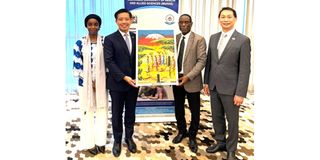
MUHAS Vice Chancellor, Prof Apollinary Kamuhabwa (right), and Singapore’s Minister of State for National Development, Mr Alvin Tan (left), pose for a group photograph shortly after the signing of a Memorandum of Understanding on strategic cooperation. Also in the picture are the High Commissioner of Singapore to the United Republic of Tanzania, Mr Douglas Foo (second right), and MUHAS Head of the Internationalisation and Convocation Unit, Dr Maryam Amour (far left). PHOTO | COURTESY.
Dar es Salaam. Tanzania’s goal to strengthen medical education, accelerate health research and expand access to specialised care have received a major boost following a new partnership between the Muhimbili University of Health and Allied Sciences (MUHAS) and the National University of Singapore (NUS), through its Duke-NUS Medical School.
The agreement is expected to directly enhance specialist training, advance cutting-edge research and support innovation in priority health areas such as sickle cell disease, infectious diseases and digital health—positioning Tanzania more firmly within the global medical research and innovation ecosystem.
In a media statement shared on June 19, 2026, the collaboration focuses on advancing medical education, joint research, clinical training, and innovation, with priority areas including infectious diseases, non-communicable diseases, digital health, precision medicine and health systems strengthening.
This comes when published reports show that Singapore’s reputation in biomedical sciences is widely recognized and thus, an opportunity for Tanzania.
Over the past two decades, the country has built a strong innovation ecosystem anchored by Duke-NUS, which is known for translational medicine, genomics research, and cutting-edge clinical applications.
The institution has been central in developing precision medicine models and integrating artificial intelligence into healthcare delivery systems.
Health experts say this makes the partnership particularly significant for Tanzania.
Speaking on the development, MUHAS Vice Chancellor, Prof Apollinary Kamuhabwa, said the collaboration reflects Tanzania’s long-term ambition to strengthen its role in global health research and medical training.
“This partnership opens a new chapter for MUHAS. It connects us to one of the world’s most advanced medical education ecosystems and gives our students and researchers exposure to cutting-edge science, innovation, and clinical practice,” said Prof Kamuhabwa.
He added that MUHAS aims to leverage the partnership to strengthen specialist training and expand research output that directly responds to Tanzania’s health priorities.
One of the most promising areas under the partnership is sickle cell disease, which remains a major public health challenge in Tanzania and across sub-Saharan Africa.
Health records show that thousands of children are born with the condition annually in the region, placing pressure on families and health systems due to limited access to advanced treatment and long-term care.
The collaboration is expected to explore advanced therapeutic approaches, including gene therapy, early diagnosis tools, and improved clinical management systems.
A Tanzanian public health specialist who follows haemoglobin disorders, Mr Amir Mbwambo, noted that the partnership could shift the country’s approach from management to innovation-driven solutions.
“For decades, sickle cell disease has been treated as a lifelong condition requiring supportive care. What MUHAS is entering into with Duke-NUS could change that narrative by opening pathways for curative research, including gene-based therapies and early intervention models,” the expert said.
He added that the biggest opportunity lies in building local capacity so that Tanzanian researchers can participate directly in global clinical trials and biomedical innovation.
Beyond sickle cell disease, the partnership is expected to strengthen Tanzania’s health systems research capacity at a time when the country is expanding specialist services and investing in medical education.
Mr Mbwambo said the collaboration is timely given rising demand for specialised care.
“Tanzania’s health system is under pressure from both communicable and non-communicable diseases. Partnerships like this bring not only knowledge transfer but also systems thinking, which is critical for improving efficiency, diagnostics, and service delivery,” he explained.
He noted that Singapore’s experience in integrating digital health records and precision diagnostics could provide valuable lessons for Tanzania as it modernises its healthcare infrastructure.
Academic diplomacy and Tanzania’s global positioning
The MUHAS–NUS agreement also reflects a broader trend of academic diplomacy, where universities play a central role in shaping international relations through science and education partnerships.
According to recent global education cooperation reports, cross-border university collaborations significantly improve research output, innovation capacity, and human capital development in low- and middle-income countries.
In Africa, such partnerships are increasingly viewed as essential for building resilient health systems and reducing dependence on external expertise.
Prof Kamuhabwa emphasised that the partnership aligns with Tanzania’s vision of becoming a regional centre of excellence in medical training and biomedical research.
“This is not just a bilateral agreement. It is a strategic investment in the future of healthcare in Tanzania and the wider region,” he said.
As Tanzania continues to strengthen its health sector, the MUHAS–NUS partnership is expected to deliver long-term benefits in training, research output, and innovation-driven healthcare solutions.
Register to begin your journey to our premium contentSubscribe for full access to premium content