Nchimbi’s shock exit: What it means for CCM, the country
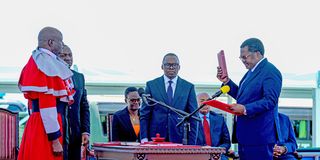
Dr Emmanuel John Nchimbi takes the oath of office as Vice President of the United Republic of Tanzania before Chief Justice George Masaju during a ceremony held at the Parade Ground, Chamwino State House in Dodoma on November 3, 2025. PHOTO | FILE
Dar es Salaam. The resignation of Vice President Dr Emmanuel Nchimbi has added a new and unexpected chapter to a political career marked by a steady rise through the ranks of CCM, major political setbacks and a subsequent return to the centre of national leadership.
Regarded by his admirers as one of the ruling party’s most astute political minds, Dr Nchimbi’s decision to step down is likely to renew questions about the circumstances behind his departure, with some analysts suggesting that it could point to deeper differences within the political establishment.
In the resignation letter he sent to President Samia Suluhu Hassan yesterday, Dr Nchimbi said he had decided to retire from politics and public service.
The resignation comes hot on the heels of statements he made in recent months that have attracted attention and raised questions about his relationship with other members of the political establishment.
Controversy
On July 24, 2026, while speaking at the Tanzania Human Rights Defenders Coalition General Assembly in Dar es Salaam, Dr Nchimbi urged Tanzanians to continue pushing for a new Constitution, describing it as the foundation for wider governance reforms and stronger protection of citizens’ rights.
“If I were asked as the Vice President to tell Tanzanians only one thing, I would say: fight to get a new Constitution,” he said.
He called for a Constitution based on agreement among stakeholders and national consensus, saying Tanzania needed a document that could guide the country for the next 50 years.
“When you listen to many people’s demands, you must choose the single major thing that can carry everything in the country. It is the Constitution,” he said.
Dr Nchimbi also said Tanzania had “a genuine opportunity to secure a new Constitution before 2030”, adding that President Hassan had the political will to advance the agenda.
Although President Hassan did not publicly comment on the remarks, they drew criticism from some CCM leaders, who argued that the party already had an established process on the matter and that constitutional reform was included in its election manifesto.
The remarks prompted CCM National Parents’ Wing chairman Fadhili Maganya to question why Dr Nchimbi wanted Tanzanians to fight.
Justice and peace
At the same July 24 event, Dr Nchimbi said political disagreement should not automatically be interpreted as betrayal.
“For gentlemen, there is agreeing to disagree. We can reach a point where we do not agree and have completely different views on how to lead the country or manage affairs, but that is not a sin and should not be treated as betrayal,” he said.
He also argued that Tanzania could not achieve lasting peace without justice, saying the two should not be treated as competing principles.
“It is impossible for a peace defender to be an enemy of justice, or a justice defender to be an enemy of peace. We must avoid that perception,” he said.
Dr Nchimbi said Tanzania needed to build a society where every citizen felt safe, valued and able to contribute to national development regardless of political beliefs, religion or ethnicity.
Pray for the President
On February 6, Dr Nchimbi made another statement that attracted considerable attention.
Speaking during the installation of the fifth national leadership of the Tanzania Council of Pentecostal Churches in Dar es Salaam, he urged religious leaders and Tanzanians to pray for President Hassan, particularly for wisdom and protection from people who could mislead her.
He asked them to pray that the President would be able to identify people he described as troublemakers, schemers, liars, thieves and untrustworthy individuals.
“Let us also pray that God shuts the gates of State House to wrongdoers,” he said.
The remarks prompted questions about who the Vice President was referring to when he spoke of wrongdoers and those who should be denied access to State House.
Competitor for the throne?
On August 9, 2025, during preparations for the CCM election campaign, he told President Hassan that he was ready to serve as her assistant rather than her competitor.
“I have fully prepared myself to be your assistant, not your competitor,” Dr Nchimbi told President Hassan.
Although the statement appeared straightforward, it raised questions about whether there were concerns over whether he would support or compete with President Hassan after the election.
Letter to the President
Dr Nchimbi announced his resignation through his Instagram page, which had not posted anything since March 8, 2023.
The letter said he had written to President Hassan informing her that he had decided to retire from politics and public service.
His resignation will take effect on September 4, 2026. He cited Article 50(2)(c), read together with Article 149(2) of the Constitution of the United Republic of Tanzania, as the basis for leaving office.
“Today, August 25, 2026, I wrote a letter to the President of the United Republic of Tanzania, Samia Suluhu Hassan, informing her that I have decided to retire from politics and public service,” Dr Nchimbi said.
He linked the decision to a commitment he said he made to President Hassan on August 27, 2025, when he pledged to serve her and the country faithfully.
“I also assured her that whenever she sees the need for another Vice President, I will vacate the position. I am fully satisfied, without any doubt, that Her Excellency the President desires change, and thus I have decided to fulfil my promise,” he said.
Rise through CCM
Born on December 24, 1971, in Mbeya Region, Dr Nchimbi grew up in a family associated with public service and CCM.
His father, John Nchimbi, was a police officer who rose to the rank of Assistant Commissioner of Police and served as Regional Police Commander for Mtwara. He also held senior positions within CCM.
Dr Nchimbi attended Oysterbay Primary School in Dar es Salaam before studying at Uru and Sangu secondary schools and later Forest Hill Secondary School.
He went on to study at the Institute of Development Management, now Mzumbe University, where he obtained an Advanced Diploma in Public Administration. He later pursued a master’s degree in banking and finance and eventually a doctorate.
He worked at the National Environment Management Council before entering senior government administration and electoral politics.
His political rise within CCM began in the 1990s. He became a member of the party’s National Executive Committee and was elected chairman of the party’s youth wing, in 1998.
In 2005, he won the Songea Urban parliamentary seat, defeating Chadema’s Edson Mbogoro with 67.6 percent of the vote.
In January 2006, then-President Jakaya Kikwete appointed him Deputy Minister for Information, Culture and Sports.
He subsequently served as Deputy Minister for Labour, Employment and Youth Development and Deputy Minister for Defence and National Service.
After retaining his parliamentary seat in the 2010 General Election, Dr Nchimbi was appointed Minister for Information, Culture and Sports and later moved to the Ministry of Home Affairs in 2012.
His ministerial career ended in December 2013 when he resigned amid political pressure following controversy surrounding Operation Tokomeza, an anti-poaching operation criticised over its implementation and human rights abuse.
The 2015 political storm
The most significant setback of Dr Nchimbi’s political career came two years later. In 2015, he was among CCM politicians who supported former Prime Minister Edward Lowassa’s bid to become the party’s presidential candidate.
When Mr Lowassa’s name was dropped during the party’s nomination process, Dr Nchimbi, together with Sophia Simba and Adam Kimbisa, publicly questioned the integrity of the process.
Speaking to journalists after a Central Committee meeting, he said: “Today, in our meeting, we did not receive all the names of the nominees, something that does not augur well for the party procedures.” John Magufuli was eventually selected as CCM’s presidential candidate and went on to win the election.
Dr Nchimbi remained within CCM despite the disagreement. He later called for unity, saying he had no bitterness over what had happened in Dodoma and that the party should move beyond factions and concentrate on winning the election.
Diplomatic mission and political comeback
In 2016, President Magufuli appointed Dr Nchimbi Tanzania’s ambassador to Brazil.
In 2022, he was transferred from Brazil and appointed ambassador to Egypt. He returned to Tanzania in 2023, just as his four-year restriction within CCM ended.
His political rehabilitation became unmistakable in January 2024 when CCM appointed him Secretary-General, replacing Daniel Chongolo, who had resigned in November 2023. The appointment placed him at the centre of the party’s preparations for the 2024 local government elections and the 2025 General Election.
His leadership of CCM was publicly characterised by an emphasis on political competition without hostility.
“Multiparty politics is not a quarrel. We should not stop greeting one another and encouraging each other because we are all Tanzanians; let us compete through ideas,” he said.
On another occasion, he urged political actors to “compete without fighting,” saying this would support President Hassan’s agenda of reconciliation and national unity.
At the same time, Dr Nchimbi remained a committed CCM strategist. During the 2024 local government elections, he urged party members to campaign door-to-door and mobilise votes for CCM.
From CCM SG to Vice President
On January 19, 2025, President Hassan picked Dr Nchimbi as her running mate for the General Election.
Following CCM’s victory in the October 29 General Election, he was sworn in as Vice President on November 3, 2025.
It was the highest constitutional position he had held and the culmination of a political recovery from the difficulties he had experienced a decade earlier.
The exit
Against that backdrop, Dr Nchimbi’s resignation on Tuesday closes a political journey marked by both confrontation and reconciliation.
He thanked President Hassan and CCM for the confidence placed in him and Tanzanians for their cooperation throughout his public service career.
“I specifically thank Her Excellency the President and Chama Cha Mapinduzi (CCM) for their trust in me,” he said.
“I also take this opportunity to thank all Tanzanians for the great cooperation they gave me throughout my time in public service. I assure you that I will continue to be a good citizen of Tanzania.”
His resignation will take effect on September 4, ending a Vice Presidential tenure of less than a year.
Bitter rivalry or 2030 strategy?
University of Dar es Salaam political analyst, Salbinus David, said the resignation had shocked many Tanzanians, with different interpretations emerging over its possible causes.
He said some believed the move reflected disagreements between Dr Nchimbi and President Hassan, while others linked it to political calculations ahead of 2030, particularly because Dr Nchimbi had previously been mentioned as a potential presidential contender.
“The truth will remain with Nchimbi in his heart because it is difficult to say what the real reason is. But what is visible from the outside is this: the decision does not appear to have been made suddenly, which is why speculation about it had been going on for a long time before it happened,” Mr David said.
Political analyst Dr Baraka Mfinanga said the resignation was significant because the Vice Presidency is the country’s second-highest constitutional office.
“For CCM, this can be interpreted in two ways. Some will see it as a sign of party discipline, where a leader voluntarily steps aside.
“Others will see it as raising questions about the real reasons for a leadership change so soon after the General Election,” he said.
He said the appointment of Dr Nchimbi’s successor would send an important message about the administration’s political, geographical and strategic direction for the remainder of President Hassan’s term.
Dr Lazaro Swai, a lecturer in governance at Tumaini University Dar es Salaam, said he viewed the resignation primarily as a political development carrying a wider message.
Given that Dr Nchimbi had been President Hassan’s running mate in the 2025 election, Dr Swai said, his departure less than a year after being sworn in was unusual in Tanzania’s political history and would intensify debate.
“Eyes will now be on the person who will be appointed. The Vice Presidency is often used to build political balance, strengthen the party’s influence in particular areas or create an environment for implementing a new government agenda,” he said.
For citizens and investors, Dr Swai said the most important issue would be continuity of policies and institutional stability.
He said that if the process of appointing a successor was handled calmly, the resignation could remain an ordinary leadership change rather than become a source of uncertainty.
Picking Dr Nchimbi’s successor
According to the Constitution of the United Republic of Tanzania, when the Vice President of Tanzania resigns, the President must appoint a replacement within 14 days and the National Assembly must approve the nominee by a majority vote.
Under Article 50(2)(c) of the Constitution of the United Republic of Tanzania, the Vice President may vacate office through resignation submitted to the President. Under Article 50(4) (read with other provisions like Article 149(2)), the President must choose a new person for the position as soon as possible, within 14 days of the vacancy occurring.
The name of the person chosen by the President must go to the National Assembly (Parliament). Members of Parliament must vote on the choice. A majority vote is required to approve the new Vice President. Once Parliament approves the nominee, the new Vice President must take the official oath of office before starting work.
Register to begin your journey to our premium contentSubscribe for full access to premium content