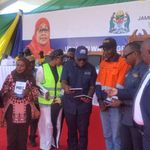
Minerals Minister Anthony Mavunde inside an exploration helicopter during the launch of the ìA Better Tomorrowî programme for the mining sector on Tuesday. During the event, he also launched Barrickís exploration helicopter, which will provide small-scale miners in Nyamongo with access to exploration services. PHOTO | COURTESY
Nyamongo. The Government has launched the Mining for a Brighter Tomorrow (MBT) programme to expand opportunities for youth, women and people with disabilities in small-scale mining by providing access to prospective mineral areas, geological information and licences.
Minerals Minister Anthony Mavunde launched the programme in Nyamongo, Tarime District, on Tuesday alongside Barrick Gold Corporation’s launch of a high-resolution airborne geophysical survey aimed at identifying mineral deposits in areas set aside for small-scale miners.
The initiative is part of President Hassan’s directive to allocate 10 percent of revenue collected from the mining sector to detailed mineral exploration across the country.
Mr Mavunde said the Government wanted to shift small-scale mining from speculative excavation towards scientifically guided operations backed by geological data and modern technology.
“Today we are beginning a journey of great success. The youth of Nyamongo are starting mineral extraction with greater certainty after Barrick agreed to provide its helicopter for professional exploration in their areas,” he said.
The Minister said Barrick would conduct an airborne survey covering about 6,000 square kilometres, using modern technology to collect detailed information on underground rock formations while reducing environmental impacts.
He directed the Commissioner for Minerals to work with the Geological Survey of Tanzania (GST), State Mining Corporation (STAMICO) and Barrick to ensure drilling equipment is deployed immediately after the airborne survey to investigate promising targets.
Mr Mavunde said GST had completed mineral mapping covering 97 percent of the country, while detailed geological and structural surveys had covered only 16 percent, underscoring the need for greater investment in technology and scientific exploration.
He said the MBT programme was intended to increase the participation of women, youth and people with disabilities in mining by ensuring they receive suitable areas and faster access to licences.
Barrick Tanzania Country Manager Dr Melkiory Ngido said the company had participated in the programme from its early stages, including returning exploration licences to the Government for allocation to small-scale miners.
“North Mara has returned 50 exploration licences to nearly 2,000 young people,” Dr Ngido said.
He said Barrick had also agreed to return areas that did not meet the requirements for large-scale investment so they could be allocated to small-scale miners.
Dr Ngido said modern exploration technology would strengthen the implementation of Tanzania’s mining policy by improving knowledge of mineral resources, increasing the sector’s contribution to the economy and expanding the value chain.
“North Mara and Bulyanhulu are among the largest taxpayers in the country and the mines leading in dividends paid to the Government,” he said.
Barrick operates North Mara and Bulyanhulu mines, as well as Buzwagi, which is at the closure stage, in partnership with the Government through Twiga Minerals.
Barrick Director of Exploration and Mining Licence Management Genes Mkumbo said the company currently held about 4,900 square kilometres of exploration licences in Tanzania.
He said the airborne survey would provide detailed information on the area’s geology and establish a strong basis for subsequent exploration aimed at identifying new gold deposits.
Chairperson of the Parliamentary Standing Committee on Energy and Minerals Subira Mgalu commended Barrick for introducing the technology, saying the resulting geological information could create more opportunities and boost economic activity.
Mara Regional Commissioner Brigadier General Evans Mtambi said access to reliable geological data would enable small-scale miners to adopt more scientific methods, reduce unnecessary costs and improve productivity.
Tarime Rural MP Mwita Waitara thanked the Government and Barrick for supporting development initiatives, including the allocation of mining licences to youth groups in the area.
FEMATA Vice-President Victor Tesha said although progress was being made, young miners still needed better exploration equipment and safer mining technologies.
The launch was attended by senior Government officials, including STAMICO Board Chairman and Kigoma Regional Commissioner Simon Sirro, Tarime District Commissioner Major Edward Gowele and Barrick North Mara General Manager Apolinary Lyambiko.
Register to begin your journey to our premium contentSubscribe for full access to premium content