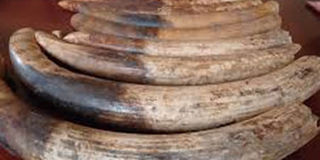
Three people caught transporting the 58 elephant tusks to Dar es Salaam are in custody. Twenty nine elephants were killed for those tusks, which weighed 130 kilogrammes.
What you need to know:
Three people caught transporting the 58 elephant tusks to Dar es Salaam are in custody. Twenty nine elephants were killed for those tusks, which weighed 130 kilogrammes.
Mtwara. Police here have intercepted an ivory haul worth Sh700 million. The breakthrough came on the same day a major anti-poaching conference was closing in the United Kingdom--a meeting at which Tanzania came under fire for its declining elephant numbers.
Three people caught transporting the 58 elephant tusks to Dar es Salaam are in custody. Twenty nine elephants were killed for those tusks, which weighed 130 kilogrammes.
Briefing journalists, Acting Regional Police Commander Maisha Maganga said the accused were arrested yesterday at around 5am at a roadblock in Chungu village on the Mtambaswala-Mangaka highway. The Tanzanian citizens were driving a Toyota Land Cruiser to Dar es Salaam at the time. The police chief said a tip-off helped nab them.
The accused hid the tusks in an improvised fuel tank under the back seat of the car that belongs to another Dar es Salaam resident. The police thanked the good citizens who tipped them about the contraband and pleaded for more co-operation. Mtr Maganga said: “We ask people to collaborate with us by unearthing all those who are killing our elephants. It is our responsibility to protect our natural resources. This arrest wouldn’t have been possible without the help of civilians and we ask them to help us more and more.”
The suspects are aged between 29 and 36.
At the London meeting, President Kikwete declared that poaching had risen dramatically and it was hard to battle the gangs. Still, he added, his government would do everything in its power to stop it. In an interview with CNN, the President described the bloody trade as “madness and a very serious matter” and called for joint efforts to end it.
Asked whether Tanzania would continue pushing for the sale of the more than 100 tonnes of its ivory stockpile, President Kikwete said the government had backed down and would contemplate destroying the ivory to send a strong message that it was determined to win the war.
Elephants are increasingly under threat and such a move would be seen as a good part of the global campaign against the ivory trade.
At Independence in 1961, the number of elephants in Tanganyika stood at around 350,000. That has dropped to around 65,000 only. Last year recorded some of the worst statistics, and experts estimate that 30 elephants were killed daily--which works out to nearly 11,000 a year.
Prior to the London meeting attended by delegates from some 50 countries to discuss how to choke world demand of ivory, Tanzania was in the spotlight for allegedly doing very little to contain poachers. President Kikwete and Minister for Natural Resources and Tourism Lazaro Nyalandu responded angrily to a report in the UK’s Mail on Sunday that accused the government of protecting poachers in high places.
Mr Kikwete reported that the government was finalising plans for the second round of operation Tokomeza, which is a military-backed offensive against poachers.
On Friday, more than 40 countries--including China and African states--signed a declaration aimed at stamping out the illegal trade in wildlife.
The London Declaration urges practical steps to end the illegal trade in rhino horn, tiger parts and elephant tusks that contribute to criminal activity worth more than $19 billion each year.
Mr Nyalandu told the conference that about 19.7 tonnes of elephant tusks were intercepted in Tanzania in three years. As at the end of last year, 320 suspects from China, Europe and Africa, including Tanzania, had been arrested and prosecuted in connection with poaching.
According to last September UN Office on Drugs and Crime report, 37 per cent of the illicit ivory consignments seized globally between 2009 and 2011 originated from Tanzania. Kenya came in second with 27 per cent of the consignments.
The stock referred to in the report comprised seizures of 800 kilogrammes and more.