Dar es Salaam. Political parties, religious leaders, diplomats, civil society representatives and other stakeholders have called for dialogue, stronger institutions and political reforms as Tanzania seeks common ground on how to strengthen democracy and prevent a repeat of the divisions and violence witnessed during and after the 2025 General Election.
The call emerged at the Tanzania Centre for Democracy (TCD) National Conference in Dar es Salaam, on Monday, September 7, 2026, where participants broadly agreed that the country’s democratic challenges require collective solutions rather than continued political blame.
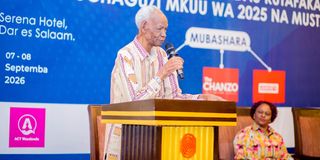
Speaking at the event as a guest of honour, Former Prime Minister and First Vice President Joseph Sinde Warioba said Tanzania’s current political and social challenges could be traced to the erosion of values that guided the country’s founders, including national unity, equality, patriotism, honesty and self-reliance.
“We need to return to the Tanzania we knew — a Tanzania of peace, equality, patriotism, honesty and self-reliance,” Mr Warioba said.
He said multiparty politics should be preserved but warned that political parties could become new sources of division if opponents were treated as enemies.
“The coming of multiparty politics turned the country into new type of discrimination, political parties became new tribes,” he said.
Mr Warioba also called for genuine citizen choice in elections, an independent Parliament, constitutional accountability and dialogue over grievances surrounding the Union between Tanganyika and Zanzibar.
“We must look at where we came from, understand where we are today and decide what kind of Tanzania we want to build,” he said.
Chairman of the National Council of Political Parties, Juma Ali Khatib, said political actors should now move beyond assigning blame for the 2025 election and focus on preventing a recurrence.
“I think now is the time to sit together, as Tanzanians, and discuss the best way and strategies to ensure what happened does not happen again,” Mr Khatib said.
For his part, Registrar of Political Parties Judge Francis Mutungi urged participants to approach the discussions with openness, including by listening to views with which they disagreed.
“Let your hearts open so that you listen to one another and speak about what you know, with the intention that it benefits others,” he said.
TCD chairperson Dorothy Semu said the country needed institutions capable of protecting democracy regardless of who was in power. “We want institutions that are stronger than individuals, laws that are stronger than the whims of leaders, and a Constitution that governs and protects the rights of all Tanzanians,” she said.
CHAUMMA Director of Information, Communication and Public Information John Mrema said national consensus would require Tanzanians to confront the sources of division rather than avoid difficult conversations. “If we are trying to build national consensus, we must look at the sources of these things that are dividing us so that we can find a remedy,” he said.
Secretary General of the Association of Islamic Organisations and Institutions in Tanzania, Sheikh Ponda Issa Ponda, said reconciliation should extend beyond political parties to longstanding questions surrounding the Union.
“Genuine unity must be built on things that are known and clearly understood,” Sheikh Ponda said.
Veteran journalist Salim Mohamed Salim said political reform would require goodwill and a credible electoral system, warning that unresolved electoral disputes could weaken confidence in democracy.
“Where there is no goodwill, you cannot do anything,” he said.
Former Lands Minister and retired UN-Habitat Executive Director Prof Anna Tibaijuka traced some of Tanzania’s current political challenges to what she described as the incomplete implementation of recommendations made by the Nyalali Commission.
She said the commission had proposed two major reforms—multiparty politics and independent candidates—but argued that Tanzania adopted the former while abandoning the latter.
“The problem in Tanzania began with the Nyalali Commission. It recommended two major things: multiparty politics and independent candidates,” she said.
Prof Tibaijuka argued that the absence of independent candidates had contributed to favouritism, divisions and corruption within political parties during the selection of candidates.
“What is defeating us is democratic principles,” she said, adding that elections must be free and fair and that political contestants should be prepared to compete fairly.
Veteran politician James Francis Mbatia said the country needed to respond to political tensions before they developed into deeper crises.
“We need to respond proactively, not reactively,” he said, calling for genuine political will to facilitate dialogue and reconciliation.
ACT-Wazalendo Mainland Vice-Chair Isihaka Rashid Mchinjita said Tanzania’s challenge was not simply the absence of laws but failure to respect and implement those already in place.
“It is not a question of whether the laws favour someone; it is a question of the laws being trampled on and State organs being used,” he said.
Human rights and gender advocate Dr Ananilea Nkya linked reconciliation to constitutional reform, warning that unresolved constitutional questions could undermine future elections.
“If our nation does not have a good Constitution, a Constitution that has the consent of all citizens, in the coming elections we could return to where we were in 2025,” she said.
CCM Mainland Deputy Secretary General Agrey Mwanri said the ruling party was prepared to listen to concerns raised during the conference and acknowledged that shortcomings in the electoral process needed to be examined.
“There are shortcomings that appear to have occurred, and if we remove these shortcomings, there is a possibility that we will not see a situation like this,” Mr Mwanri said.
CUF National Chairman Mirambo Yusuf said restoring calm should be the immediate priority while the country works towards a new constitutional framework.
“What is required of us first is to recognise that we need some stability; we need some calm,” he said.
Veteran journalist Jenerali Ulimwengu cautioned against assuming Tanzania was immune to political problems experienced elsewhere, saying the country needed to learn from its own experience and that of other nations. “We should accept that we are not exceptional in any way. We obey the same laws obeyed by others,” he said.
Representing the Tanzania Episcopal Conference, Father Faustine Furaha said democratic dialogue would only succeed if leaders and citizens were willing to speak honestly while respecting one another. “If you want to raise an argument, do not attack the person; present your argument,” he said, warning that personal attacks could create fear and discourage people from participating in national debate.
Representing diplomats, Ireland’s Ambassador to Tanzania, Nicola Brennan, drew on her country’s experience of conflict and reconciliation, saying Tanzania could learn from the importance of sustained dialogue.
“Reconciliation is not an event but an ongoing process,” she said, while stressing that trust, accountability and inclusive political participation were necessary to rebuild confidence.
On top of that, Switzerland’s Ambassador to Tanzania, Nicole Providoli, said dialogue remained central to finding lasting solutions and noted Switzerland’s support for TCD’s work since 2022.
“Dialogue is at the heart of Swiss foreign policy. Tanzania have our full support,” she said.
Register to begin your journey to our premium contentSubscribe for full access to premium content