Power utility firm unveils smart home technology to help households cut electricity bills
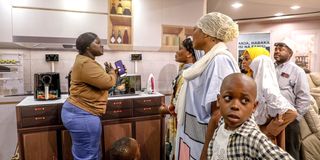
Tanzania Electric Supply Company (Tanesco) marketing officer Ms Madeline Shaidi demonstrates how exhibitors can control smart houses using mobile phone applications at the 50th DITF. PHOTO | COURTESY
Dar es Salaam. The Tanzania Electric Supply Company (Tanesco) has introduced smart home technology that enables customers to monitor and control household electrical appliances remotely using mobile phones, in a move aimed at reducing electricity bills, improving safety and promoting efficient energy use.
The innovation is among technologies being showcased at the ongoing 50th Dar es Salaam International Trade Fair (DITF), where the utility is demonstrating digital solutions designed to give consumers greater control over electricity use in their homes.
Speaking at the exhibition yesterday, Tanesco Director of Communications and Customer Experience, Ms Irene Gowello, said the smart home solution forms part of the utility's broader strategy to modernise electricity consumption as more Tanzanians gain access to reliable power.
She said the technology is intended to help customers use electricity more efficiently by reducing unnecessary consumption while improving convenience and household safety.
"Customers can monitor electricity use, switch appliances on and off remotely and programme devices to operate only when they are needed. This gives households greater control over their energy consumption and helps reduce electricity bills," she said.
Ms Gowello added that the initiative supports the government's clean energy and digital transformation agenda by encouraging the adoption of technologies that improve energy efficiency without compromising comfort.
Providing further details, Tanesco Marketing Officer Madeleine Shaidi said the system works by connecting household appliances, including televisions, refrigerators, air conditioners, microwaves, water heaters and electric cookers, to a central digital platform operated through the Smart Life mobile application.
She explained that customers only need to install smart sockets and smart switches, which work alongside existing electrical wiring, eliminating the need for costly renovations.
"Once the devices are installed, homeowners can control electrical appliances from anywhere using a smartphone connected to the internet," she said.
According to Ms Shaidi, the Smart Life application allows users to organise appliances according to different rooms, such as the living room, kitchen and bedroom, making it easier to manage individual devices remotely.
Beyond remote control, the technology enables users to automate everyday activities by scheduling appliances to switch on and off at specific times.
For instance, outdoor security lights can be programmed to switch on automatically at sunset and turn off at sunrise, while water heaters can be activated shortly before family members wake up or return home. Homeowners who forget to switch off appliances after leaving the house can also do so instantly using their mobile phones.
The system also provides detailed information on electricity consumption, allowing users to track daily and monthly power usage and identify appliances that consume the most electricity, helping households make informed decisions to reduce energy wastage.
A smart home user, Mr Safari Fungo, described the technology as a significant step towards modern living, saying automation can improve both convenience and energy efficiency.
He said motion sensors can automatically switch off lights and air conditioners when rooms are unoccupied, while homeowners can remotely activate appliances before arriving home to ensure comfort without wasting electricity.
"With a smart home, you can programme outdoor lights to switch on automatically at sunset and turn off at sunrise. The technology helps eliminate unnecessary electricity consumption while making everyday life more convenient," he said.
Mr Fungo also called for regulations that would allow households with rooftop solar systems to feed excess electricity into the national grid through two-way metering, saying such a framework would encourage greater investment in renewable energy while complementing smart home technologies that promote efficient electricity use.
Register to begin your journey to our premium contentSubscribe for full access to premium content