Dar es Salaam. The government has identified five priority areas it says are central to achieving the National Vision and delivering meaningful socio-economic transformation for Tanzanians.
The areas are agriculture, an improved business environment, increased national income, strengthened monitoring systems, and better use of statistics in national and international reporting frameworks.
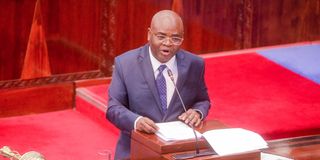
Minister for Planning and Investment, Prof Kitila Mkumbo, told Parliament on Wednesday, June 23, 2026, that the government was responding to concerns raised by members of parliament during debate on the National Development Plan and the 2026/27 national budget tabled on June 11, 2026.
The budget was passed with 97.66 percent approval after 385 MPs voted in favour out of 393 members present.
Speaker of the National Assembly, Mr Mussa Azzan Zungu, announced the results, noting that eight MPs voted against the budget while another eight were absent during the voting session.
Prof Mkumbo said the government has prioritised agriculture as a key driver of economic transformation, noting the sector will play a central role in boosting national income in the coming financial years.
He said the structure of the economy and labour force shows that 54.2 percent of Tanzanians are engaged in agriculture, livestock keeping, and forestry, while 10.3 percent are in industry and 35.5 percent in services.
“Compared to 2021, when agriculture accounted for 60.4 percent of employment, the current figure has declined to 54.2 percent. This reflects a gradual structural shift as the economy modernises and agricultural productivity improves. It does not reduce the importance of agriculture, but rather shows the need for balance across all sectors to create more jobs,” said Prof Mkumbo.
He added that the government is working to improve the business environment, described as a key tool for growth and formalisation.
The budget introduces measures to stimulate industrial production and employment, with industry expected to become the leading employer.
The Minister further said agriculture remains a priority even as industrialisation advances, stressing that no industrial transformation can take place without agricultural development.
Prof Mkumbo also highlighted the informal sector as a critical area of focus, saying reforms will formalise informal businesses and improve contribution to the economy.
He said efforts are underway, including the development of framework, ncluding the development of a new framework dubbed ‘Mkumbi 2’, which is in the approval stages, urging MPs to support the initiative as a conducive business environment key to formalisation.
On national income, he said confusion exists on gross domestic product (GDP), explaining the economy stood at Sh234.14 trillion in 2025, with per capita income derived from total GDP divided by population.
He outlined the fourth area as the use of poverty measurement frameworks, noting the poverty line for the mainland is Sh63,164 per household per month.
Fifth area strengthening monitoring and evaluation systems saying National Planning Commission, focusing on results-based tracking through performance indicators.
“The government has taken MPs' views and has begun preparing a monitoring and evaluation policy and draft law for a framework,” he said, urging a productivity-driven approach.