Regional pipeline project launches initiative to improve menstrual health and hygiene in schools
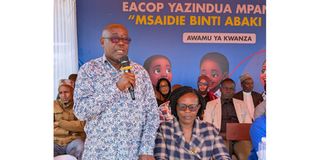
The Acting Chief Executive Officer of Singida Council, Mr Christopher Kidubo, speaking during the launch of the ‘Help a Girl Stay in School’ programme, organised by the East African Crude Oil Pipeline (EACOP) project, over the weekend in Ntonge Ward, in the region.
Singida. The East African Crude Oil Pipeline (EACOP) project has launched the first phase of a school-based menstrual hygiene programme dubbed “Keep a Girl in School” under its Social Economic Investment and Corporate Social Responsibility (SEI/CSR) programme.
The initiative aims to empower primary and secondary school girls—especially those in rural areas—to attend school consistently and improve their academic performance by providing various forms of support, including sanitary pads along the EACOP corridor.
Speaking during the launch, EACOP’s Manager for Community Empowerment and Accountability, Ms Clare Haule, said the programme will initially be implemented in three regions—Singida, Shinyanga and Dodoma—covering a total of 19 schools and benefiting more than 4,596 students.
She said that in the first phase, the programme will be implemented in six schools in Singida, seven in Shinyanga and six in Dodoma.
“This programme will be implemented in phases. In this first phase, we have started in these three regions and will later expand to other regions in the country,” she said.
“Overall, we expect to reach 4,596 students in 19 schools,” she said.
Ms Haule noted that various studies show that 15 to 20 percent of girls miss school for one to two days each month due to menstruation-related challenges.
She said the situation is largely caused by a lack of proper sanitation facilities at schools during menstruation and limited access to sanitary pads.
Through the programme, EACOP aims to provide reproductive health awareness and create a supportive environment for menstrual hygiene management in schools in order to reduce absenteeism and poor academic performance among female students.
She further noted that, besides this initiative, the EACOP project continues to implement various community development programmes aimed at improving the well-being of communities affected by the project.
These include projects in agriculture, beekeeping, entrepreneurship, and business training.
Speaking at the event, the Singida Regional Medical Officer, Dr Victorina Ludovick, who represented the Regional Commissioner, said the programme aligns with the goals of the National Development Vision 2050, which emphasises gender equality and access to essential services for children, including girls.
“By supporting proper menstrual hygiene management in schools, we are laying the foundation for responsible and empowered women who will contribute to our nation,” said Dr Victorina.
She emphasised the importance of protecting and empowering girls—who are key contributors to national development—by providing them with a safe learning environment so they can continue their education without obstacles.
The Acting Regional Education Officer for Singida, Ms Regina Yaghambe, said the programme has come at the right time as it will help reduce absenteeism among girls caused by the lack of proper menstrual hygiene facilities in schools.
Some parents who attended the launch said that before the programme began, their daughters often missed classes during their menstrual periods due to a lack of essential supplies such as sanitary pads and private sanitation facilities.
They said that sometimes they had to give their daughters pieces of cloth to manage menstruation, while others occasionally resorted to using plant leaves because sanitary pads were either unavailable or unaffordable—especially for families with low incomes and those living in rural areas.
“We thank EACOP for starting this programme for our daughters who used to miss school and feel excluded from their peers. This support motivates girls to perform better and gain confidence in school,” said Ms Faulina Sinde, a resident of Igauli.
Students who received the sanitary pads said the support would help them feel more confident during menstruation and enable them to attend all their classes.
One of the students, Edina Metusaeli, a Form Four student at Ntonge Secondary School, said the assistance would help them attend lessons without missing classes as they had done before.
“These sanitary pads will help us attend all our classes without missing them and allow us to study hard so that we can achieve our dreams,” she said.
The programme was launched at Igauli Secondary School in Igauli Village, Ntonge Ward, Singida District Council.
The EACOP project, which stretches 1,443 kilometres, runs from Hoima in Uganda toChongoleani in Tanga.
The project’s shareholders include TotalEnergies (62 percent), the Tanzania Petroleum Development Corporation (TPDC) (15 percent), the Uganda National Oil Company (UNOC) (15 percent), and the China National Offshore Oil Corporation (CNOOC) (8 percent).