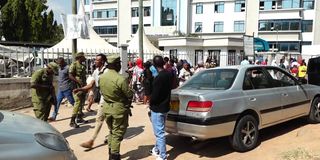
Mwanza. Tension erupted at the Sekou Toure Regional Referral Hospital in Mwanza on Friday, July 24, 2026, after relatives of the late Wambura Mumbiya, 54, became embroiled in a dispute over where and by whom he should be buried.
The confrontation unfolded after the deceased’s first wife, Ms Elizabeth Nyakao, learnt that her husband’s relatives were planning to bury him at the home of his second wife, a move she strongly opposed.
Speaking outside the hospital, Ms Nyakao said she had lived with her husband for 32 years before he distanced himself from their family over the past five years.
She accused her in-laws of insisting that Mr Mumbiya be buried at the second wife’s home, saying she had never even met the woman.
"What pains me is that I want to bury my husband, but my brother-in-law is preventing me. He insists the body should be taken to the second wife, and I cannot accept that," she said.
The deceased’s eldest daughter, Ms Happiness Wambura, said the family was alarmed after receiving information that there were plans to secretly remove their father’s body from the hospital without informing them.
"We received information that there was a plan to take our father's body without our knowledge. That shocked us, which is why we rushed to the hospital to stop it," she said.
"All we want is to be given our father's body so that we can give him a dignified burial. We cannot allow him to be buried away from his family," she added.
Ms Wambura said her father had been ill for six months before his death and had spent much of his time living on the islands due to his work as a fisherman.
"Our father was a fisherman and spent most of his time on the islands. He has left behind seven children and six grandchildren. We simply want him to receive the dignified farewell he deserves," she reiterated.
However, the deceased’s elder brother and family spokesperson, Mr Gradson Mambiya, said the dispute stemmed from the fact that Mr Mumbiya had two wives, both of whom had children with him.
"The reality is that my younger brother had two wives, and both were his legitimate spouses in their own way. The disagreement now is over who has the right to bury him, and that is where the conflict began," he said.
Mr Mambiya claimed that before his death, the deceased had made his wishes clear, expressing a desire to be buried at the home of his second wife.
"He told us very clearly that if he died, he did not want to be buried at the first wife's home. He wanted to be buried at the second wife's home. He told me personally, and other relatives are also aware of those wishes," he said.
He said the first wife rejected the deceased’s wishes, insisting that she had the right to fully participate in her husband’s burial arrangements.
"After his death, we informed the first wife about what the deceased had said, but she refused to accept it. Since both women are his wives, the family has decided that the body should instead be buried at his ancestral home in Musoma to avoid further conflict," he said.
According to Mr Mambiya, the decision was intended to ensure that neither side felt excluded or denied its rights.
"We want everyone to be satisfied. He was our relative, and we do not want him to be buried amid violence. We want him to rest in peace, while those left behind can resolve their differences later," he said.
Ms Dativa Witlaus, from the Research Unit of the Mwanza-based organisation Shujaa wa Maendeleo na Ustawi wa Jamii (Sinaujata), said officials rushed to the hospital after receiving reports of the dispute.
"When we arrived, we found heated arguments between the first and second wives, with each insisting that the body should be released to her for burial. The situation was tense, forcing us to convene an emergency meeting in an attempt to reconcile the two sides," she said.
She said both parties maintained hardline positions during the meeting, making it difficult to reach an immediate agreement.
"We agreed that, as social welfare officers, it was not our role to decide who should take the body. Instead, we advised the families to reach a mutual agreement and then report back to us," she said.
The mediation efforts, however, failed to produce an immediate breakthrough.
Ms Witlaus said the situation deteriorated shortly after the meeting when discussions resumed outside the hospital.
"When we stepped outside, a crowd of around 40 people or more had gathered. Instead of continuing discussions, shouting broke out, people started arguing, and some exchanged punches. It became a dangerous situation. Dust filled the air, and passing vehicles were at risk of hitting people," she said.
According to Ms Witlaus, police officers at the scene attempted to intervene but struggled to restore order because of the large number of angry relatives and onlookers.
"The officers did their best, but the situation had become extremely chaotic. Hospital management and other leaders also had to intervene to calm people down," she said.
She added that the social welfare team later went to Mwanza Central Police Station to seek assistance from senior authorities.
Mwanza resident, Ms Mariam Ezekiel, described the incident as unfortunate and said it should serve as a lesson to society.
"This is a very sad incident. In many African traditions, when a man dies, he is usually buried within the family of his first wife. Even if he had other wives, the burial is often conducted there," she said.
She argued that such disputes could be avoided if there were clearer legal frameworks governing polygamous marriages, including encouraging men to leave written wills.
"The government should establish a formal system requiring men with multiple wives to record their wishes on matters such as burial arrangements. That would help prevent disputes like this," she said.
By 4 pm, efforts to reconcile the two sides were still ongoing, with authorities continuing to urge dialogue to ensure that the deceased is laid to rest peacefully and with dignity, without a repeat of the violence witnessed earlier at the hospital.