Alfred Zacharia is a business reporter for The Citizen and Mwananchi newspapers.
Mwananchi Communications Limitted
Dodoma. The Rural Water Supply and Sanitation Agency (Ruwasa) plans to raise rural water coverage from 85.2 percent to at least 90 percent by 2030/31, but faces a Sh3 trillion financing gap to achieve the target.
The agency says it needs Sh5.184 trillion to implement its 2026/27–2030/31 Strategic Plan, while conventional public financing is expected to provide only Sh2.184 trillion.
The shortfall has prompted Ruwasa to seek alternative sources of funding, including Public-Private Partnerships (PPPs), private investment, internally generated revenue and climate finance.
Ruwasa Director of Planning Enock Wagala said diversifying financing would be necessary to implement the agency’s priorities.
“We need to expand funding channels to ensure that the strategic priorities are implemented as planned,” he said.
The strategy seeks to extend water services to 1,575 villages that remain without reliable access, while completing 878 ongoing projects valued at more than Sh1 trillion.
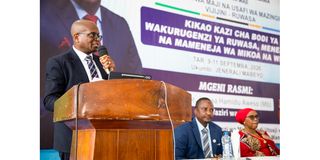
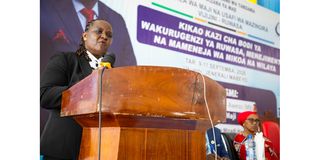
Deputy Permanent Secretary of Ministry of Water Ms Rose Ambrose
Ruwasa Director General Wolta Kirita said the agency had extended water services to 10,758 of Tanzania’s 12,333 villages.
The remaining 1,575 villages, he said, represent the next major challenge in expanding rural water access.
“They should not be viewed merely as statistics because they represent communities that continue to face difficulties accessing clean, safe and reliable water,” he said.
The agency plans to expand existing schemes, develop new projects and complete those already under construction.
Since its establishment, Ruwasa has completed 3,714 projects worth more than Sh1.8 trillion and connected more than 630,311 rural households to water services.
Beyond construction, the strategy places emphasis on keeping existing infrastructure operational.
Mr Kirita said completing water projects was not enough unless systems were properly managed and maintained.
“Completing the construction of a water project alone is not enough to ensure that wananchi receive sustainable services. The service needs to be operated, managed and the infrastructure maintained efficiently,” he said.
Ruwasa plans to strengthen Community-Based Water Supply Organisations (CBWSOs), which manage water schemes at village level.
The agency currently has 885 CBWSOs that have been formed, registered, linked, trained and monitored. Their responsibilities include managing finances, operating water systems and maintaining infrastructure.
To mobilise additional funding, Ruwasa is also exploring climate finance and carbon markets. With support from development partners, it has established a team to build institutional capacity and develop mechanisms for accessing the markets.
The agency expects PPPs and private investment to provide additional capital for rural water projects, easing pressure on government resources.
At the same time, Ruwasa plans to strengthen project monitoring, planning and financial management through digital systems, including eOffice, NeST, GAMS, GAMIS, MUSE, Maji IS, RSDMS, HCMIS and PEPMIS.
It is also implementing ISO 9001:2015 quality-management standards to improve planning, monitoring and continuous improvement.
Deputy Permanent Secretary in the Ministry of Water Rose Ambrose said stronger monitoring would be critical as Ruwasa seeks to mobilise the Sh3 trillion required from non-traditional sources.
“We must ensure that every shilling allocated is accounted for and produces results,” she said.
Ms Ambrose urged the agency to prioritise projects with the greatest impact on communities and establish clear indicators for measuring progress.
The strategy therefore shifts the focus beyond building more infrastructure to ensuring that water systems remain functional and that the remaining underserved villages are reached.
Ultimately, its success will depend on whether the additional financing is secured and more rural households gain reliable access to clean and safe water.
Register to begin your journey to our premium contentSubscribe for full access to premium content