Ruwasa targets 1,575 villages as funding gap hits Sh3 trillion

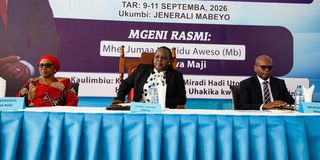
Deputy Permanent Secretary in the Ministry of Water Rose Zacharia Ambrose (centre) addresses delegates alongside Ruwasa board members and senior officials during a three-day working session in Dodoma.
Dodoma. The Rural Water Supply and Sanitation Agency (Ruwasa) is seeking alternative financing to extend water services to 1,575 villages that remain without access to clean and safe water.

The move comes as the government estimates that about Sh5 trillion is required to meet the country’s remaining water infrastructure needs, leaving a financing gap of approximately Sh3 trillion.

Speaking on Wednesday, September 9, 2026, during a three-day working session involving the Ministry of Water, Ruwasa’s Board of Directors, management and regional and district managers in Dodoma, Deputy Permanent Secretary in the Ministry of Water Rose Ambrose said the financing challenge required institutions to explore alternative sources of funding.

She said the government’s development direction places greater emphasis on private-sector participation in financing development projects, reducing reliance on public funds alone.

Ms Ambrose said the focus should be on practical financing arrangements capable of accelerating investment in water infrastructure while ensuring projects deliver sustainable services to communities.

The financing push comes as Ruwasa builds on progress in expanding rural water access.

According to the agency’s performance figures, rural water coverage increased from 64.1 percent in July 2019 to 85.2 percent in June 2026, with services reaching 10,758 of the country’s 12,333 villages.

The remaining 1,575 villages are now at the centre of the agency’s expansion plans.

Ms Ambrose said the villages should not be viewed merely as statistics because they represent communities continuing to face inadequate access to water.

She said shortages particularly affect women and children, who in many communities are forced to walk long distances in search of water.

“Lack of water in these villages has a direct impact on women and children,” she said, stressing the need for interventions that produce measurable improvements on the ground.

She said improving access would free women to engage in economic activities and household responsibilities, while enabling children to spend more time in school and reducing health risks associated with unsafe water.

The Deputy Permanent Secretary also challenged Ruwasa managers to become more proactive in identifying and resolving challenges instead of waiting for instructions from senior management.

She described regional and district managers as the institution’s “eyes, ears, hands and feet”, saying they should take greater responsibility for water projects and services in their areas.

Ruwasa Director General Walta Kirita said the agency had completed 3,714 water projects valued at more than Sh1.8 trillion, while enabling 630,311 rural households to connect to water services.

“We have also established and supported 885 Community-Based Water Supply Organisations to manage rural water supply and sanitation services,” Eng Kirita said.

He said the agency would continue strengthening data systems, performance contracts, staff capacity, accountability and technology in its operations.

Ruwasa recently obtained ISO 9001:2015 certification, while it has also begun implementing its 2026/27–2030/31 five-year strategic plan.

A Ruwasa Board member, Ngusa Mpembe, said funding shortages remained a major constraint affecting project implementation.

“The recognition of these financial challenges by the Ministry is encouraging, and we are exploring alternative financing mechanisms to complement government resources,” Eng Mpembe said.

He said a paper on alternative financing prepared with private-sector participation would be shared with Ruwasa management before being presented at an African engineers’ conference.

Eng Mpembe also urged managers and staff to conduct self-assessments and ensure resolutions from the meeting were measurable and produced tangible results.

The meeting, which runs from September 9 to 11 in Dodoma, brings together the Ministry of Water, Ruwasa’s Board and management, regional and district managers and representatives of community-based water organisations.