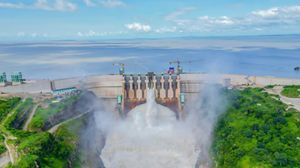
Rufiji. President Samia Suluhu Hassan has officially launched the Julius Nyerere Hydropower Project (JNHPP), saying its completion has disproved claims that the Sh7.452 trillion investment would become a "white elephant" with no practical benefit to Tanzania.
Launching the project in Rufiji District, Coast Region, on Saturday, August 22, 2026, President Hassan said the project had gone through difficult moments, including opposition from within and outside the country, but successive governments maintained faith in its importance and continued with its implementation.
She said the project had been part of Tanzania’s development plans for decades and faced challenges at different stages, but the country did not abandon it because of the difficulties.
“When we make decisions that are in the national interest, we should not give up simply because the path to achieving them is difficult. We must have the courage and determination to uphold our vision and decisions until we achieve the goals we have set,” she said.
President Hassan said the completion and operation of the 2,115-megawatt plant demonstrated that the decision to proceed with the project was justified.
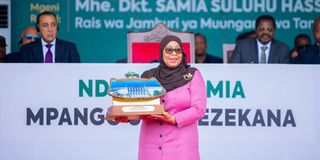
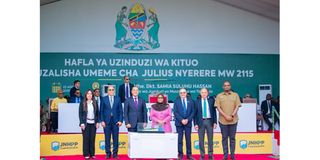
President Samia Suluhu Hassan addresses leaders, guests and members of the public attending the inauguration of the Julius Nyerere Hydropower Project (JNHPP), with an installed capacity of 2,115 megawatts, in Rufiji, Coast Region, on August 22, 2026. PHOTO | STATE HOUSE
She said some people had questioned the usefulness of the project, particularly whether Tanzania would have sufficient transmission infrastructure to evacuate the electricity generated at the dam.
“There were people who said the dam had been completed but would have no use because there were no major transmission lines to carry the electricity,” she said.
According to her, the government had continued investing in transmission infrastructure alongside the hydropower project, including the recently completed 400kV Chalinze–Dodoma transmission line.
The line was energised on August 20, 2026, and has enabled electricity generated at JNHPP to reach Dodoma, she said.
Furthermore, the project had significantly increased Tanzania’s electricity generation capacity and helped reduce power interruptions that had affected production, businesses, and essential services.
She urged Tanzanians to take advantage of the increased electricity supply to expand investment, manufacturing, businesses, and other productive activities.
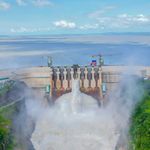
The project has nine generating units, each with a capacity of about 235MW, giving it a total installed capacity of 2,115MW.
President Hassan said Tanzania should not stop at the current surplus, warning that electricity demand would continue rising as investment, industrialisation, mining, modern agriculture, and other economic activities expand.
“We have sufficient electricity reserves today, but perhaps after three years these reserves will no longer be enough,” she said.
She said the government would therefore continue investing in other sources, including solar and wind power, while strengthening the national transmission and distribution networks.
Heavy rain warning
President Hassan also directed authorities to prepare for possible heavy El Niño rains expected in the coming months, saying the Tanzania Meteorological Authority had issued information pointing to increased rainfall.
She directed leaders in Coast and Morogoro regions, including district authorities and security committees, to take precautionary measures to protect communities and infrastructure.
According to her, the project, which had been conceived decades ago, demonstrated that Tanzania could undertake and complete major strategic investments when there was political commitment, faith in national priorities, and sustained follow-up.
“Without peace and security in our country, all the other achievements we are witnessing and celebrating today would not be possible,” she said.
The warning is particularly significant for the JNHPP area, where the President also stressed the need to protect the environment and water sources that feed the reservoir.
She directed the relevant government institutions to strengthen conservation efforts to ensure the sustainability of the project.
Why power outages remain frequent despite rising generation
Despite a significant increase in electricity generation capacity, Tanzania is still facing frequent power interruptions, with the government pointing to weaknesses in transmission and distribution infrastructure as part of the problem.
Energy Minister Deogratius Ndejembi said increased generation alone cannot guarantee a reliable electricity supply unless the infrastructure needed to transmit and distribute power is strengthened.
He said the government was therefore working to expand and improve transmission and distribution infrastructure to ensure that electricity generated reaches consumers reliably and reduce frequent outages.
“We are not only talking about generating electricity, but also strengthening the infrastructure to transmit it and ultimately ensure that it reaches all users across the country,” he said.
The intervention comes as Tanzania’s electricity generation capacity continues to rise, particularly following the completion of JNHPP, which has a generation capacity of 2,115 megawatts.
According to the minister, the impact of completing the transmission line has been seen within a short period, with the country’s peak electricity demand rising from 2,130 megawatts to 2,280 megawatts within just three days.
“Just last week, the peak electricity demand in our country was 2,130 megawatts. But immediately after switching on the Chalinze–Dodoma transmission line, we reached a peak of 2,280 megawatts. This happened within just three days,” he said.
“The true importance of this project is not simply the 2,115 megawatts. It is what that electricity makes possible: to power factories, connect businesses, create jobs, and improve education and healthcare,” he said.
Mr Ndejembi said the government’s priority was now to ensure that the increased generation capacity was matched by adequate transmission and distribution systems.
He said Tanzania was also exploring opportunities to use its growing generation capacity to sell electricity to regional markets.
“Because of this increase in generation, we are currently in discussions with Kenya, Zambia, and other countries so that we can sell them electricity,” he said.
Tanzania is positioning itself as an important link between the East African Power Pool and the Southern African Power Pool, creating opportunities to trade electricity with neighbouring countries.
Development partners
For his part, Egyptian Prime Minister, Dr Mostafa Madbouly, said the completion of the JNHPP had opened a new chapter in Tanzania–Egypt relations, with the two countries seeking to deepen cooperation beyond the energy sector.
Dr Madbouly said the $2.9 billion project, with a generation capacity of 2,115 megawatts, demonstrated the ability of Egyptian companies to undertake major infrastructure projects in Africa while strengthening economic ties between the two countries.
He praised Egyptian companies Arab Contractors and Elsewedy Electric for their contribution, describing it as a historic achievement in the construction of one of Africa’s major dams.
“The completion of the Julius Nyerere Dam represents a qualitative shift in bilateral cooperation between Tanzania and Egypt on various fronts, particularly in the economic sphere,” he said.
He said Egypt was ready to work with Tanzania to increase bilateral trade and investment and called for greater participation of the private sector in areas of mutual interest.
Dr Madbouly said the two countries could expand cooperation in construction, roads, maritime transport, ports, logistics zones, agriculture, livestock, fisheries and aquaculture, pharmaceuticals, food processing, marble, and energy, among other sectors.
He said the expansion of economic cooperation should build on Egyptian President Abdel Fattah el-Sisi’s visit to Dar es Salaam, describing it as an important step in strengthening relations between the two countries.
Former African Development Bank president Dr Akinwumi Adesina described the JNHPP as a powerful signal of Tanzania’s confidence in its future and a potential energy hub for East, Central, and Southern Africa.
Dr Adesina said the 2,115MW dam, valued at Sh7.45 trillion and fully government-financed, goes beyond electricity generation.
He commended President Hassan’s leadership, saying her commitment to infrastructure, industrialisation, and opportunity was evident in the transformation taking place across the country.
Drawing from his 10 years at the AfDB, Dr Adesina said Tanzania had always delivered on big projects and called on the country to use the additional power to drive factories, mineral beneficiation, and agricultural processing.
“Tanzania has the geography and resources to become an energy and industrial hub for the region. The tunnels have been built. Now let industries follow. Let jobs follow. Let prosperity follow,” he said.
Register to begin your journey to our premium contentSubscribe for full access to premium content