Samia’s reconciliation roadmap: Path to a New Constitution?
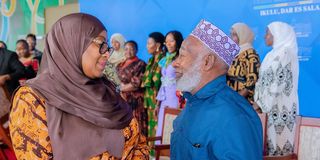
President Samia Suluhu Hassan speaks with AAFP Chairman Said Soud Said after a meeting with political leaders at State House, Dar es Salaam, on July 30, 2026. PHOTO | STATE HOUSE
Dar es Salaam. President Samia Suluhu Hassan’s announcement of plans to establish a Reconciliation Commission has triggered wide debate among political and governance stakeholders, with many saying the move could mark the beginning of efforts to build consensus towards a new constitution and strengthen national unity.
However, stakeholders say the success of the commission will not depend on its formation alone, but also on the commitment of leaders, political will, inclusion of all relevant parties, and willingness to address the root causes of political disputes in the country.
President Hassan made the announcement on Thursday, July 30, 2026, during a meeting with leaders of 18 political parties held at State House in Dar es Salaam.
The meeting provided an opportunity for political parties to raise concerns and ask questions on issues including reconciliation, political reforms, the economy, social services, employment, investment, and peace and security.
In her address, President Hassan referred to the reconciliation process in Zanzibar, saying the government was preparing for the next steps towards constitutional review and that every stage would follow legal procedures and serve the wider interests of the nation.
She said Zanzibar had made significant progress, with former presidents of the Isles contributing to dialogue that helped parties reach an agreement.
“The major task ahead of us now is to discuss and implement what has been signed. We need to discuss what direction we want to take. How are we moving forward? After completing this, we will proceed with amendments to the Zanzibar Constitution,” said President Hassan.
On July 9, 2026, Zanzibar opened a new chapter towards a Government of National Unity (GNU) after leaders from ACT-Wazalendo and the ruling CCM signed a seven-point political reconciliation agreement.
During Thursday’s meeting with political leaders, President Hassan said the government was preparing to establish a reconciliation commission to accelerate the process towards a new constitution.
“While the Presidential Criminal Inquiry Commission led by Justice Shaban (Ally Lila) continues with its investigations, because the two issues are unrelated, the reconciliation commission itself will be announced to begin work and address constitutional matters,” said President Hassan.
Stakeholders’ views
Political analyst Kiama Mwaimu said the main purpose of reconciliation was to ensure national stability, noting that there were currently disagreements between opposition parties and the ruling party.
“Reconciliation is important, but for it to work, all sides must have genuine commitment towards the issues they want to discuss. From my perspective, I want to believe the President’s statement was made with genuine intentions,” said Mr Mwaimu.
He said opposition parties must also demonstrate commitment, but stressed that the causes behind the need for reconciliation must first be identified.
“Before reconciliation, we must establish what caused the conflict that requires reconciliation. Without identifying the source of the dispute, we will not achieve anything,” he said.
Mr Mwaimu added that both sides must agree and show readiness to participate in the process.
The director of Advocacy and Access to Justice at the Legal and Human Rights Centre (LHRC), Mr Fulgence Masawe, said President Hassan’s remarks showed good intentions from the government.
However, he said calls for reconciliation and a new constitution had been made several times, stressing that truth and accountability should remain central to the process.
“Reconciliation that takes place without stating what happened and who was responsible tends to repeat itself. We support reconciliation because nobody rejects the need to move forward,” said Mr Masawe.
“We cannot create a constitution while the nation remains divided. When entering reconciliation, all political parties must be given equal opportunity and differences should be addressed before coming to the negotiating table,” he added.
Mr Masawe said political leaders who are currently detained should be released to allow them to participate fully in the process.
Ada Tadea chairman, Mr Juma Ali Khatibu praised President Hassan’s speech, saying she had demonstrated willingness to work with all political parties.
“Yesterday, every party was given an opportunity to speak and present its views. President Samia (Suluhu Hassan) responded to some issues immediately and promised to work on others. I urge Chadema to use this opportunity to meet with President Samia so that challenges can be resolved,” he said.
“There is nothing better than sitting down and discussing with the Head of State. I advise Chadema to attend the next meeting because this is our President and there is no other,” added Mr Khatibu.
Civic United Front (CUF) chairman, Mr Yusuf Mirambo, said reconciliation was necessary for the country to move forward, arguing that it was part of modern political systems where parties sit together after disagreements and find solutions.
“Reconciliation means agreement. One side agrees and the other side agrees. I become uncomfortable when people say they do not want reconciliation while they do not understand the meaning of the word,” said Mr Mirambo.
He said genuine reconciliation required addressing both sidesm those who suffered and those responsible for causing harm.
“Those who suffered must be supported through compensation and counselling. Those who caused harm must face legal processes so that justice can be achieved through court decisions,” he said.
ACT-Wazalendo leader, Ms Dorothy Semu, said President Hassan’s decision to invite political party leaders for dialogue was a positive step.
“We believe these talks will be based on truth and political will to help the country overcome the various challenges and disagreements that have emerged,” said Ms Semu.
She added that Tanzania needed a new constitution, saying the demand was not recent but had existed for years.
“The demand for a new constitution has been raised by politicians and citizens for a long time. CCM promised that within 100 days it would begin the process, and yesterday we wanted to know where that commitment stands,” she said.
Chadema vice chairman (Mainland) Mr John Heche, said the party would issue a statement regarding President Hassan’s remarks.
‘I will meet political party leaders three times’
President Hassan also said she would meet political party leaders three times to discuss the country’s economic, social, and political development, saying no individual had the right to claim ownership of Tanzania and do whatever they wanted.
“Development belongs to everyone, and democracy requires collective responsibility. When we take responsibility together, the government delivers, benefiting the party in power today and all citizens in the future,” she said.
“We are doing well, but one of our colleagues is still reflecting. We continue to receive his concerns, needs, and demands,” added President Hassan in a calm tone.
Journey towards political reforms
The debate on reconciliation and political reforms has also revived calls for the resumption of the new constitution process and implementation of recommendations from previous government-formed commissions.
On July 24, 2026, during the annual conference of the Tanzania Human Rights Defenders Coalition (THRDC), Vice-President, Dr Emmanuel Nchimbi urged politicians, activists, and other stakeholders to focus their efforts on pursuing a new constitution, describing it as the foundation for wider political and legal reforms.
Dr Nchimbi said if given the opportunity to tell Tanzanians one thing, he would urge them to ‘remain firm’ in pushing for a new constitution, saying it was the supreme law that protects citizens’ rights and allows any law that contradicts it to be challenged.
He stressed that Tanzania needed a constitution built on consensus among stakeholders to strengthen good governance and protect citizens’ rights.
His remarks were interpreted by many as a call for greater focus on the new constitution agenda, sparking renewed debate on the role of the government and other stakeholders in advancing the process.
Former chairman of the 2012 Constitutional Review Commission, Justice Joseph Warioba, has also repeatedly called for the continuation of the new constitution writing process.
Justice Warioba has maintained that the draft constitution produced from citizens’ views remains an important foundation for building a governance system that responds to Tanzanians’ needs and addresses political and administrative challenges.
The political reform debate has also brought renewed attention to recommendations of the Justice Francis Nyalali Commission of 1991, which, besides recommending the restoration of a multiparty political system, proposed major constitutional and legal reforms to strengthen democracy.
Veteran lawyer and politician Justice Mark Bomani has also been among those who have argued that a new constitution is essential for strengthening the rule of law, accountability among leaders, independence of state institutions, and protection of citizens’ rights.
Register to begin your journey to our premium contentSubscribe for full access to premium content