Samia tasks marine scholars to drive blue economy agenda
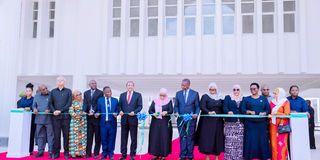
President Samia Suluhu Hassan (centre) marks a milestone for the blue economy by cutting the ribbon on new facilities at the Institute of Marine Sciences in Zanzibar. PHOTO/COURTESY
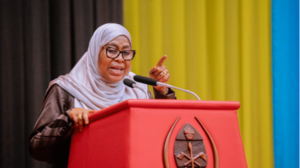
Unguja. President Samia Suluhu Hassan yesterday challenged marine scientists, scholars and experts to ensure their knowledge and research become a catalyst for the growth of Tanzania’s blue economy, urging them to produce practical studies that inform policy, support livelihoods and sustainably harness marine resources.
Speaking while inaugurating new academic, administrative and student hostel buildings at the University of Dar es Salaam’s Institute of Marine Sciences (IMS) in Zanzibar, President Hassan said the blue economy remains one of the country’s most strategic development pillars—both for people’s welfare and national growth.
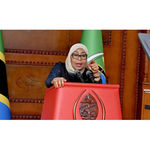
“The blue economy is among the key drivers of our development. The presence of this institute provides a major opportunity to realise that vision through research, innovation and skills that directly benefit our people,” President Hassan said.
The inauguration formed part of celebrations marking the 62nd anniversary of the Zanzibar Revolution and came a year after Zanzibar President Dr Hussein Mwinyi laid the foundation stone for the buildings on January 5, 2025.
The facilities were constructed under the Higher Education for Economic Transformation (HEET) project, a joint initiative between the government of Tanzania and the World Bank aimed at strengthening higher education infrastructure and aligning it with national economic priorities.
Blue economy at the heart of national strategy
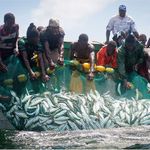
Tanzania’s blue economy agenda has gained prominence in recent years, driven by the country’s vast coastline, rich marine biodiversity and the livelihoods of millions who depend on fishing, aquaculture, maritime trade and coastal tourism.
On the Mainland, the agenda has been integrated into national development frameworks focusing on fisheries modernisation, port infrastructure, marine transport and value addition.
In Zanzibar, the blue economy has been elevated as a flagship development strategy, with dedicated policies and investments targeting fisheries, seaweed farming, marine tourism and ocean governance.
President Hassan said institutions such as IMS are critical in ensuring that the blue economy is not only expanded, but also managed sustainably for current and future generations.
“I urge lecturers and researchers at this institute to work closely with the private sector so that the research conducted here produces tangible results for national development and for the wellbeing of our citizens,” she said.
She further directed the institute to introduce short, practical training programmes for surrounding communities—many of whom depend on fishing—to help improve productivity, incomes and sustainability within the blue economy.
Research, innovation and responsibility
The President described IMS as a strategic institution for Zanzibar, noting that it “carries the future of the people” and has continued to serve as a key pillar of the marine economy.
She also called on students—both current and future—to fully utilise the opportunities provided by the expanded infrastructure.
“Make the most of these facilities by conducting research and innovations that promote the sustainable use of marine resources,” she said, cautioning that, “in everything you do, you must be careful to ensure that marine resources are conserved and developed responsibly.”
According to the Head of State, research within the blue economy is essential for boosting national income, expanding employment opportunities and shaping sound policies that benefit both present and future generations.
Linking the occasion to the spirit of the Zanzibar Revolution, she noted that meaningful transformation cannot be achieved without sustained investment in science and technology.
"These buildings reflect the true meaning and goals of the Revolution. Their timely completion is a result of accountability, discipline and results-oriented leadership,” she said.
She reaffirmed the government’s commitment to continued investment in higher education to build a competitive, inclusive and sustainable economy, while also thanking the World Bank for its support to Tanzania’s education sector.
Call for further support
Former President Jakaya Kikwete, who is also the Chancellor of the University of Dar es Salaam (UDSM), said investment in education has remained a national priority through projects that deliver direct impact.
“UDSM continues to improve infrastructure and the teaching and learning environment, while also strengthening research across disciplines,” Mr Kikwete said, adding that new campuses in Kagera and Lindi were at advanced stages and are expected to begin admitting students by October this year.
He described the HEET programme as instrumental in positioning UDSM as a leading producer of skilled professionals across key sectors.
However, he appealed for additional support—either through a second phase of HEET or direct government funding—to complete a girls’ hostel, construct a boys’ hostel and acquire a marine training vessel.
“The absence of such a vessel creates a significant gap in training. If HEET Phase Two becomes available, we ask for support, but even if it does not, we appeal to the government to find a way to assist,” he said.
Mr Kikwete also thanked President Mwinyi for facilitating land title deeds for the institute and the construction of an access road to the campus.
Minister for Education, Science and Technology Prof Adolf Mkenda said the HEET project is supporting similar infrastructure developments across 16 regions, with a total of 1,177 buildings nationwide.
UDSM alone has been allocated $49.5 million over five years from 2021 to implement various projects, including those inaugurated at IMS.
UDSM Vice-Chancellor Prof William Anangisye said the new academic and administrative blocks feature 41 offices accommodating more than 80 staff, 10 classrooms for 300 students at a time, five teaching and research laboratories, a computer room, a 150-seat conference hall and a 40-bed student hostel.
“The completion of this project marks a new phase of development. It will enable the introduction of six new marine programmes, including degrees in fisheries and marine technology, and aquaculture and aquatic sciences,” Prof Anangisye said.
He added that the laboratories—covering marine chemistry, biology, physics, microbiology and biotechnology—will support advanced research on marine resources, climate change and the development of marine-derived products, further anchoring Tanzania’s blue economy ambitions in science and innovation.
Register to begin your journey to our premium contentSubscribe for full access to premium content