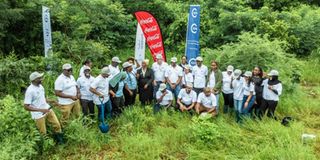
Morogoro. Tanzania has launched a $1.94 million (approximately Sh4.995 billion) initiative aimed at strengthening water security in the Ruvu Basin, a vital resource serving nearly nine million people in Morogoro and surrounding regions.
The four-year project, titled Nature-Based Solutions for Catchment Restoration and Water Replenishment in Ruvu Basin (NbS4Water – Ruvu), focuses on the Ngerengere catchment.
This area is critical for the Mindu Dam, which provides roughly 75 percent of the water supply for Morogoro Municipality and acts as a lifeline for communities, farms, and businesses across eastern Tanzania.
The initiative is funded by the Coca-Cola system through the Global Water Challenge (GWC) and is implemented by the International Union for Conservation of Nature (IUCN) in partnership with the Wami-Ruvu Basin Water Board (WRBWB).
Speaking during the official launch deputy director of Water Sources, ministry of water, Ms Rosemary Rwebugisa described the project as a major milestone for the Tanzania Development Vision 2050 (Dira 2050). “By attending this event, you have demonstrated your commitment to catchment restoration, protection, and sustainable use of water in Ngerengere catchment and beyond,” she told delegates.
Ms Rubigisa emphasized that the project supports pillars of environmental sustainability and inclusive growth, ensuring water remains a foundation for economic transformation and food security. She noted that restoring the Ngerengere catchment will improve water availability not only for Morogoro but also for Dar es Salaam and the Coast.
The project adopts a Nature-Based Solutions (NbS) approach to address pressures such as deforestation, soil erosion, unsustainable water use, and climate change.
IUCN Tanzania Country Representative, Mr Charles Oluchina, explained that this approach is fundamental because it restores ecological processes while delivering resilience and socio-economic benefits.
“Without NbS, water management remains dependent on fragmented grey infrastructure solutions that only address symptoms rather than the bridge leading to persistent water scarcity, declining water quality, and rising sedimentation,” he warned.
Mr Oluchina highlighted that this effort builds on IUCN’s long history in Tanzania, following the recent launch of an $8.2 million program for the Ruvuma Basin.
Representing the Global Water Challenge, Senior Water Stewardship Director, Malik Keita described the project as a partnership built on trust and a shared vision for sustainability.
“Today is not just about launching a project; it is about strengthening a shared commitment to protecting one of Tanzania’s most vital water systems and water sources,” he said.
Mr Keita noted that as populations increase, the demand for potable water for agriculture and drinking grows, requiring solutions that work with nature,.
The private sector's role was underscored by Managing director Coca cola Kwanza (Tanzania), David Chait, who recalled the severe water scarcity Dar es Salaam faced recently.
“We have a responsibility to assist those who face water scarcity and to help protect local water resources where we operate, especially in places with the biggest challenges,” Chait stated.
He added that the project is "more than an investment in water; it’s an investment in people, in livelihoods, and in the future".
Vice President of Franchise Operations for Coca-Cola East and Central Africa, Alfred Olajide, added that the global community is experiencing increased water insecurity where demand exceeds supply.
“The Coca-Cola system intends to continue focusing on promoting water stewardship, increasing water use efficiency, and treating and returning safe water to communities,” he stated.
Senior Director for Coca-Cola Africa, Eugene Nguing, placed the Ruvu project within the broader Africa Water Stewardship Initiative, a nearly $25 million commitment to address water security in 20 African countries.
“Many of our water replenishment projects have additional co-benefits such as helping improve soil health, conserve water, restore degraded lands, contribute to biodiversity and help mitigate climate change,” he noted.
The project also targets the promotion of climate-resilient livelihoods for 2,000 farmers. IUCN Project Officer Mwalo Kidai explained that the overall goal is to increase water volume through replenishment.
“The overall goal is that the water replenishment will have increased by 584.7 million liters of water,” she said, noting the project would also promote smart agriculture, beekeeping, and fish farming.
The Acting Basin Director for Wami-Ruvu, Mr Juvenal Tarimo, detailed specific challenges including unplanned mining and livestock grazing within water sources.
He explained that the project would involve demarcating 60-meter river buffer zones and constructing livestock watering troughs.
“This project will help resolve various challenges in the Ngerengere catchment and benefit citizens in Mvomero, Morogoro District, and Morogoro Municipality,” Tarimo said.
Supporting this sentiment, Morogoro’s Deputy Mayor, Mohamed Thabit, pledged the municipal council’s full cooperation and revealed that funds have been allocated for spice tree seedlings in the 2026/27 budget.
“We will continue to cooperate with our water colleagues because as the slogan says: without water, there is no life,” he said.
The launch event, which included a symbolic tree-planting ceremony, marks the beginning of on-the-ground implementation scheduled to run through 2028.