Tanzania academic explores how tech impacts African lives
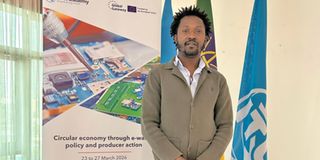
Dr Samwel Ntapanta, Post Doctoral Research Fellow, Department of Anthropology, Aarhus University in Denmark, explores e-waste and people whose jobs are to pick up the pieces of the technology junks. PHOTO | COURTESY
His doctoral research, titled Gathering the African Technosphere: An Ethnography of Informal Electronic Waste Recycling in Tanzania, took him into the world of informal e-waste recycling in Dar es Salaam and Zanzibar
Dar es Salaam. When most people throw away an old mobile phone, laptop or circuit board, they rarely think about where it goes next.
For Dr Samwel Moses Ntapanta, that is precisely where the story begins.
The Tanzanian anthropologist has followed the afterlife of things that others discard, from electronic waste piling up in African cities to the informal networks of workers who extract value from it, for nearly two decades.
More recently, his research has taken a digital turn, towards Bitcoin and cryptocurrencies and the ways people in the Global South are using them to navigate economies where conventional financial systems can be uncertain or inaccessible.
The subjects may appear unrelated but for Dr Ntapanta, they are connected by a broader question of how people adapt, improvise and create value when formal systems fail to meet their needs.
"What I want is for the people who are already doing this work, the scrap dealers, the repairers, the collectors, to stop being treated as a problem the state hasn't solved yet, and start being recognised as the important infrastructure that keeps cities going,” said Dr Ntapanta in an interview.
“That's true whether I'm talking about e-waste in Dar es Salaam or cryptocurrencies in Nairobi, informality isn't the absence of a system, it is the system, and it deserves to be studied and legislated for, on those terms."
Born in Tanzania's Tabora Region in 1985, Dr Ntapanta's academic journey began far from the universities and research centres where he would later work.
At Milambo Secondary School, he studied English, Kiswahili and French before moving to Sumba High School, where he studied history and geography.
He later joined the University of Dar es Salaam, graduating in 2009 with a degree in Political Science and Sociology.
But his formative education, he has said, came as much from working with communities as it did from university lecture halls.
Interest in environment
Immediately after university, Dr Ntapanta entered the environmental sector which placed him at the intersection of environmental research and journalism, working with media organisations and journalists across Tanzania to translate scientific research, including studies on climate change and marine ecosystems, into information that could be understood and used by the wider public.
In 2012, he joined ActionAid Middle East and North Africa in Egypt, where he trained young activists in Al-Fayoum in advocacy and campaigning at a time when the region was still grappling with the political upheavals and expectations unleashed by the Arab Spring.
A year later, he returned to Tanzania and continued training activists and organisers in governance and campaigning strategies.
The experience gave him something that would later prove central to his anthropological research: an interest in how ordinary people organise themselves, negotiate institutions and find ways of responding to systems that shape their lives.
By 2015, Dr Ntapanta had moved deeper into academia.
He earned a Master's degree in Human Security from Aarhus University in Denmark and, in 2018, began a PhD in Social Anthropology at the University of Oslo, Norway.
It was during his doctoral studies that he began examining one of the world's less visible consequences of technological progress: electronic waste.
The people behind the junk
His doctoral research, titled Gathering the African Technosphere: An Ethnography of Informal Electronic Waste Recycling in Tanzania, took him into the world of informal e-waste recycling in Dar es Salaam and Zanzibar.
Rather than treating discarded electronics simply as an environmental hazard, he examined the people whose livelihoods depend on them.
For workers involved in collecting, dismantling and recycling electronic equipment, what appears to be worthless junk can represent income, opportunity and an intricate set of skills.
At the same time, those livelihoods can expose workers and communities to hazardous substances contained in electronic waste.
That tension between economic opportunity and environmental and health risks became central to his research.
His research offers a different way of looking at the technology economy. Instead of focusing only on the companies that manufacture devices or the consumers who buy them, Dr Ntapanta follows the workers who inherit the consequences once those devices are no longer wanted.
After completing his PhD in 2022, Dr Ntapanta spent two years as a Senior Research Associate at the University of Bayreuth in Germany. In February 2024, he returned to Aarhus University for a postdoctoral fellowship examining The Social Life of Cryptocurrencies in the Global South.
The project explored how people in Kenya, Cuba and the Philippines are using Bitcoin and other digital currencies amid economic uncertainty and limitations within formal financial systems.
For Dr Ntapanta, the interest lies not simply in the technology itself but in what people do with it.
That perspective connects his cryptocurrency research to his earlier work on e-waste.
Dr Ntapanta’s next act is already taking shape. He is preparing for a project about the “right to repair,” comparing the European Union's push for repairable electronics with Tanzania's thriving informal repair economy, and closing the loop by examining China, where most of those devices are designed and built in the first place.